
UNC board confronts teacher shortage

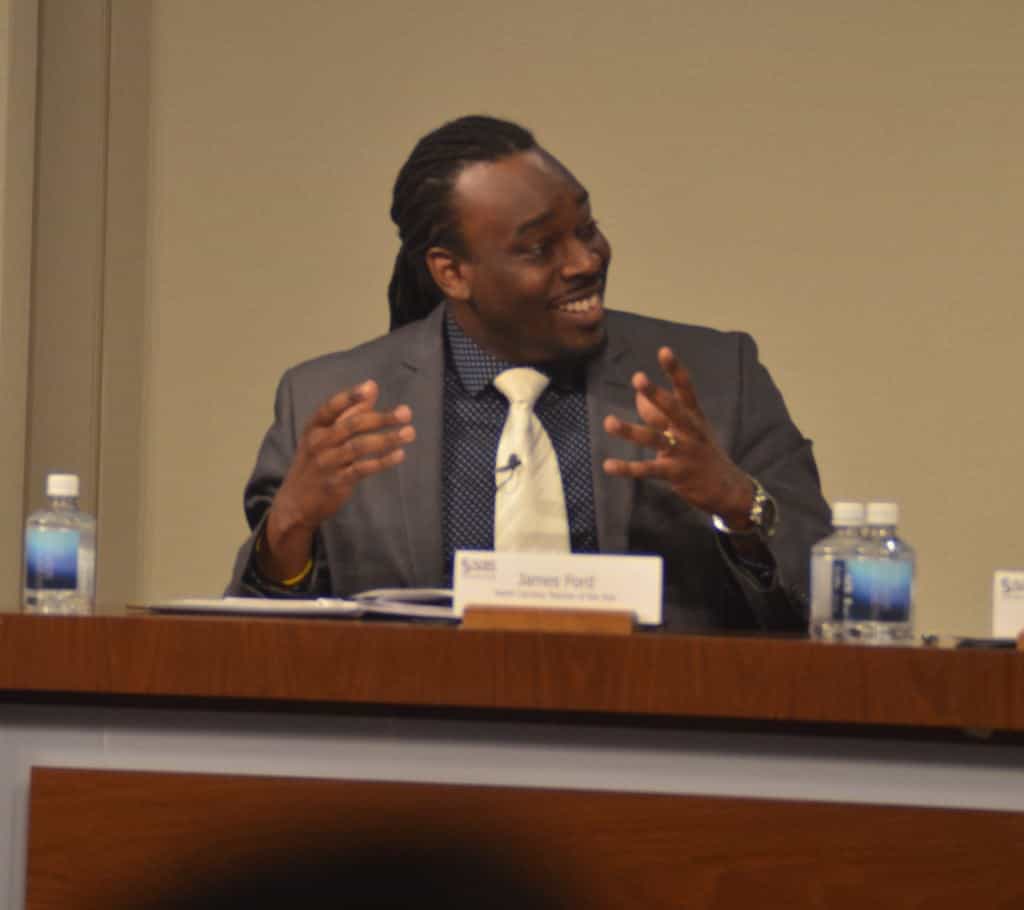
Leaders of the state’s public universities, community colleges, and public schools gathered yesterday to confront a growing shortage of teachers in North Carolina.
“We have a crisis in North Carolina,” said John Fennebresque, the chairman of the University of North Carolina Board of Governors, which hosted the gathering on the campus of SAS Institute. “Nothing is more important to the future of North Carolina,” he said.
As North Carolina becomes the ninth most-populous state in the nation, enrollment in university schools of education is in sharp decline.
Alisa Chapman, the UNC system’s Vice President for Academic and University Programs, said the combined undergraduate and graduate enrollment in schools of education across the system declined by 12 percent from 2013 to 2014 alone, and 27 percent over the last five years.
Chapman underscored that even though the University system is the single largest provider of North Carolina teachers, the state remains an importer of teachers.
In Wake County, 45 percent of teachers come from out of state, while just 30 percent were trained at UNC institutions. In Union County, east of Charlotte, 24 percent of teachers were trained at UNC institutions, while 44 percent came from outside the state.
Ellen McIntyre, dean of the School of Education at UNC Charlotte, said that the state’s crisis over low teacher pay has created “a little bit of a pause” among students who might otherwise go into teaching.
While a starting salary of $33,000 might sound good to an 18-year-old, she said, “It’s their parents who don’t want them (to go into teaching). It’s their parents who are dissuading them from going into schools of education.”
Though legislators approved average raises of 5.5 percent for teachers last year, James Ford, a history teacher from Charlotte who is the N.C. Teacher of the Year, said that having enough money for groceries remains an issue for many.
Fifty-two percent of public school teachers work a second job, he said.
“The luster, the status of teaching over the last several years, has been diminished,” Ford said.
Retention a challenge
McIntyre said that retention of teachers may be an even bigger problem than the decline in enrollment.
“We prepare enough teachers. We just don’t keep them,” she said. “We do keep teachers in the wealthy districts. We’re not keeping them in schools of poverty –- and those are the students who need experienced teachers.”
McIntyre invited elected officials to spend an entire day with a teacher in a “school of poverty” and a full day with a teacher in a wealthy school district to see the differences first-hand.
Chapman said that 85 percent of teachers trained in the UNC system remain in teaching at least three years, and 75 percent remain after five years. Among teachers trained outside the state, 74 percent remain after three years and 57 percent after five.
Beginning teachers need both higher salaries and better preparation, McIntyre said, especially for teaching in impoverished and/or rural areas. Young teachers would benefit from intensive mentoring in the first few years and work conditions that allow “more time to think,” she said.
Ford agreed that teacher development is an important part of keeping teachers in the classroom. “Most early teachers are bad – I was bad,” Ford said, adding that great teaching mentors and feedback allowed him to grow as a teacher.
Collaboration on campus and off
Chancellor David Belcher of Western Carolina University said that a debate sometimes emerges between those who say a teacher’s training in a specific field is more important and those who contend that teaching techniques are more important.
“In a way it’s sort of a ridiculous question … because it requires both,” Belcher said.
Administrators must make it clear that colleges of arts and sciences must collaborate with colleges of education, Belcher said, which requires “a fundamental attitude on campus that we’re in this together to produce the best teachers.”
BOG subcommittee’s recommendations
After a year of study, a subcommittee of the Board of Governors recommended just that yesterday in a list of seven recommendations. The recommendations also include:
- Better partnerships between universities and K-12 schools;
- Yearlong clinical practice modeled on medical-school education;
- And scholarship programs for students preparing to teach in high-need areas like science, mathematics, and special education, or in rural areas. “We need to strengthen the recruitment of these candidates,” said Board of Governors member Laura Wiley. “We need to say why it is good to be a teacher.”
- The panel also recommended expansion and full funding of the N.C. New Teacher Support Program, a program that relies on experienced teachers to act as “coaches” to support younger teachers in their first three years. The program has shown initial improvements in teacher retention in high-need schools.
See all the recommendations here.
“Strengthening the 15 schools of public education is the most important lever the University has in affecting positive change in public education,” said Board of Governors member Hannah Gage, a member of the subcommittee. “It’s fundamental to the prosperity and well-being of North Carolina.”
UNC President Tom Ross said that North Carolina is already a national leader in assessing teacher effectiveness and identifying weaknesses. “We’re way ahead of the curve on that,” Ross said. “I think we need to be proud of North Carolina … but recognize as we leave here there’s a lot more to do.”
Editor’s Note: SAS Institute supports the work of EdNC.