
Skip to content
EdNC. Essential education news. Important stories. Your voice.

Search ednc.org

Trauma researchers continue community-driven work to disrupt poverty in Edgecombe

Share this story

Our republishing policy

EdNC is a nonprofit, online, daily, independent newspaper. All of EdNC’s content is open source and free to republish. Please use the following guidelines when republishing our content.
  • Our content must be republished in full. If your organization uses a paywall, the content must be provided in full for free.
  • Credit our team by including both the author name and EdNC.org in the byline. Example: Alex Granados, EdNC.org.
  • If republishing the story online, please provide a link to EdNC.org or a link to the original article in either the byline or credit line.
  • The original headline of the article must be used. Allowable edits to the content of the piece include changes to meet your publication’s style guide and references to dates (i.e. this week changed to last week). Other edits must be approved by emailing Hannah Vinueza McClellan at [email protected].
  • Photos and other multimedia elements (audio, video, etc.) may not be republished without prior permission. Please email Hannah Vinueza McClellan at [email protected] if you are interested in sharing a multimedia element.
  • If you republish a story, please let us know by emailing Hannah Vinueza McClellan at [email protected].

Please email Hannah Vinueza McClellan at [email protected] if you have any questions. This work is licensed under a Creative Commons Attribution-NoDerivatives 4.0 International License.

Canonical tag

Please include the following canonical tag in the <head> of the republished story.

<link rel="canonical" href="https://www.ednc.org/trauma-researchers-continue-community-driven-work-to-disrupt-poverty-in-edgecombe/">

HTML content

This includes the title, byline, content, and tracking pixel required for republishing this story.

This story is tagged:

For months, Rural Opportunity Institute co-founders Seth Saeugling and Vichi Jagannathan have gathered Tarboro community members, interviewed families and leaders, and analyzed research around intergenerational trauma in a Pattillo Middle School office. 

“Where we’re headed is to really identify where is the leverage?” Saeugling said. “What’s the North Star and how can we all start rowing in the same direction when it comes to trauma and trying to provide healing opportunities?”

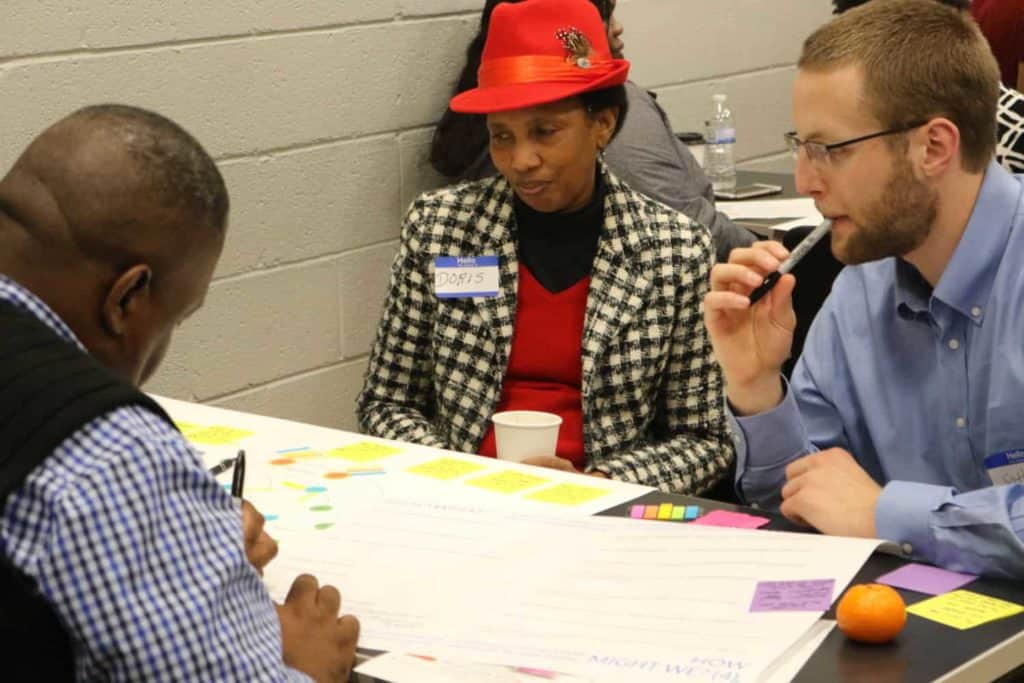
On Tuesday, healthcare providers, pastors, education leaders, and other Tarboro residents met to dissect a map of the largest issues in their community. 

Karen Grattan, CEO and co-founder of Engaging Inquiry, led the group through “systems thinking” practices that allow analyzation of a larger system before focusing in on one solution. Groups of three or four community members took one “leverage point” and identified what is already happening in the community and how those resources can be used to shift negative patterns of trauma.

“We’re going to try to find places in the system where we can unlock the opportunity for potentially relatively small interventions to have an outsized impact,” Grattan said. “That’s the idea of leverage.”

The pair’s project is housed in the Public School Forum of North Carolina and has its roots in the classroom. Both Saeugling and Jagannathan were Teach for America teachers in eastern North Carolina. They returned to the region after spending time in the Bay area and realizing innovative problem-solving in California was not making its way to the communities they had left.

Watch the video below to see some of the ideas that emerged from the workshop.