
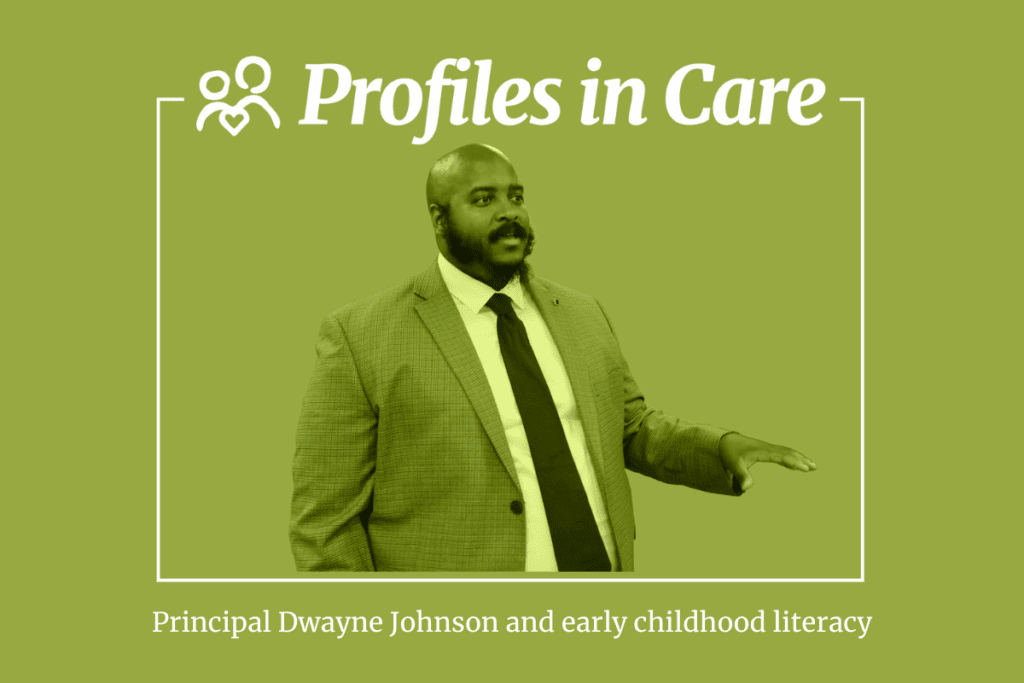
Profiles in Care | Principal Dwayne Johnson and early childhood literacy
EdNC is highlighting the experiences of educators, families, researchers, and advocates with a stake in North Carolina’s early care and learning landscape. These profiles illustrate that care and education are inseparable, especially in a child’s first five years — caregivers educate, and educators care. In this series, we refer to those profiled in the way they are known by their community.
Woodland Elementary School Principal Dwayne Johnson — not to be confused with wrestler and actor Dwayne “The Rock” Johnson — was attending an education summit when a vendor table caught his eye.
“Nobody was really around them, but the sign said, like, ‘Put free books in your kids’ hands for the summer,’” Mr. Johnson said.
This was his introduction to the Durham-based nonprofit Book Harvest and their Books on Break program, which enables pre-K and elementary school students to select 10 new books — with options in English and Spanish — to add to their home libraries before or during summer break.
During a career in which he has worked his way from teaching high school social studies to serving as principal of an elementary school in Person County, Mr. Johnson has learned the foundational importance of literacy in the earliest years of learning.
Research shows that a lack of access to books is a leading barrier to early childhood literacy and that providing free books to young students over the summer improves their reading achievement scores, regardless of income.
“I was like, hey, this would be a good initiative to bring to our school, because every kid doesn’t have access to books,” Mr. Johnson said.
It took a collaboration between Book Harvest, a family foundation, and a dual-language English teacher to make it happen. Now, Woodland Elementary School is a model for how Books on Break can put books into the hands of young learners.
‘Reading is a civil right’
Mr. Johnson is a Person County native and attended Person County Schools from kindergarten through 12th grade. As a high school student, he volunteered with a program where he tutored middle school students who were assigned in-school suspension. One of the students improved so significantly that teachers started urging young Dwayne to consider a teaching career.
But that wasn’t his goal.
“I wanted to be a sports analyst, like a Stephen A. Smith or a Stuart Scott,” Mr. Johnson said.
It wasn’t until he attended North Carolina Central University — where his parents had met, and where he met his own wife — that he fell in love with history. His mother, a principal herself, encouraged him to use that passion to become a teacher, and he followed her advice. He returned home to teach and coach at Person High School.
In that role, he noticed a pattern when it came to reading.
“There’s such a huge percentage of kids and people who just fear words,” Mr. Johnson said. “Like if they see a lot of words at once, there’s an automatic shutdown, and that’s scary to think about.”
He said shutting down when words are intimidating can put students at a disadvantage in a wide variety of circumstances over the course of their lives.
“People can find a way to do you wrong if you don’t know how to read carefully,” Mr. Johnson said.
 Sign up for Early Bird, our newsletter on all things early childhood.
During his career, he’s come to think of literacy the way Tonya Peterson, Person County Schools’ exceptional children instructional coach, describes it: “She always says reading is a civil right.”
That’s why, when he attended UNC-Chapel Hill to become a school administrator, his introduction to reading instruction was so impactful.
“I remember my professor saying, ‘Some of you high school folks know nothing about early childhood literacy or early childhood education. You’re going to see how teachers help kids learn how to read. In that process, you’re going to be blown away,’” Mr. Johnson said. “And sure enough, I was.”
He interned at an elementary school, then worked as an assistant principal at a middle school, before becoming the principal at Woodland Elementary School, one of two dual-language elementary schools in Person County.
“I felt like, as a principal coming into this space, it was a heavy literacy space,” Mr. Johnson said. “They were already very passionate about reading and wanting to know what we can do to make sure kids can read better.”
He’s still blown away when he sees how the teachers at his school teach young students how to read using the science of reading.
“I joke with them all the time, like y’all would teach laps around us over at the high school,” Mr. Johnson said. “Being able to teach all these subjects while engaging these kids at this age all day is a superpower.”
‘Good readers read books’
Mr. Johnson had reading as a civil right in mind when he attended the 2023 Color of Education Summit — an annual event that brings together stakeholders focused on eliminating racial disparities in education — and encountered Book Harvest’s vendor booth.
Speaking to the Book Harvest team, he got excited about Books on Break — until he learned it would cost $16,000 to offer it at Woodland. That was out of his price range.
“They emailed me, called me; I’m sending it to voicemail,” Mr. Johnson said. “I was like, I don’t need to talk to y’all anymore because I can’t afford it.”
Then one day, a group of women pulled into his school’s parking lot and intercepted him as he was walking toward the school’s entrance.
They were from the JES Avanti Foundation, founded by the owners of a sheet metal company, and they wanted to cover the cost of Books on Break for Woodland Elementary.
“And I was looking around like, where’s Ashton Kutcher? This is not real,” Mr. Johnson said, referencing the host of MTV’s reality prank show, Punk’d.
It turned out that the reason Book Harvest had been calling was because Brie Sanders, director of education and project management for JES Avanti, had recently moved to Person County from Durham, where she had become familiar with the Books on Break program. She was looking for ways to give back to her new community.
“And I’d asked (Book Harvest) if any schools in Person County were on their list,” Sanders said. They told her about Mr. Johnson and Woodland. “So I emailed Mr. Johnson a couple times, and he thought it wasn’t real.”
With the support of JES Avanti, Woodland has offered Books on Break for the last two summers.
Morgan Brooks, a dual-language English teacher at Woodland, has been key to making that happen. Mr. Johnson asked her to take on the event, and she’s done so with gusto.
“It’s a huge population of our kids that can’t afford to get a book at a book fair,” Brooks said. Through Books on Break, she tries to create the opposite of that experience.
For each of the last two summers, she established a theme for the Books on Break event in late May, along with a corresponding Spirit Day for the whole school.
By all accounts, she’s gone all-out decorating the media center around the theme and the students do the same with their outfits. For this year’s theme, Brooks turned the room into a jungle of books, where students in safari vests and animal costumes could hunt down new books of their choosing.


Liz Sanders, co-founder of JES Avanti, said she was encouraged to learn from Book Harvest that Woodland has become the model for how Books on Break should work. Centering it on students by making it a Spirit Day — and creating a free book fair vibe — is part of what makes it special.
With the help of volunteers like Wanda Peed from JES Avanti, every student at Woodland comes through the media center with their class and selects 10 new books to take home with them.
“We had a lot of kids that wanted to pick books for their younger siblings that were at home, and I was pretty touched by that,” Peed said. “It’s not just for themselves, they were looking out for everybody in the family.”
Mr. Johnson credits Books on Break, along with other literacy initiatives at the school, for helping the school meet — and nearly exceed — growth in reading proficiency this year.
“But the most magical piece was seeing kids the days after, because it’s a few weeks until summer. Every kid, every kid coming off that bus with their new books, is reading,” he said. “They’re reading from the bus when they get off, all the way to the cafeteria, reading throughout the day, every day for the rest of the year, which to me shows the power of a kid just having a new book in their hand.”
Brooks outlined the connection between free books and improved literacy succinctly: “Good readers read books, and they read more books, and they read more books.”
Starting at birth
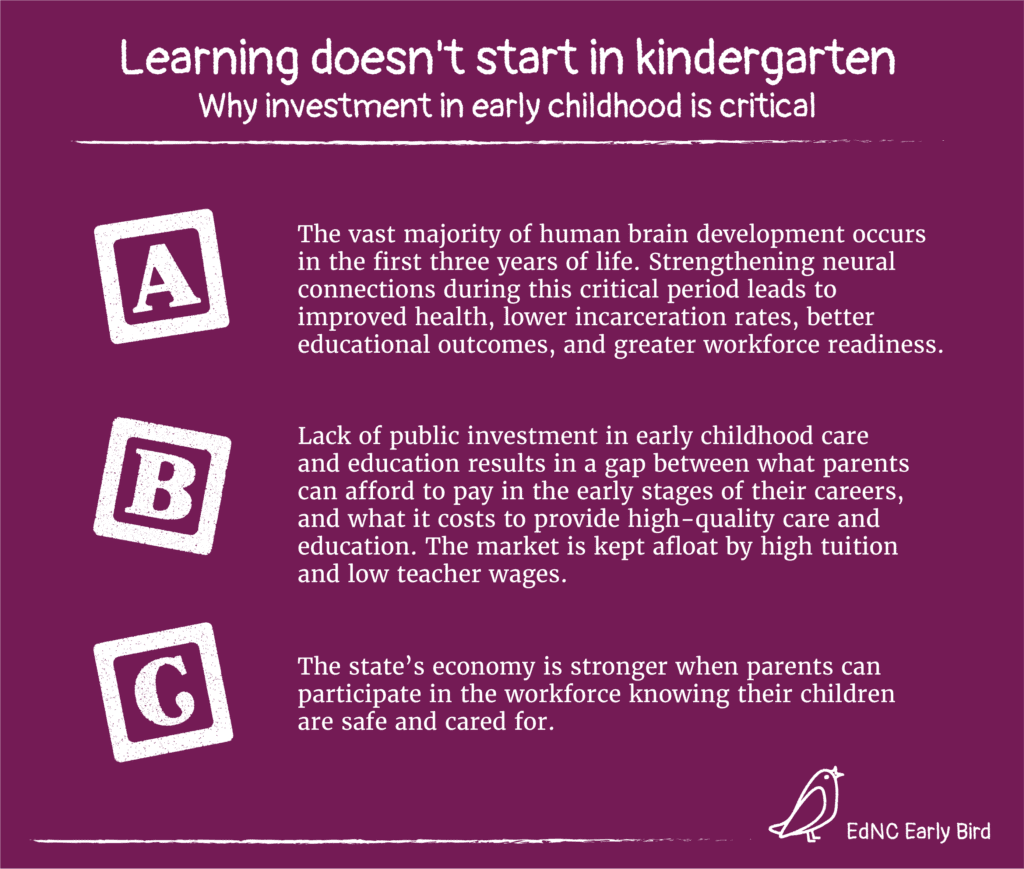
While Mr. Johnson is proud of the work his team is doing to improve literacy for their students, he said he wishes there was more being done before students start kindergarten.
When he was a high school teacher, he said he could look back at a student’s experiences in middle school and elementary school to understand the educational circumstances they found themselves in by the time they reached his classroom.
“But what you can’t see is when a kid’s been at home for four or five years, and their education there as far as early literacy looks different than a kid who started preschool at 2 or 3, or who has parents reading to them every night,” Mr. Johnson said. “Those nuanced differences show up in a huge way when they start kindergarten, just in their ability to quickly develop some of those literacy skills.”
He’s seen teachers at his school help students make incredible gains in the classroom, but meeting every student where they are and designing reading interventions for their individual needs is a complex challenge in a classroom of 30 young learners.
“I think that if we really want the reading gaps to close, and want our reading scores to go up, we’ve gotta start addressing that at birth, we’ve gotta start being intentional,” Mr. Johnson said.
And he said he wants policymakers to see their role in helping to bridge that gap.
“What they can do from a policy perspective is make sure kids up to 4 years old are getting that explicit instruction, because every parent can’t sit with their kid every night and read for story time, because they’re working two or three jobs, and that’s not their fault,” Mr. Johnson said.
He has big goals for his little learners as they grow into the next generation of parents and leaders.
“I just want to see a world where people love each other and understand context and nuance,” Mr. Johnson said. “And I think the foundation of that is literacy.”