
Senator uses Charter School Advocacy Day to call attention to equity

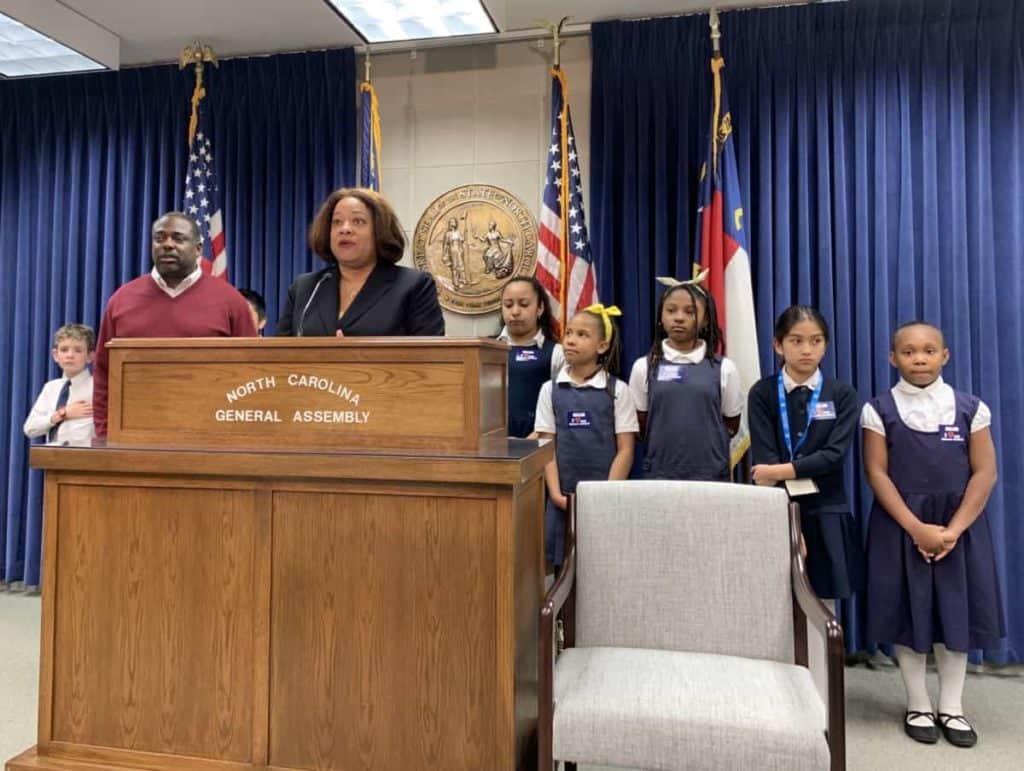
Charter School Advocacy Day was planned as a convening of leaders, parents, teachers, and students to speak out against reinstating a cap on charter schools in North Carolina, but it kicked off with Sen. Erica Smith, D-Northampton, joining her constituents in voicing concern over the state of equity among the state’s public charter schools.
Smith invited one of her constituents, Kashi Bazemore-Hall, a founder of a now-closed charter school, to a press conference kicking off the advocacy event and questioned the equality of support among public charter schools run by or predominantly serving African-Americans.
Following their comments, the North Carolina Association for Public Charter Schools — which organized the Charter School Advocacy Day event — distanced itself from the comments.
“In no way do Ms. Bazemore-Hall’s opinions reflect the attitude or beliefs of the NC Association for Public Charter Schools,” the group stated in a release. “The Association looks forward to continuing its positive working relationship with the Office of Charter Schools, the Charter School Advisory Board, and the State Board of Education as we work to provide high-quality educational offerings to families in our state.”
Smith started the press conference expressing disappointment with the events that led to the closing of Bazemore-Hall’s school, Heritage Collegiate Leadership Academy, in November 2017.
“Throughout this process, in searching for answers and asking questions, I saw first-hand that the African-American-operated CMOs — charter management organizations — do not appear to receive some of the support of the predominantly white-run charter programs,” Smith said. “It was discouraging for many of the families who have reached out to me. I’ve had parents calling me in that area whose students were devastated at the closing of this charter school. Because I serve such wonderful constituents, I worked very hard to try to find the answers as to why this wonderful educational program was eliminated for students in a very challenging area, rural area, high-poverty area, economically-distressed area.”
Heritage Collegiate became the first-ever charter school to have its charter revoked by North Carolina. At the time, the State Board cited a “pattern of failure” to comply with stipulations. Specifically, the State Board pointed to failure to meet deadlines to get information to the state, submit the notice of renewing its charter on time, and over-projecting its enrollment by almost 100 percent.
Bazemore-Hall claimed on Tuesday that Heritage Collegiate Leadership Academy had met every stipulation, and pointed instead to unequal treatment for her school compared to others. She cautioned against “choice not being tainted choice,” adding that “poverty is an impediment to academic achievement.”
Smith added: “Coming from this rural area, I’ve had an opportunity to observe first-hand the challenges of education in the areas that I serve. I have been a firm supporter of school choice. And when I support school choice, I support smart school choice. … North Carolina’s public charter schools, especially those with a mission to provide educational programs aimed at serving socio-economically disadvantaged and academically-challenged communities across our state, are a priority emphasis of why we are here today.”
Senate Bill 247
Charter school advocates also addressed their disagreement with Senate Bill 247. Filed last week, it would commission a study of charter schools and implement a moratorium on charter school growth (effectively capping the number of charter schools where it stands).
Sen. Dan Blue, D-Wake, the Senate minority leader, is the primary sponsor of SB 247 and scheduled a press conference for 2 p.m. today to discuss it further.
Marcus Brandon, executive director of CarolinaCAN, said that charter schools are fulfilling their purpose of innovation and acting as incubators for moving education forward in the state.
“Charters all across the state of North Carolina have been leading districts in innovation,” he said. “Whether they deal with opportunity culture, whether they deal with personalized learning, whether you’re dealing with dual enrollment — which is becoming very popular — these are the things that started … from charters. We were able to move education forward because of the things that we were able to do and the flexibilities that we have.”
Brandon joined the other advocates in attendance in opposition to capping the number of charter schools. He spoke about ways he believes charter schools have helped the state education system as a whole, including by promoting International Baccalaureate programs, assisting with capacity, and — according to Brandon — helping to raise the quality of education as a whole in districts where charters are located.
While he did not rebuke the idea of a study such as the one proposed in SB 247, he questioned the need for one.
“There are people who welcome a study,” Brandon, a former Democratic representative from Guilford, said. “As a person that has [worked] in this building, I think we just study a lot to find out answers that we already know.”
Editor’s note: Opportunity Culture is an initiative of Public Impact. Co-president Bryan Hassel says, “To clarify, Opportunity Culture isn’t in any North Carolina charters and didn’t start in charters. By contrast, it is in 300+ district schools nationally. Charters are welcome, but they haven’t been as quick to innovate in staffing models as district schools.”