
NC students score at or above average on national assessment, but pandemic gaps persist

This press release was originally posted by the N.C. Department of Public Instruction.
Data released today by the U.S. Department of Education shows that North Carolina students are ahead of the nation in eighth grade math and tracking with their peers in other tested subjects.
The National Assessment of Educational Progress, or NAEP, is administered to fourth and eighth graders every two years in the subjects of reading and math. Known as the Nation’s Report Card, NAEP provides a common measure of student achievement across the nation using a representative sample of schools and students.
The 2024 data shows that there has been no significant change in North Carolina students’ scale scores in any area since 2022 and three of the four tested areas remain below pre-pandemic levels. In fourth grade math, there is no statistically significant difference in students’ scores from 2019 to 2024.
 Sign up for the EdDaily to start each weekday with the top education news.
However, the percentage of students scoring at or above the proficient level has increased for both fourth and eighth grade math since 2022.
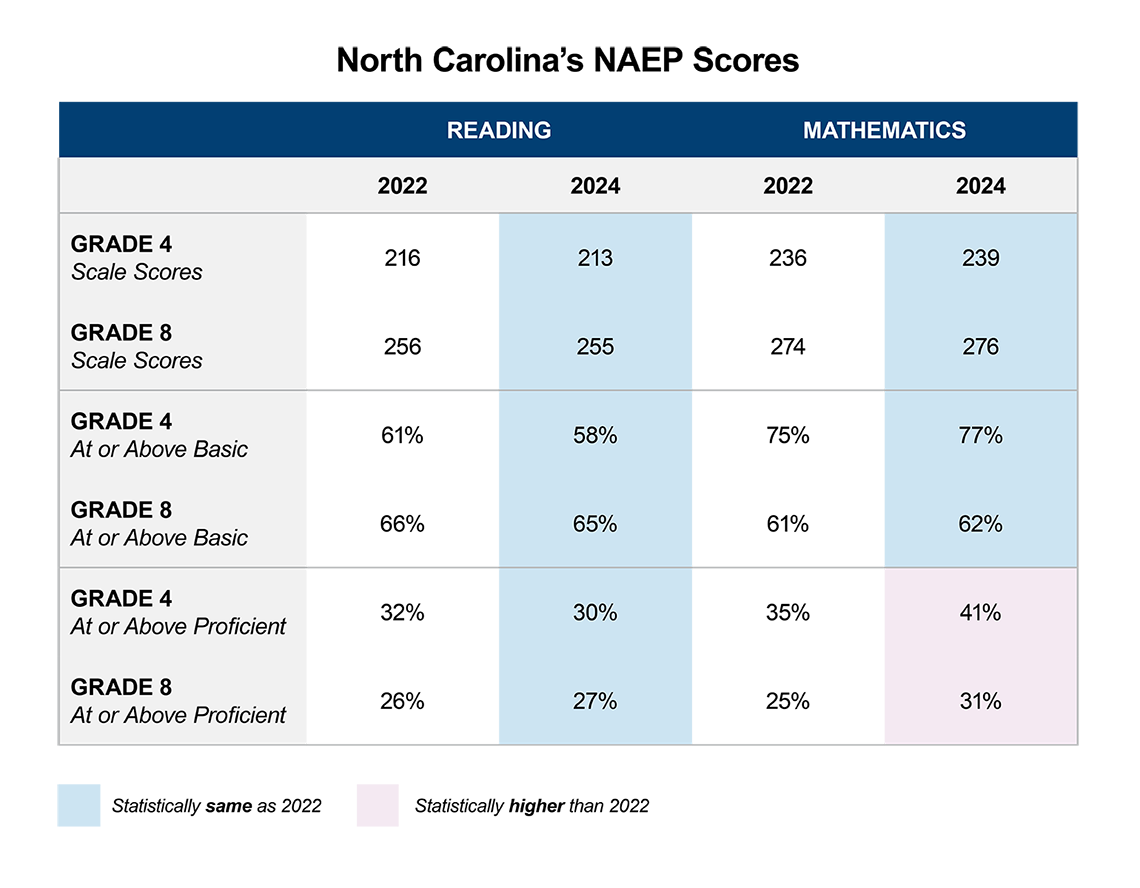
Nationally, fourth grade math scores improved and eighth grade math scores did not change. However, North Carolina’s grade 8 math scores were statistically above the nation. Reading scores for the nation declined for both grade levels.
Additionally, there are increasing disparities between high performers – students in the 75th and 90th percentiles – and lower performers in the 10th and 25th percentiles.
State Superintendent Maurice “Mo” Green said this data shows that while the pandemic may be over, its effects are still being felt. The fourth graders who participated in the test were in kindergarten in spring 2020, and the eighth graders were in fourth grade at the beginning of the pandemic.
“These students had their learning disrupted during a critical time in their early education. While it is always disappointing to see a lack of progress, the NAEP data tracks with trends we’re seeing in state-level end-of-grade testing,” Green said. “The widening achievement gap between our highest performing students and those with greater needs adds another layer of urgency to the work my team and I will be doing over the next four years to inspire excellence in our public schools.”
Green noted that the test, administered in the first quarter of 2024, does not reflect the progress made in literacy education with the implementation of the science of reading in North Carolina schools. Between 2021 and June 2024, more than 44,000 teachers, administrators and coaches completed K-5 or early childhood Language Essentials for Teachers of Reading and Spelling, or LETRS®, professional development course.
Beginning-of-year data from the DIBELS 8 (Dynamic Indicators of Basic Early Literacy Skills) assessment shows that North Carolina students outperformed their peers on a national level in grades 1-3, while grades K-3 continue to show steady improvement.
“We can see in our DIBELS data that K-3 teachers are now laying a solid foundation for students’ literacy skills,” Green said. “In total, North Carolina educators spent 6.5 million hours learning about the science of reading. While much can occur during the next two years, I am optimistic that this foundation of early literacy skills will be reflected in the 2026 NAEP results.”
A bright spot in North Carolina’s NAEP results is eighth grade math. Approximately 62% of North Carolina students scored at or above Basic versus 59% nationally.
There are three NAEP achievement categories:
- NAEP Basic – Partial mastery of fundamental knowledge and skills.
- NAEP Proficient – Solid academic performance, demonstrates competency over challenging subject matter.
- NAEP Advanced – Superior performance.
Tammy Howard, senior director of accountability and testing for the N.C. Department of Public Instruction, said it’s important to note that NAEP Proficient is not the same as grade-level proficiency on North Carolina’s end-of-grade or end-of-course tests.
“NAEP and end of-grade tests have different definitions for ‘proficient,’” she said. “NAEP Proficient and Advanced are similar to Levels 4 and 5 on the EOG in that they both signify solid and superior academic performance.”
The assessment is used by education experts and policymakers as a benchmark to track states’ progress in the tested subjects over time. Results are only reported on the state level, not by district or school.
However, two North Carolina districts – Charlotte-Mecklenburg Schools and Guilford County Schools – do receive district-level results as part of their participation in the Trial Urban District Assessment (TUDA).
The full set of publicly available data is available at www.nationsreportcard.gov. DPI staff plans to present more information about this data at the State Board of Education’s February meeting.