
NC researchers discuss the potential of micro-credentialing for educators

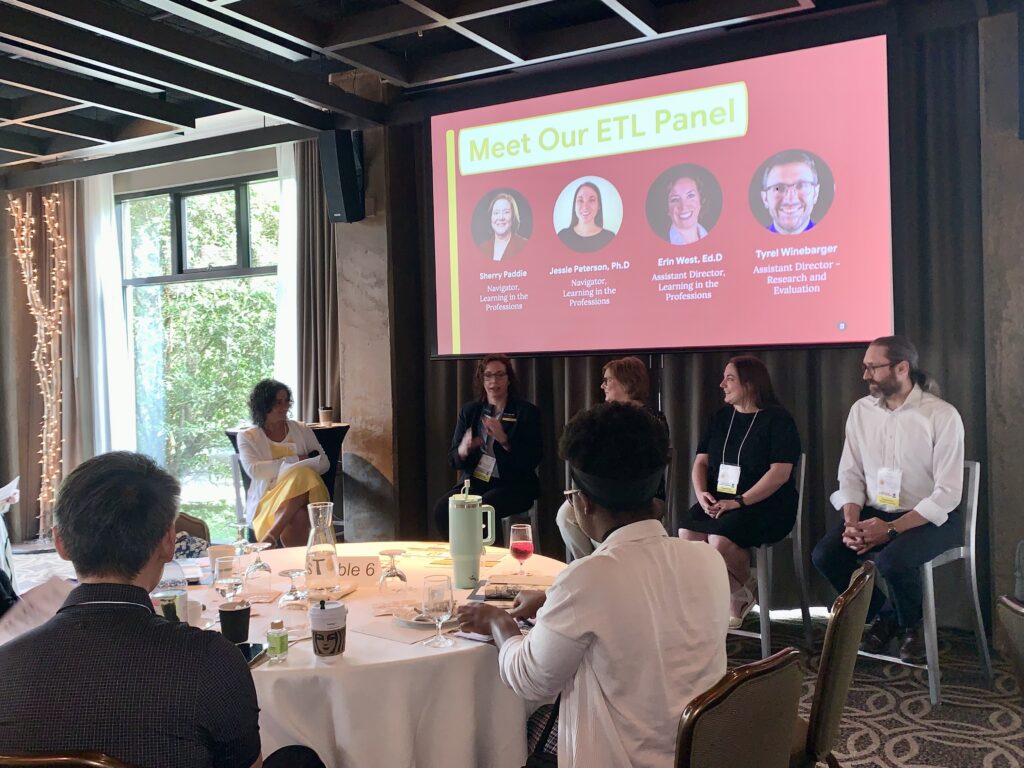
The Office of Rural Promise at Appalachian State University hosted a summit about micro-credentials for educators and other stakeholders at the Proximity Hotel in Greensboro on June 16.
The summit was a culminating event for the Empowering Teacher Learning (ETL) project.
As explained in the project’s white paper, micro-credentials “are digital certifications for specific skills that allow learners to prove competency through evidence rather than course completion.”
 Sign up for the EdDaily to start each weekday with the top education news.
Researchers participating in one part of the project explored how Teacher-Directed Professional Learning (TDPL) could strengthen the engagement and instructional practices of teachers while subsequently improving student outcomes, the paper says.
Micro-credentials support TDPL by being self-paced, “an essential feature given the competing demands of teaching,” the paper says.
The project was supported by a federal Education Innovation and Research grant. Some of the funds received from the five-year, $12 million grant were used to give teachers stipends as an incentive for completing the micro-credentials. The project was developed in response to growing concerns regarding “the effectiveness of traditional professional development (PD), teacher burnout, and instructional inequities in rural schools,” the paper reads.
In total, 659 educators participated in the project across rural western North Carolina, according to the paper. Nearly one-third completed all three of the micro-credentials offered; 65% completed at least one. Examples of the micro-credential offered can be found here.
Researchers who analyzed TDPL and GREAT STEM — another initiative under ETL, were invited to discuss their findings on a panel for the summit audience last week.
The ETL panelists said they are in the final stages of analysis, and are encouraged by the results so far.
The Department of Education thinks that they could “see more” from student outcomes — but that is hard to measure since this was a teacher-level intervention project, said Tyrel Winebarger, assistant director of research and evaluation at the Office of Rural Promise, during the panel.
Also on the panel was Erin West, assistant director of the project. West said that offering micro-credentials helped create a nonevaluative environment where teachers can learn and grow.
Another overarching theme expressed by the panelists was the importance of supporting both teachers and school administrators.
“I’ve had teachers — 25-plus-year veteran teachers — who have said to me, “This is the first time in 25 years that I have been this excited to run a biology lab,’” West said, “Because they are given permission to try something new, and they know even if they fail, they can try again.”
Panelists were asked to give a piece of advice to people researching or building micro-credentials. All of the panelists expressed how important it was to have both buy-in from school administrators and a coach or navigator to support them as they start the courses offered by the micro-credentialing system.
Jessie Peterson, who served as a navigator providing coaching to educators in the project, said that introducing micro-credentialing helps the next generation of self-directed learners.
Panelists were then asked to end on a note that they are most excited about.
Winebarger said education is at a crossroads — that the profession is now between the traditional way of delivering education and a new era of self-directed learning.
“Younger generations can go on YouTube and learn just about anything,” Winebarger said. “If we can find a way to institutionalize that, then I think we are taking a step in the right direction.”