EdNC is highlighting the experiences of educators, families, researchers, and advocates with a stake in North Carolina’s early care and learning landscape. These profiles illustrate that care and education are inseparable, especially in a child’s first five years — caregivers educate, and educators care. In this series, we refer to those profiled in the way they are known by their community.
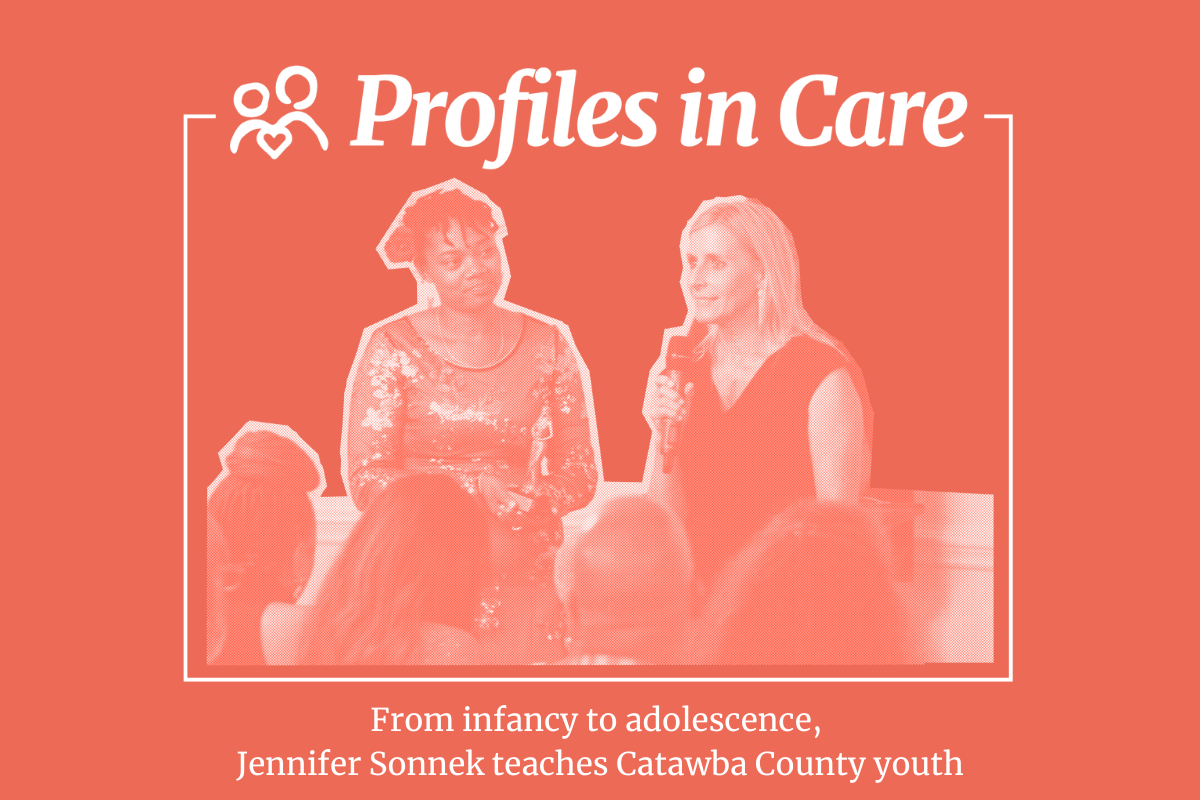
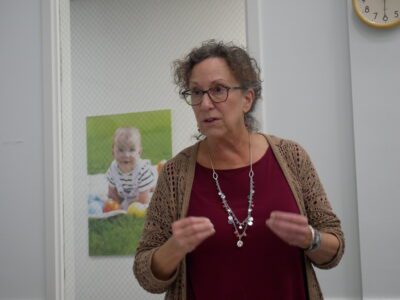
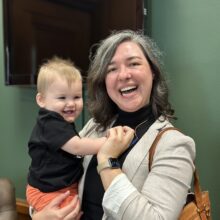
In the Venn diagram of North Carolina’s more than 1,000 licensed family child care home providers (FCCH) and about 90,000 local public school teachers, Jennifer Sonnek finds herself in the narrow overlap between the two.
For 20 years, she’s owned and operated Shining Stars in Hickory. For half of that time, she’s also been teaching at St. Stephens High School in Catawba County Schools.
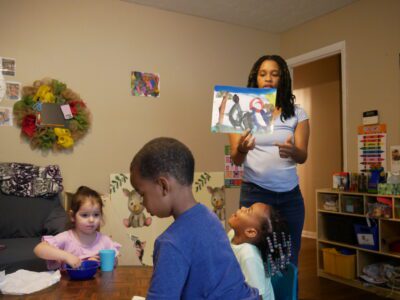
From about 7:30 a.m. to 2:30 p.m., she’s Ms. Sonnek to her teenage students at the high school. Then from 3:30 p.m. to 9:30 p.m., she’s Jennifer to the five young students enrolled in her family child care home.
“As a high school teacher, I can sometimes tell the difference when they’ve had a good early childhood experience, where they’ve learned and socialized,” Jennifer said.
She started her home-based child care program to give her own children that experience, and she keeps her doors open for parents working second shift to give that experience to their children, even while teaching high school full time.
“I have realized, and I hope other people do, that it does make a difference what kind of environment you’re in, even at age 2 and 3,” Jennifer said.
How it started
When Jennifer learned she was pregnant in the late 1990s, she couldn’t bear the thought of leaving her infant son in someone else’s care.
As the only child of a single, teenage mother who worked two jobs, her own childhood had been a lonely one in which she had to care for herself from an early age. She wanted to be more present in her new role as a mom.
“My kids are first, you know, since I didn’t feel that I was put first in my childhood,” Jennifer said.
At the time of her pregnancy, she was married and living with her husband on a military base. She decided to start a family child care home through the military’s child care program so she could be there for her new son — and for the children of other families on the base.
“Not everyone has family nearby where they could just say, ‘Hey, could you watch (my kid)?’” Jennifer said.
She operated her military FCCH while her son was young, serving families who worked irregular hours and often needed last-minute child care due to the demands of their service commitments.
When her young family moved to Hickory and her son started attending his local public school, she put her undergraduate degree to work as a dietician for a local hospital, before doing lateral entry to become a food and nutrition teacher at Hickory High.
She liked the consistent schedule and the fact that the job came with health care and retirement benefits. Plus, she could continue working with students, being a caring and trusted presence in their lives.
“If you have at least one person, sometimes one person can make all the difference,” Jennifer said.
Then she learned she was pregnant. At this point, she was a single mom of an 8-year-old son, and she’d been told she couldn’t get pregnant again. She was thrilled to learn otherwise.
She learned about how to start a licensed FCCH in North Carolina’s civilian system and got Shining Stars up and running in her home before the birth of her daughter.
Two years later, she gave birth to another son.
Because her licensed FCCH was limited to five students, and she had two of her own, she could only enroll three additional pupils. So she extended her hours for families working first, second, and third shifts at factories, in the health field, or in other jobs requiring atypical work hours.
“I had five on first, including my two kids, five on second, and five on third,” Jennifer said, because only offering first shift wasn’t enough income.
When her two youngest children started attending local public schools, she stopped offering child care during first shift and went back to teaching, this time at St. Stephens.
Jennifer said the fact that family child care homes like hers have more flexible hours than most licensed child care centers is one reason why families choose them. She said FCCHs also offer other benefits.
A smaller environment, a home, more personalized attention with the kids. A lot of people think homes don’t have a structure, but we do. The kids know when it’s time to go outside, when it’s time to come back in, wash your hands, eat, have a snack, and when we have a routine… but the number one reason is it’s a smaller environment, and it’s more comfortable than being in a center. It’s a home. It’s just going from one home to another.
Jennifer Sonnek
How it’s going
Jennifer is now in her 10th year of teaching high school at St. Stephens and will celebrate 20 years of operating Shining Stars on Nov. 5, 2025.
She only offers second shift child care these days, except during the summer, when she has the flexibility to offer families additional hours. During the years when she still provided for third shift, Jennifer said she wasn’t getting enough sleep before having to get up early to teach her high school students.
She has five students enrolled at Shining Stars — between the ages of 8 months and 8 years — from two families. Parents from both families are colleagues who work in the security field.
Jennifer said one of the families recently experienced a period of housing insecurity. During those weeks, she kept extra clothes available and bought toys for each of the children that they could keep at her home until their families found stable housing again.
In 20 years of operating Shining Stars, Jennifer said at least 95% of the families she’s served were eligible for child care subsidies, something she takes pride in because her own family relied on food stamps when she was a child.
Jennifer said the demands of the work are high, and the compensation is low, much like in her career as a high school teacher. But unlike teaching in a local public school, her work as a FCCH educator doesn’t come with health and retirement benefits.
“I know monetary compensation isn’t everything, but don’t we deserve to have something for us too? We give so much of ourselves, but then we struggle financially,” Jennifer said.
 Sign up for Early Bird, our newsletter on all things early childhood.
Jennifer is resourceful and well-educated — she has a bachelor’s and master’s degree — which has helped her cobble together resources to keep her program going.
She participates in the USDA’s Child and Adult Care Food Program, which provides partial reimbursement for the healthy meals and snacks she serves at Shining Stars, including dinners every day. And with the help of her state licensing consultant, she applied for — but did not receive — a grant to convert her home to a center in a residence, which would have enabled her to grow her small business and accommodate more children and families.
Jennifer also collaborates with the other FCCH educators in Catawba County. They text each other, meet up monthly, take their students on joint field trips, and even host a combined graduation ceremony for students preparing to start kindergarten.
“It’s really neat, because they’ll text, ‘Do you have an opening for second shift?’ and we’ll refer families to each other,” Jennifer said.
She also participated in MDC’s Home-Based Child Care Haven program, joining a cohort of other licensed FCCH providers and license-exempt Family, Friend, and Neighbor (FFN) caregivers for leadership and advocacy training.
“They taught me how important I was, and that self-care was really important because you have to take care of yourself, otherwise how will you be able to take care of anybody else?” Jennifer said. “We can’t forget about ourselves. We’re important too.”
But despite all of the ways that she continues to innovate in her field, the financial realities of being a home-based child care provider and a local public school teacher still present a hardship for a single mom with one child in college and another who will be next year.
The ongoing federal government shutdown hasn’t helped matters.
“With the government shutdown… I was so worried that I wouldn’t get the subsidy or food checks. It was late, but I got them,” Jennifer said. “That’s always a concern that there might not be a food program anymore, and I really depend on that because food is so expensive and the families depend on me.”
She said things were easier when licensed child care providers were getting stabilization grants during and after the COVID-19 pandemic.
“Oh, that was wonderful! Then I felt appreciated… Once that stabilization grant came, it was such a sigh of relief because I didn’t have to worry about money,” Jennifer said. “That sustained us. Then we were finally making enough.”
The funding for those stabilization grants ran out earlier this year.
Read more
With teacher pay still under negotiation in the state legislature, Jennifer is weighing her career options.
“I’ve kicked around the idea of quitting one (job) and just having the other,” Jennifer said. “But I really can’t live on either one… And I’m 53, so I need my retirement and my health (benefits).”
There are a few ways Jennifer said policymakers could improve conditions for teachers working in child care:
- Make child care workers eligible for the same health and retirement benefits as local public school teachers.
- Expand grant opportunities that could help licensed FCCHs and centers improve/expand their facilities and provide more enrichment opportunities for their students, especially those with disabilities.
- Make small business training available for educators who are preparing to open licensed child care centers or FCCHs.
- Increase the availability of child care subsidies and match them to the true cost of care.
- Fully fund the Child Care WAGE$ program for all 100 counties.
And for local public school teachers? Jennifer said they need raises.
“I’ve never heard of another job where you don’t get a raise,” she said.
As for why it’s worth investing in educators at every level, Jennifer said: “How do kids get to be whatever they are in life? From a teacher!”
Recommended reading