
Perspective | The #BlackHistoryYear Campaign

As February 2024 draws to a close, another Black History Month is in the books.
Since 1976, February has held a special significance for Black people in the US. It feels like the one time when we can speak unapologetically about being Black, our history, and numerous accomplishments with minimal pushback. This is particularly salient given the recent attempts to whitewash school curriculums and limit perspectives that make historically privileged groups feel uncomfortable.
History matters, both in who is included and how it is told.
Truth is, many in our nation have been taught a fabricated history of Black people where we have contributed nothing, were given everything, and had the nerve to complain about it.
Rapper Cool Breeze perfectly sums up the inadequate teaching of Black history in schools in his guest verse on the Goodie Mob classic “Dirty South” (1995). He raps, “See in the third grade this is what you told. You was bought. You was sold.” Sadly, he’s right.
Black History is traditionally taught in an extremely abbreviated fashion. It begins with slavery, maybe takes a brief detour to the Harlem Renaissance, then fast forwards to the Civil Rights Movement, where it quickly ends. I’d imagine newer textbooks might include the election of Barack Obama, but you get the point.
It’s an incomplete and oversimplified version of events that suggests once upon a time something “bad” happened, but then there were some people who fought to make it better and now everyone is equal and free.
It violently warps the contributions of Black people and all but erases any meaningful accomplishments from the historical canon. States have been trying their hardest to pass “divisive concept” bills that amount to memory laws in legislatures all over the country — including our very own North Carolina. They actually believe that our history can be constrained by legal barriers or limited to a particular month of the year. They could not be more wrong.
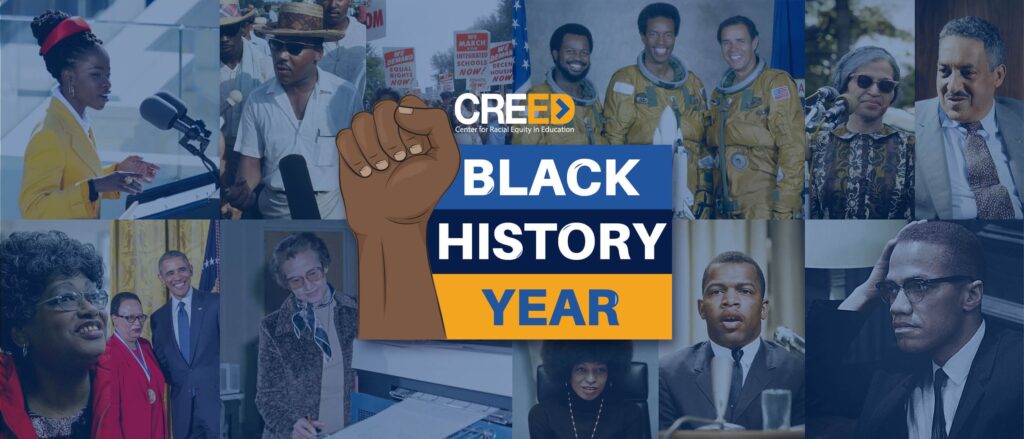
To prove this point, we are encouraging everyone to make 2024 #BlackHistoryYear.
Racism is only possible through deliberate acts of ignorance. If you believe Black people have no history to speak of or have had everything to learn and nothing to teach, it’s easy to see yourself as superior. But to subscribe to this train of thought is to ignore that you don’t have American History or World History without Black people. There is simply no era in which we haven’t existed or continent we haven’t been. And in a period where information is more readily accessible than ever before, it’s amazing more people don’t know this. So, it’s time to put everyone on notice — ALL YEAR LONG.
To be “Black” refers to a racial group of people who have African descent (i.e. African Americans, Afro-Caribbeans, Afro-Latinos, and Indigenous Africans). It’s a category used in modernity to describe the phenotype of an ancient people. As such, whether discussing people from antiquity or in contemporary times, these are individuals who share these common traits.
This campaign is making it your personal business to educate your fellow citizens for the rest of the year about the innumerable ways Black people have made local, national, and global history. Use whatever means of communication you have to share information. Bring it up in conversation. Post it on your social media.
Don’t stop just because February is over. Let’s use the rest of the year to talk about:
- our inventions and firsts;
- our freedom movements and leaders;
- obscure facts and unsung figures;
- our musical contributions and genres;
- our gastronomy and cuisine;
- our religious practices;
- our communities and civilizations; and
- our language and culture.
#BlackHistoryYear is about setting the record straight and inviting all who are willing to know more about who Black people really are.
Black pasts, Black presents, and Black futures.
A more complete and accurate view of Blackness that refuses to succumb to censorship or fragile sensitivities. It’s about making clear the role Black people play as members of the human family.
This is #BlackHistoryYear! And there is not a law strong enough to stop it nor a falsehood big enough to stop it.