
Perspective | Our moment to lead: Equitable instruction and COVID-19
The COVID-19 news began as a slow burn, the reaction turned frenetic. Worldwide, schools closed their doors. Throughout North Carolina, educators scrambled to establish logistical plans for online learning, hybrid plans, in-person plans, and on and on.
Amid the pandemonium, the opportunity gap was accentuated. While some saw the issue as one of family support for students, clear signals revealed multiple structural, economic, and societal barriers: A digitally divided population (both access to hardware and connectivity), a lack of safety nets for students with special needs, child care needs, and, most importantly, health concerns.
As school leaders welcome back faculty, staff, and students in plan A, B, or C, the crisis has turned into a new normal. The situation requires leaders to reject the default to efficiency and familiarity in seeking solutions. The time is ripe and necessary for leaders to engage in conversations about high-quality and equitable instruction.
School leaders hold powerful spaces to lead these conversations and actions, as well as drive policy and instructional innovations. In other words, this time of crisis has created a space for reimagined leadership for equity.
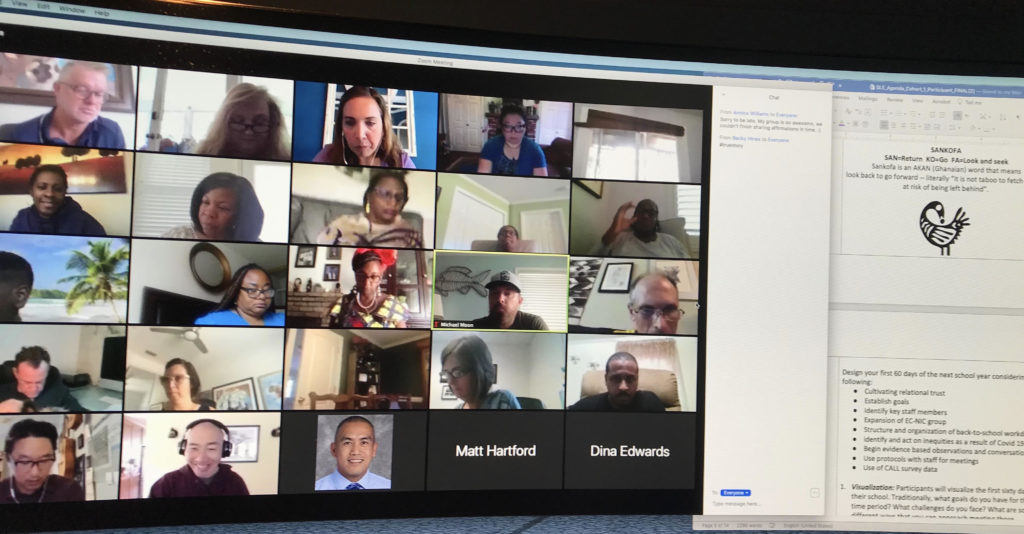
As university instructors, we too were forced to mobilize efforts to a new teaching and learning format. We moved three Ed.D. cohorts online, as well as a cohort of 70 school leaders from across the country who are in a year-long micro-credential focused on equitable academic discourse. During the transition, we were relentless with our design efforts to utilize strategies that were engaging and created spaces for contextualized conversations.
In our work, we model teaching practices focused on relationships and self-care, community building, inquiry, and academic discourse. We create online meeting spaces in which Learning Exchange axioms anchor our work. We strongly advocate for the belief that “The people closest to the issues are best situated to discover answers to local concerns” and “Hope and change are built on assets and dreams of locals and their communities.” Engaging in “exchanges” harnesses and liberates the gifts of the traditionally marginalized voices.
These axioms facilitate community meetings that give voice to all and generate knowledge through not only new information, but also the gifts and assets of those present. Why shouldn’t classrooms do the same, even when online? Through our determination to change from the efficiency model of static recordings, unidirectional online lectures, and webinars that benefit a narrow segment of students, we developed high-quality, equity-focused WebExchanges.
Our redesigned, if not reimagined, WebExchanges — an engaging learning model for online learning that we created and implemented — establish equitable practices with a powerful set of pedagogies that align to the gold standard teaching — strong academic discourse for all participants based on adult and student learning theory:
- Equitable relationship-building and self-care: We begin each session with space for unstructured conversations and dialogue. Next, we practice dynamic mindfulness: action, breathing, and centering as a mechanism for both transition and self-care.
- Equitable community building: Through storytelling practices, we provide space for personal narratives focused on the emotions of the people engaged in the complexities of change. For example, students read or view passages or visuals and then answer a prompt and relate it to a personal experience. We incorporate equity-centered design thinking practices for empathy and reflection. Students create artistic representations of work, and we add in physical movement when feasible, usually during mindfulness.
- Equitable inquiry: All learning begins with a focus on self-discovery and each leader’s assets and gifts. Leaders share autobiographies and digital stories that become emotional hooks for new learning. We use intimate conversation protocols in small group break out rooms, virtual learning walks, and private chats to reinforce learning for all students. Planning provides questions that align to high-quality text coupled with inquiry-based activities.
- Equitable academic discourse: We set a virtual table to establish a circle of voices. We model equitable discussion strategies so that leaders can help to transfer the practices to their work with teachers and their teachers with students. Private chat boxes, break out rooms, and intentional discussion structures ensure that all participants unpack their learning and the learning of others.
By no means are these practices new. In fact, we borrowed from indigenous ways of knowing and doing. As a result, we transformed our pedagogy and liberated our students. In the process, we build relational and community trust. We believe this learning is more democratic and equitable. Most importantly, it works! We have witnessed high levels of engagement and positive measured feedback from our students.
This historical rupture in time has created an opportunity. Educational leaders are uniquely positioned to help classroom teachers (K-12 and higher education) create equitable instructional experiences. Equitable and democratic instructional practices are not only necessary in this new online environment, they are attainable.