
Perspective | Northern Ireland taught tolerance but not democracy. Now it’s burning

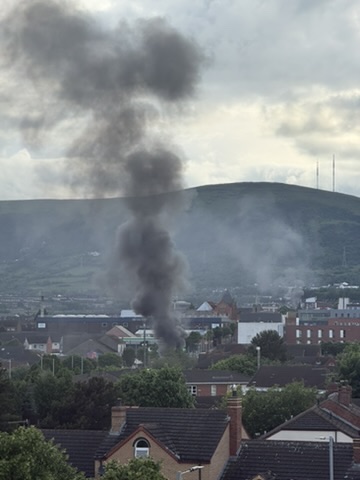
On a Tuesday evening, I watched from the sixth floor of my student housing in Belfast as a stream of black smoke rose above the rooftops and engulfed the green hills which surround the city. Below my window, teenagers dressed in all black — hooded and masked — crept down the street. They were headed to the anti-immigration “protests” that shook Belfast last month.
During these riots, buses were burned, a list of targeted houses in immigrant neighborhoods was posted on Facebook, and shops were ordered to close by 7 p.m. One Facebook post read, “wear dark clothing…and be prepared to fight or be arrested.” My fellow Davidson College students and I had come to Northern Ireland to study divided societies through the lens of education. Standing at that window, we were witnessing a divided society firsthand.
Northern Ireland is one of the world’s peace process success stories. The Good Friday Agreement ended a 30-year conflict known as the Troubles. Since then, the country has invested millions into integrated education, or schools that deliberately mix Catholic and Protestant children. The research shows it works: Students who attend integrated schools understand and respect their peers more. So why, 25 years later, does it feel like the peace remains unsettled?
Hoping to understand this, I spent weeks interviewing stakeholders across the political and educational system: a former member of parliament, a senior integrated education official, a community relations commissioner, and principals and students at Catholic, Protestant, and integrated schools. Instead of answers, I discovered something more concerning: the education system isn’t designed to ask hard questions about itself.
The teacher assistant of our program, herself from Northern Ireland, put it plainly, saying, “People here are taught not to question what they’re told — the peace is fragile, and any question feels like a threat to the system.”
 Sign up for the EdWeekly, a Friday roundup of the most important education news of the week.
The deeper I dug, the clearer it became that this wasn’t accidental.
A senior youth work manager told me, “Decision-makers can be a bit hesitant to fund (youth civic engagement programs), because maybe they don’t want a more vocal, active constituent base — especially among young people.”
A senior Alliance Party politician from Northern Ireland’s largest cross-community party told me this is an access issue rooted in the education system. The government’s flagship peace program reaches only one in 30 young people at any given time. And that’s only part of the problem: Students take an exam at 11 that splits them into grammar (academically selective, state-funded schools) or non-grammar schools — two entirely separate civic futures.
Those who attend grammar school get resources and encouragement to engage in society. Those who don’t are more likely to drop out at 16, disengage from politics, and channel frustration into far-right narratives online. Eventually, that frustration makes its way onto the streets.
A senior official at an integrated education nonprofit had seen this before, just at a smaller scale. She described teaching at a North Belfast school where students were best friends inside the classroom, joking together all week. On weekends, they faced off at the community recreation center and hit each other with bricks. Inside school, friends. Outside, members of rival communities.
Related reads



I recognized this division because I’ve seen it at home: North Carolina ranks seventh in the country for economic segregation in schools, with neighborhoods separated by school district lines that map almost perfectly onto race.
In both places, we send students to school and hope division lessens. But hope isn’t a strategy. Where schools fall short, organizations like the Northern Ireland Youth Forum step in, building civic confidence and spaces for cross-community dialogue.
Belfast didn’t wake up one day and riot. It got there slowly, quietly, through years of teaching young people to coexist without ever teaching them to disagree. A society can teach its young people to smile across the divide and still watch them reach for bricks when the school bell rings.
Tolerance without agency, it turns out, is not the same thing as democracy. The question worth sitting with is whether we’re doing the same thing in North Carolina — and whether we’ll recognize the smoke when it rises here.