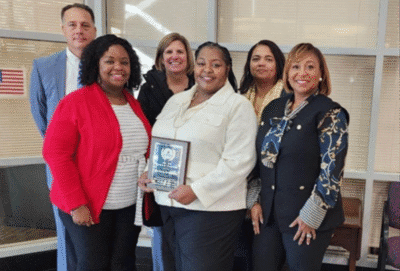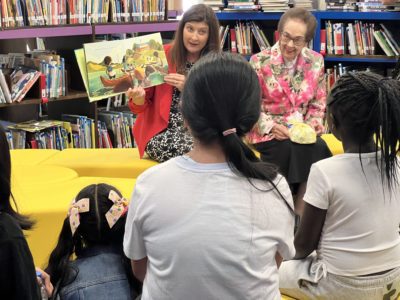
April Ferguson was selected to participate in the inaugural Teacher Leaders Institute sponsored by Schools That Lead, an organization aiming to equip teachers to lead using the tools of improvement science. Schools That Lead wants to transform how schools improve from the classroom up by centering student voice, leveraging new data in new ways, and creating schools that work for the people inside them. This mission aligned seamlessly with Ferguson’s own commitment to reflective practice and meaningful instructional change. The following is Ferguson’s account of using improvement science to improve reading comprehension.
I wanted my students to become stronger readers by becoming stronger thinkers.
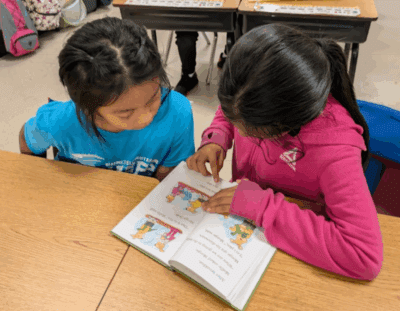
From the start of the quarter, I focused on an area where many of my students had faced persistent challenges: their comprehension and writing skills with informational texts. Instead of relying on traditional comprehension drills, I turned to a strategy I believed could fundamentally shift the way my students processed information: “CER” writing, which stands for, “claim, evidence, reasoning.”
From the very first week, I immersed my students in historical primary sources, using these complex texts as a gateway to deeper informational reading. I asked them not simply to read, but to analyze — not just to summarize, but to construct arguments. Throughout the quarter, they drafted and revised “CER” responses to speeches, letters, photographs, and political cartoons. I examined their writing closely, looking for clearer claims, more purposeful evidence, and reasoning that demonstrated an understanding of cause and effect.
Early on, many students struggled. Their claims lacked clarity, their evidence was sparse, and their reasoning often drifted into retelling. I responded with intentional scaffolding, especially for my English language learners and students with exceptional needs, ensuring that each student had access to the support they needed.
 Sign up for the EdDaily to start each weekday with the top education news.
As the weeks progressed, I began to see a noticeable shift. Students started selecting evidence more deliberately. Their explanations became more precise. Their writing reflected a deeper grasp of the historical content — and a more sophisticated understanding of how ideas connect. With each “CER” cycle, I gradually released supports and raised expectations, guiding them toward greater independence and analytical confidence.
Embedded in my approach was the core discipline of improvement science. I treated each instructional cycle as a small test of change, studying student work, identifying patterns, and adjusting my supports accordingly. Improvement science emphasizes learning through iterative practice — trying something, studying its impact, and refining it. I embraced this mindset fully. Each “CER” assignment became both a learning opportunity for my students and a data point for my own professional inquiry. This disciplined, reflective process allowed me to respond quickly to student needs and continuously strengthen my instructional moves.
By the end of the quarter, I compared students’ early writing to their later drafts and paired those observations with data focused on informational text performance across my three classes. The results told a compelling story.
Five out of seven exceeded expected growth and gained an entire year’s worth of growth or more in one quarter. One student met expected quarterly growth, and one maintained.
Their writing had become stronger, and their reading comprehension data reflected the same upward trajectory.
A note from Schools That Lead: For April, the project affirmed what she believed from the start — that writing can be a powerful tool for developing deeper thinking and that it can unlock deeper comprehension.
Her students didn’t just learn to write better; they learned to understand more fully. And in that growth, April saw the impact of a simple yet transformative idea, strengthened by the disciplined, reflective cycles of inquiry and carried out with consistency, curiosity, and empathy.


Recommended reading