
Not your father’s shop class

VOICES FROM THE 31ST ANNUAL EMERGING ISSUES FORUM
Yesterday’s vocational education has evolved to become today’s Career and Technical Education.
In the early 1900s, the first public school vocational courses were centered on agriculture, focusing on teaching young men to be productive farmers, and home economics, leading young women to be good homemakers.
Over the last century, the names have changed and the courses have expanded to give students a first-hand glimpse into the myriad of careers awaiting them after graduation. Career and Technical Education (CTE) courses now span eight major areas and fit into one or more of the 16 career cluster areas identified by the U.S. Department of Labor.
Beginning with exploratory courses in sixth grade and continuing with skill development courses throughout high school, CTE aids students to identify and solidify their career pathway.
Whether the pathway involves post-secondary education, certifications, or on the job training, CTE now provides opportunities for informed students to navigate to a productive and rewarding career.
CTE offers over 150 courses in the following areas: Agricultural Education; Business, Finance, and Information Technology Education; Career Development; Family and Consumer Sciences; Health Sciences Education; Marketing and Entrepreneurship Education; Technology Education; and Trades and Industrial Education. Each area contains courses designed to offer students a range of opportunities from exploring potential careers to developing skills for entry level jobs. CTE programs may also include courses designed to meet the specific needs of local business and industry which aids recruitment efforts for expansions and eliminating shortages for skilled workers.
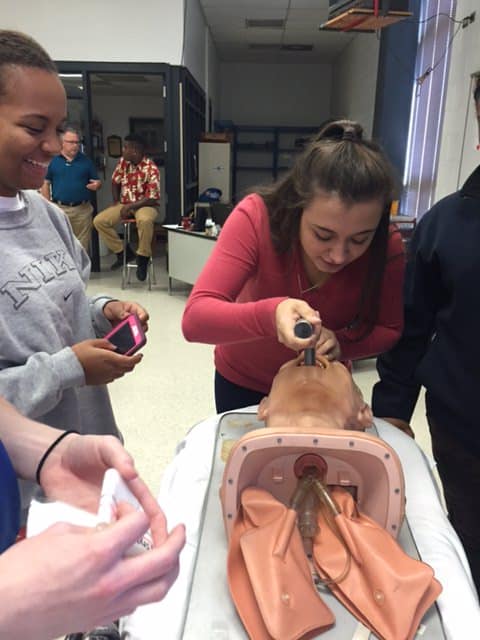
In an effort to ensure a quality program of skill development and exploration, many of CTE courses are adopted or adapted from industry training courses. This not only aligns courses to industry standards, but also allows students to earn credentials associated with those industries. Over 122 industry recognized, stackable credentials such as ServSafe®, Microsoft Office Specialist, Adobe Certified User, and N.C. Emergency Medical Technician Basic help students become more marketable as a potential employee. In 2014-15, North Carolina students earned 130,611 industry credentials, certifying their skills for the workplace. Employers benefit from the credential attainment in the savings associated with training costs for new employees. For the student, the earned credentials can translate to faster promotions, higher starting wages, and validation of their value as an employee. Additionally, many of the credentials are stackable providing growth opportunities for students after graduation.
Many high school CTE courses are articulated with community college technical courses accelerating a student’s pathway to their career. Through earned articulated credits and courses taken through Career and College Promise, students can conceivably earn up to a year’s worth of college credits towards a post-secondary technical degree, at no cost to the student, before graduating from high school. Taking advantage of these options saves tuition costs to earn a post-secondary degree or certification. The shortened pathway coupled with cost savings equals an individual earning wages earlier with potentially shorter intervals for career growth.
While technical courses are the “meat” of the CTE program, there are many more opportunities for students to enhance their pathway to a career. Work-based learning opportunities offer students on the job, real experiences with community business and industry partners. These experiences can range from one day job shadowing events to semester long internships to even longer term registered apprenticeships. CTE programs across the state are always looking for additional community partners to offer these real world experiences for students.
Career and Technical Student Organizations offer students opportunities to prove their skills in competitive environments, develop critical leadership skills, and network with students in the state and nation who share similar goals. Seven of these organizations exist today to carry individual above and beyond the classroom curriculum. Those are as follows: The National FFA Organization, FBLA, FCCLA, HOSA, DECA, TSA and SkillsUSA. Many former students tout networks created through these student organizations as being major connectors to their current careers.


Regardless of the requirements to get that first job, a student’s experiences in CTE can help clear and accelerate the career pathway. A student finding out what careers they are not interested in or not skilled at an early age is just as valuable as finding their niche and calling.
The technical, workplace, and leadership skills that are developed in quality CTE programs allow students to achieve their career goals quickly, without tremendous debt, and provide for future advancement along pathways that will span their lifetime.