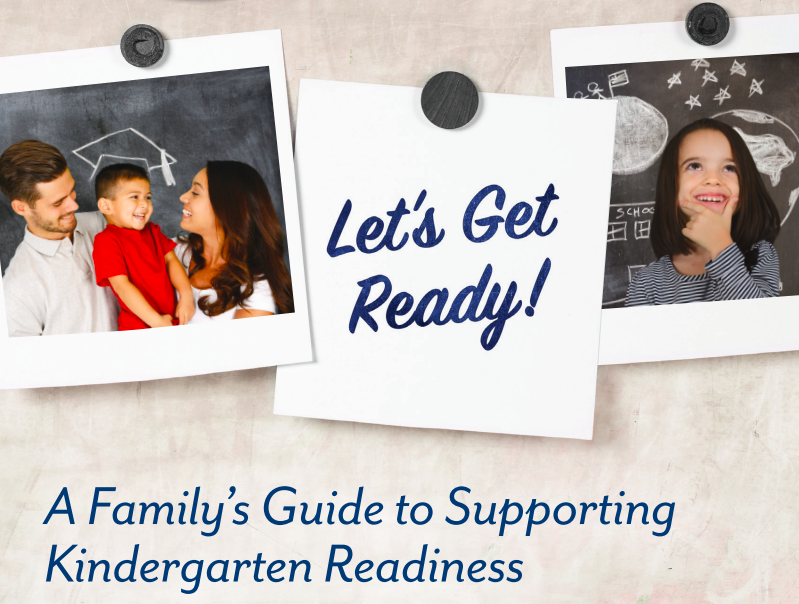
As families across the state navigate the kindergarten registration process, EdNC is sharing the Office of Early Learning’s (OEL) at North Carolina’s Department of Public Instruction (DPI) guide designed to help parents and caregivers support kindergarten readiness.
The “Let’s Get Ready!” guide is available here in English and Spanish and can be optimized for printing. Families also have the option of ordering a printed version directly from OEL for as little as $3. There’s also a recorded overview available on YouTube.
What readiness means
In the world of early childhood education, it’s common to hear people talk about “kindergarten readiness,” but what readiness means can vary.
The guide begins:
A child’s first school experience is a monumental occasion for both the family and the child. One may wonder, “Is my child ready for school?” and, “Is the school ready for my child?” While there is no one formula for ensuring school “readiness” there are many opportunities for families and caregivers to promote and support a child’s development and learning prior to entering kindergarten.
The guide is formatted around the North Carolina Foundations for Early Learning and Development (Foundations), which the state has relied on for more than a decade in early care and learning settings. There are five focus areas in Foundations:
- Approaches to play and learning
- Emotional and social development
- Health and physical development
- Language and communication development
- Cognitive development
The authors of the guide describe it as “a tool to support the family-school partnership. It is a collection of ideas and strategies to empower families and caregivers in supporting the natural unfolding of a child’s skills, abilities, and potential for lifelong learning.”
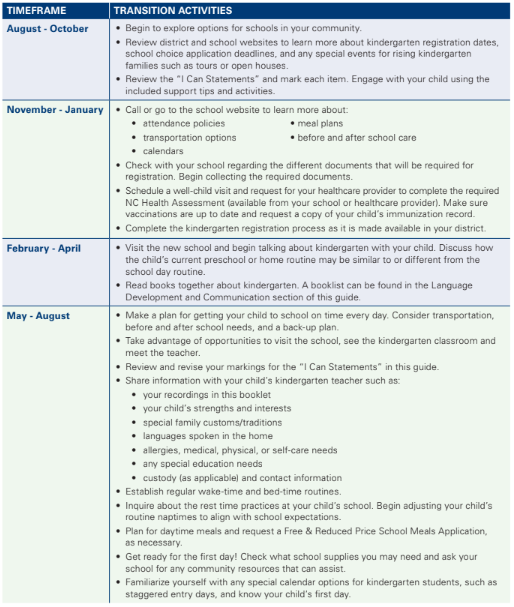
The guide also includes a transition timeline for families to use throughout the year leading to the first day of kindergarten.
How to use the guide
The “Let’s Get Ready!” guide is divided into five sections that correspond to the focus areas of Foundations. Each section contains a summary of the focus area, a series of measurable “I Can” statements, support tips, and “Try This!” activities.
For example, in the “Approaches to Play and Learning” section, the authors of the report describe the focus area:
The Approaches to Play and Learning area addresses how children learn and includes children’s attitudes toward and interest in learning. It reflects behaviors and attitudes such as curiosity, problem-solving, maintaining attention, and persistence. Children display these characteristics in the way they learn in all domains and curriculum areas, including music, dramatic play, and art.
This description is followed by a series of “I Can” statements such as: “I can use my imagination to think about new ways to play,” and “I can play by myself.” There’s a scale for parents and caregivers to mark how frequently they observe the child demonstrating that skill: Not Yet, Sometimes, or Most of the Time.
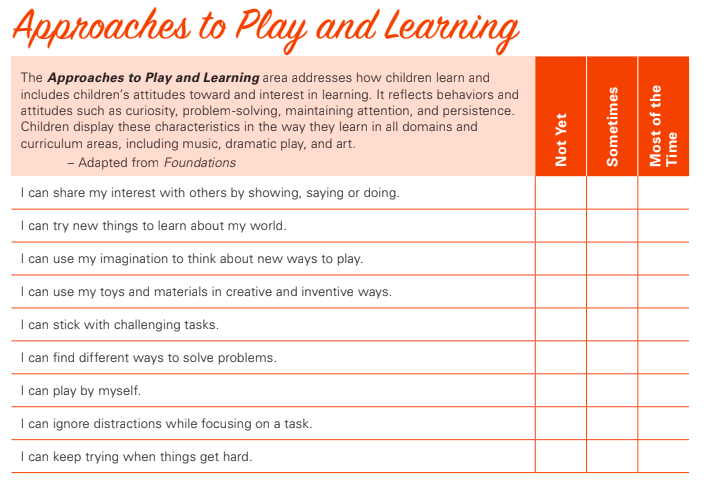
This can help families determine which approaches to play and learning they can work on with their children. The guide include “Support Tips” for doing this, such as:
- “Provide extended blocks of time for the child to play, explore materials, and work at their own pace. Allow the child to be independently involved without interruption.”
- “Encourage children to play with toys in new ways. For example, a block may become a car or telephone. A hat may become a crown or basket.”
These “Support Tips” are followed by “Try This!” activities to give parents and caregivers specific strategies for implementing tips and developing “I Can” statements. For example, one activity in the Approaches to Play and Learning section is “Act it Out”:
Read a favorite story together. Allow the child to find items from around the house that they can use to act out the story (clothes, props, etc.). Encourage them to create additional events for the story or even new endings.
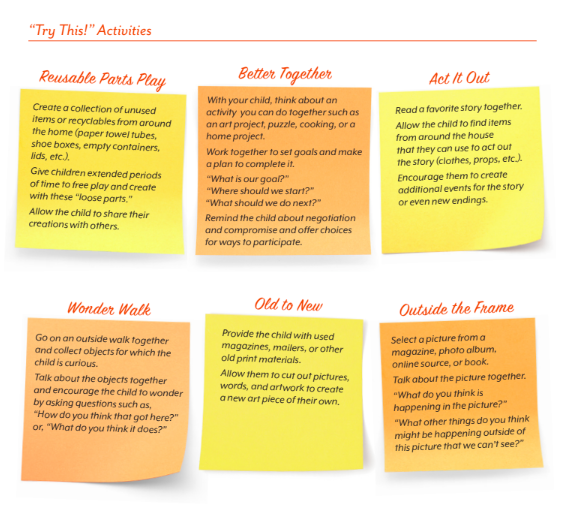
Each of the five Foundations has its own set of “I Can” statements, support tips, and “Try This!” activities.
“Let’s Get Ready!” also includes guidance on reading with children every day, along with a suggested reading list of almost 20 books, more than half of which are available in both English and Spanish.
 Sign up for Early Bird, our newsletter on all things early childhood.
Why readiness matters
As EdNC has previously reported, teachers say that teaching young students how to count, write, and spell is only possible when young learners arrive at school with the social and emotional skills that make them ready to learn.
That means young children arrive at kindergarten prepared to participate in group learning. This requires the ability to develop trusting relationships with adults outside of their homes, such as teachers. In the first years of school, young students will be called upon to sit, stand, or move in groups of other children, as well as share toys and materials. As such, they should be able to communicate their wants and needs to others and to develop the skills necessary for regulating their emotions.
Recent trends suggest that many children, especially those whose first years were shaped by the COVID-19 pandemic, are not showing up to kindergarten with these basic skills.
An article from the Hechinger Report notes evidence of increasing behavior challenges — “biting, kicking, wandering the classroom” — among the nation’s youngest learners.
Another article from The 74 Million examined the results of a survey of more than 200 kindergarten teachers who work with students born during the pandemic. They found:
- 73% of teachers say kindergartners are behind in early literacy.
- 82% say students are less socially-emotionally ready, especially with sharing, collaboration, and emotion regulation.
- 89% report shorter attention spans during reading; two-thirds say much shorter.
- More than half say students are less confident participating in reading activities.
In North Carolina, new data show that just 66.1% of children between the ages of 3 and 5 meet the criteria for school readiness. And that percentage varies widely based on factors such as poverty and special health care needs status.
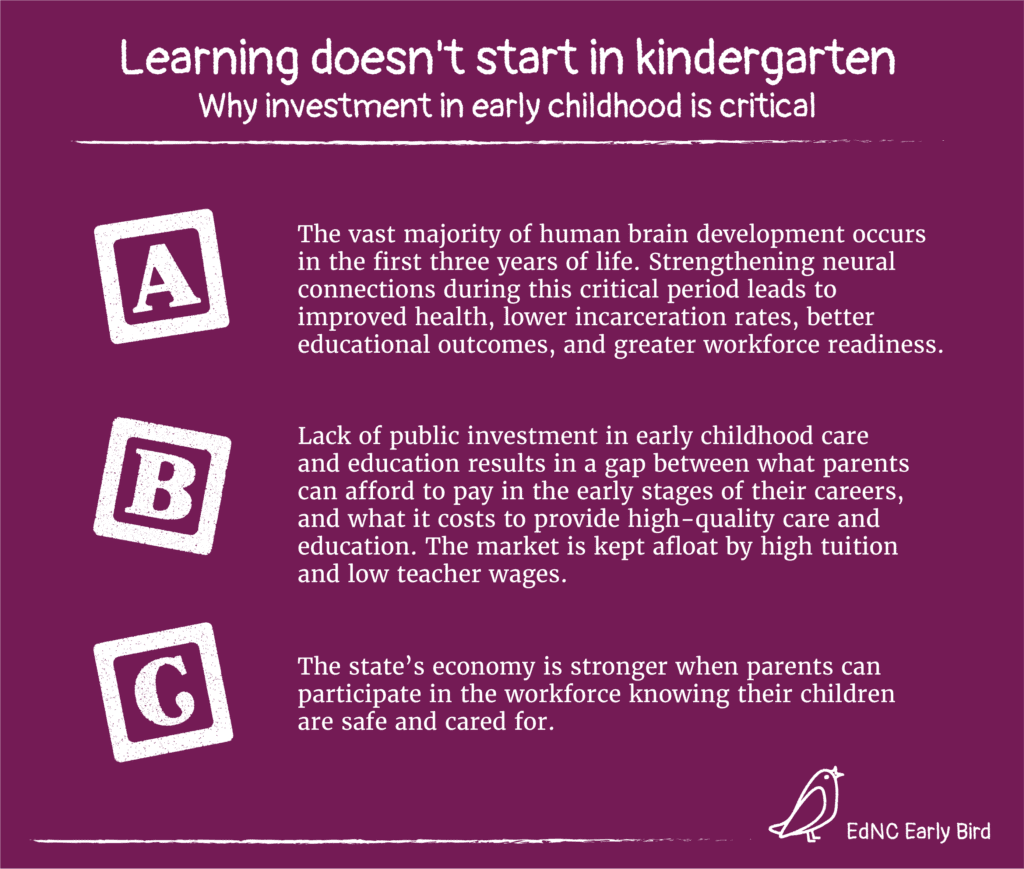
Decades of evidence have shown that high-quality early learning leads to improved health, education, and earnings outcomes as students progress through school and into the workforce. Students who receive high-quality early learning are also less likely to be incarcerated or use government assistance programs later in life.
Editor’s note: DPI first shared this guide four years ago. EdNC is resharing the information ahead of kindergarten registration.
Recommended reading