
North Carolina has record net loss of licensed child care programs since mid-2023

North Carolina has had a net loss of 367 licensed child care programs since the start of the COVID-19 pandemic. More than 12% of those losses occurred in the final quarter of 2025.
The net loss of 45 programs in three months represents the largest single-quarter drop since EdNC began tracking changes in the number of licensed child care programs statewide in June 2023. Child care centers and family child care homes (FCCHs) had similar numbers of losses — the net loss of centers was 24 and the net loss of FCCHs was 21.
Based on data provided by the N.C. Child Care Resource and Referral (CCR&R) Council in partnership with the N.C. Division of Child Development and Early Education, EdNC previously found that North Carolina lost 5.8% of licensed child care programs during the five years when stabilization grants were used to supplement teacher wages. That net loss has increased to 7% since the end of stabilization grants in early 2025.
Trends among licensed centers and homes
Since February 2020, the last month of data before the COVID-19 pandemic, the number of licensed FCCHs has decreased by 24%. The number of licensed child care centers has decreased by almost 1%.
Since EdNC began tracking the data in June 2023, the number of licensed FCCH’s has decreased each quarter, including the net loss of 21 programs between October and December of 2025.

There were 1,363 FCCHs in February 2020. That number was down to 1,096 in March 2025, prior to the end of stabilization grants. By the end of 2025, North Carolina was down to 1,031 FCCHs.
While licensed child care centers have also experienced a net loss since February 2020, the trend has been less linear. Last quarter’s net loss of 24 centers has the number of licensed child care centers approaching their lowest level since EdNC began tracking.
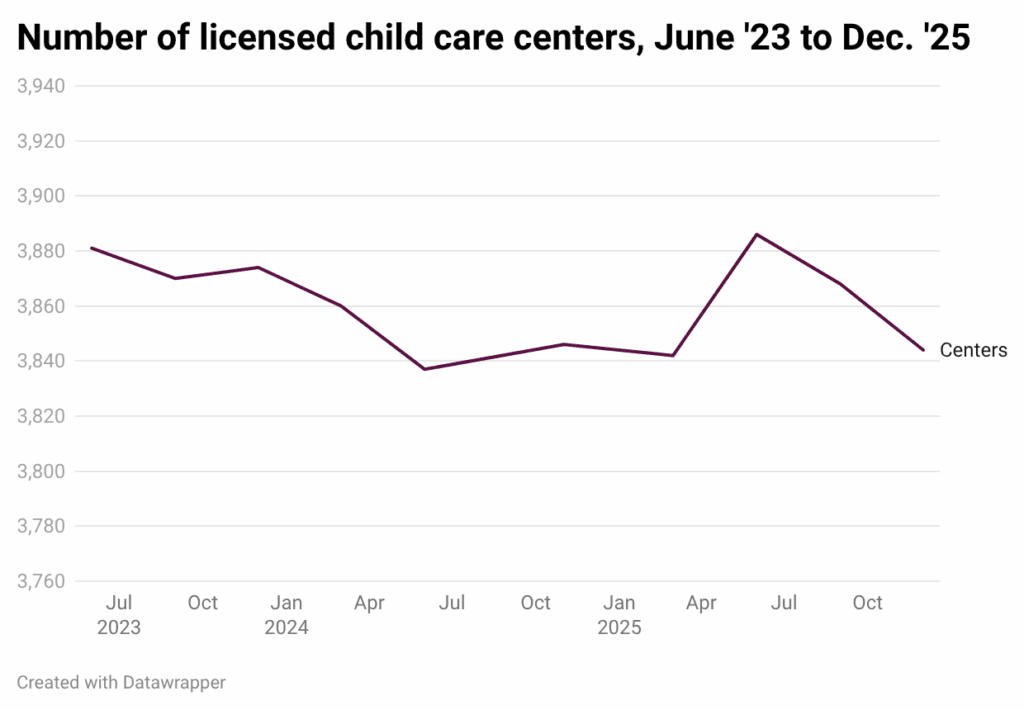
There were 3,879 licensed centers prior to the pandemic. When EdNC began tracking in June 2023, the number was slightly higher at 3,881. Since that time, some quarters have seen net gains and others net losses. The state ended 2025 with 3,844 licensed centers.
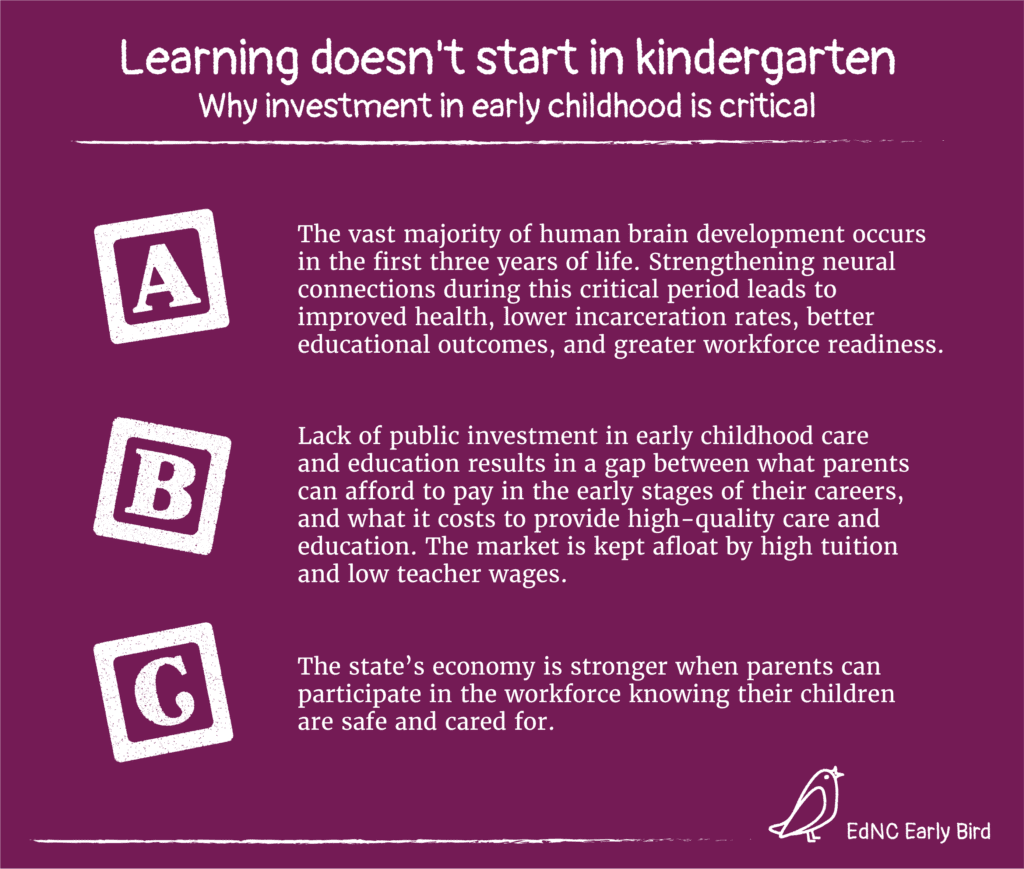
Access to high-quality, affordable early care and learning is essential in the critical years before North Carolina’s youngest learners begin kindergarten. And families having the freedom to choose from a wide variety of child care options enables parents to participate in the workforce or continue their education knowing their children are safe with professional educators.
Trends among subgroups
In addition to monitoring overall licensed child care trends, EdNC examines trends among three subgroups of counties each quarter.
In the counties that make up the area covered by the Dogwood Health Trust (Avery, Buncombe, Burke, Cherokee, Clay, Graham, Haywood, Henderson, Jackson, Macon, Madison, McDowell, Mitchell, Polk, Rutherford, Swain, Transylvania, and Yancey), the number of licensed child care sites is 7.3% lower than before the pandemic. These counties had a net loss of seven programs from October through December 2025. They’ve been consistently losing child care programs for all of 2024 and 2025.
 Sign up for Early Bird, our newsletter on all things early childhood.
In the majority-Black counties (Bertie, Edgecombe, Halifax, Hertford, Northampton, Vance, Warren, and Washington), the number of licensed child care sites remained relatively stable during and after the pandemic. But in the second half of 2025, these counties had a net loss of 11 programs. They’re now 5.5% lower than before the pandemic.
In Robeson and Swain, which both have large Indigenous populations, the number of licensed child care sites had also remained relatively stable during and after the pandemic. In the third quarter of 2025, the number of licensed child care programs in these counties dipped just below pre-pandemic levels. It remained stable in the fourth quarter.
Editor’s note: The Dogwood Health Trust supports the work of EdNC.