
Moving Forward: Issues that matter in cities, regions, and states


In January 2024, a group of leaders from around the country gathered in Birmingham, Alabama. Together, we imagined putting together an anthology of independent public policy research that could shape the moving forward after the elections in November regardless of the outcomes.
In July, thanks to the generosity of the Blumenthal Foundation, Philip Blumenthal, and Wendy Burns, we met at Wildacres in the mountains of North Carolina and worked on it around the clock in the beautiful library. Lanie Sorrow, our graphic designer, was a true Godsend.
The anthology focuses on five issues: housing, infrastructure, K-12 education, postsecondary attainment, and fiscal policy.
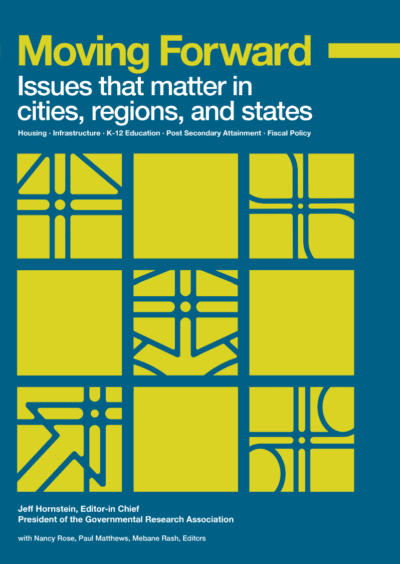
It features research by organizations who belong to the national Governmental Research Association (GRA), which has been around since 1914 and includes “organizations who are professionally engaged in public policy, governmental, and civic research” at the local, regional, and state level.
Ryan Hankins — the executive director of the Public Affairs Research Council in Alabama, the vice president of the GRA, and whose Ph.D. focused on the role of independent public policy research in governmental affairs — wrote the introduction.
“In 2024, the GRA claimed 27 members in 17 states,” he writes. “The oldest current member was founded in 1886, and the newest in 2015. The organizations vary by geography, political culture, policy environment, research agenda, target audience, and more. Still, they share a common goal: providing objective, nonpartisan policy research to policymakers and the public.”
Hankins notes that the following factors define the research in the anthology relative to the hyper-partisan and crowded information space now available online that allows people and policymakers to easily avail themselves of echo chambers:
- The research is non-ideological;
- The research is local;
- The research is responsive;
- The research is accessible;
- The research is applied;
- The research(er) is known; and
- The research(er) is trusted.
“The characteristics,” Hankins says, “are interrelated and reinforce each other.”
“Objective, non-ideological research does not guarantee wise policy decisions, but the absence of such research guarantees bad decisions,” he concludes.
The anthology has been shared with policymakers and public policy instructors around the country, and it is available here.
“Moving Forward” includes the groundbreaking research by Hannah Vinueza McClellan, which identified five indicators that contribute to the financial health of community colleges.
This work — including the reporting and research of EdNC — focuses on public problems now in people’s lives in communities in our towns and cities and across our regions and states.
Even more importantly, it continuously raises the hope and promise of a better tomorrow for all.