
KidoNomiCs tackles childhood health
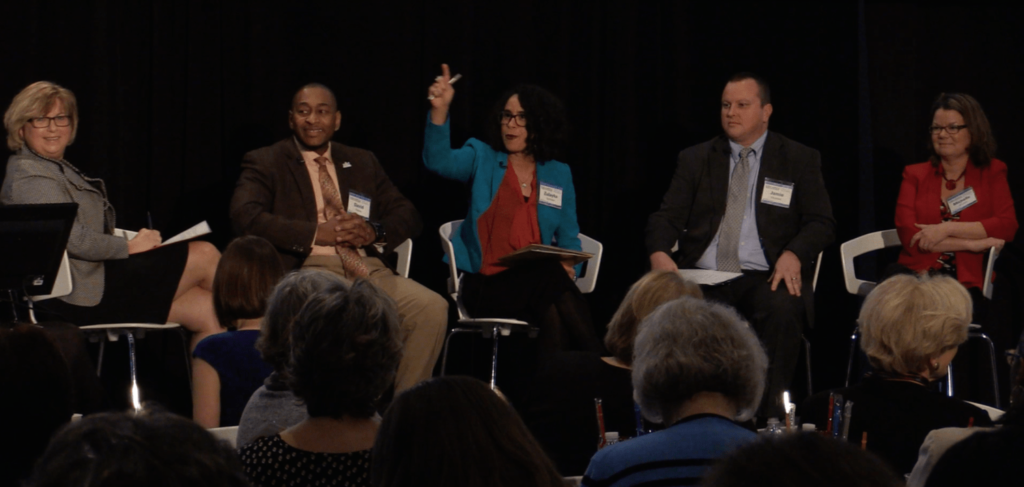

As part of its kidoNomiCs kickoff Tuesday, the Institute for Emerging Issues (IEI) at North Carolina State University held a panel discussing health in childhood at the James B. Hunt Library on the campus of NCSU.
Kathy Higgins, president of the Blue Cross and Blue Shield of North Carolina Foundation and vice president of BCBSNC Corporate Affairs, moderated the panel, which included the following guests:
- Michelle Hughes, executive director, NC Child
- Jamie Kilpatrick, associate manager, Public Consulting Group
- Zulayka Santiago, director, NC Oral Health Collaborative
-
David Reese, president and CEO, East Durham Children’s Initiative
Santiago said that the most important thing that the state can do for the health of young children is making sure they have good oral health.
“We can harness our collective wisdom, our tremendous resources, our skills, to ensure that all of our children have access to essential preventative services,” she said.
She noted that tooth decay is the most common chronic disease of early childhood and is two to three times more common than asthma or obesity.
“This is totally preventable,” Santiago said.
Kilpatrick said access to high-quality prenatal care is key, noting that it has benefits beyond just improved birth outcomes.
“It also helps identify those special needs and special support services at the earliest stages,” he said.
Hughes said that child poverty is the single biggest issue affecting children’s health.
“We know that children’s health is impacted by where they live, the conditions where they are going to school, where they’re learning, where they’re playing,” she said.
Reese said one of the issues he runs into when working with children in Durham is that kids in struggling communities are trying to escape. He and his organization want them to think differently about themselves and their role in the community.
“When we really begin to think about communities where kids have safe, healthy economically thriving neighborhoods, there really shouldn’t be a desire to get out,” he said.
He said he tries to talk to children about the need to come back and make their community into something better.
“This is not about escape,” he said. “This is really about coming back and building into your community.”
Hughes said that changes in public policy have improved children’s health over the past few decades. She noted in particular the Child Fatality Task Force, which has been operating for the past 25 years.
“In North Carolina, since 1991, we have reduced the number of children that have died by 46 percent, which is amazing,” she said.
That was done through infant mortality prevention, prenatal care, graduated drivers licenses and more, she said.
Santiago also touched on equity and what the word means when it comes to health.
“At the basic level, equity means the attainment of the highest level of health for all people,” she said. “And it’s about eliminating health disparities.”
She added that there is a social justice element to health equity, and that the two can’t be separated.
“To achieve health equity, we are required to have focus and ongoing efforts that address both historical and contemporary injustices,” she said.
See the full panel discussion below.