Being a farmer is not just what you do — it is who you are. As stewards of the natural world, farmers are essential workers, and their success is measured on our dinner tables, with production methods, freshness, availability, seasonal variety, and natural forces all playing a role. A farmer never clocks out, and there is no paid time off.
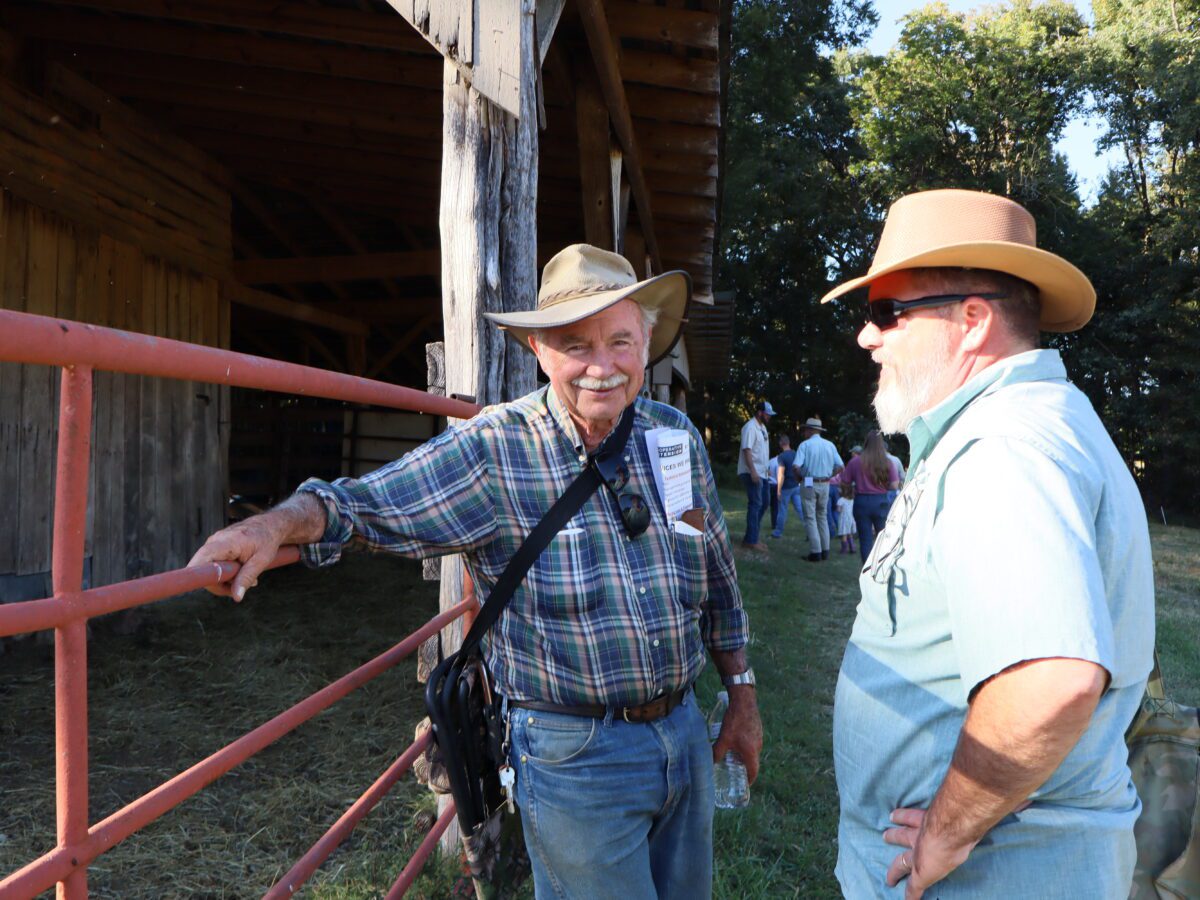
In the words of Dennis Layton, an 82-year-old farmer from Liberty, not only are farmers constantly working and actively networking with one another, but they are also always learning.
“My theory is we’re in school all our life, one way or another, till we turn our toes up,” said Layton, keeping pace with his fellow lifelong learners as they wound through a tour of Harris Homeplace Farm in Snow Camp, North Carolina.
Layton was indeed in “class” thanks to a new partnership between the West Chatham Area Chamber of Commerce, led by CEO and Executive Director Josh Harris, and the Central Carolina Community College (CCCC) Small Business Center (SBC), led by Director Phillip Pappas.
The initiative, called Impact the AREA: Agricultural Resilience, Entrepreneurship & Adaptability, began with a four-part series of weekly gatherings “designed to help local farmers strengthen their bottom line and prepare for the future,” according to a press release from CCCC.
 Sign up for Awake58, our newsletter on all things community college.
Launching AREA
AREA was primarily designed to help established and aspiring local farmers, agricultural producers, and small business owners strengthen their bottom line while also exploring ways to prepare for the future. In a place like west Chatham County, selling a family farm can result in the loss of productive agricultural acreage to increasing development. While that may be a lucrative option, Harris hopes to promote other enticing pathways for those who choose to continue farming their land.
“We’ve got a habit of disconnecting ag from business a lot of times,” said Harris. “When you start challenging your thought processes, then your thoughts about what you should be doing will change. That’s what we’ve seen.”
When Pappas first suggested an agribusiness-focused collaboration between the Chamber and the SBC, the wheels immediately began turning for Harris. Top of mind were ways to showcase avenues by which farmers might consider diversifying their revenue streams.
“We see a lot of people that are moving this way that are new to farming, and then we also see a lot of older farms that, in order to stay around, they’re going to have to adapt,” said Harris.
Read more on Central Carolina Community College



At 34 years old, Harris represents the sixth generation of his family to lead Harris Homeplace Farm. His father stopped spraying chemical pesticides on their land — which produces grass-fed beef, woodland-raised pork, and pasture-raised chicken — in 1998, and he hasn’t looked back. This passion for land conservation and stewardship of natural resources instilled in Josh early on the importance of adapting to a rapidly changing agricultural economy without sacrificing environmental integrity.
Rather than promoting a single method or ideology as the magic bullet for farmers, AREA aimed to expose participants to a variety of options through educational outreach, resource awareness, and in-person networking.
“We want to just give people some different ideas,” said Harris. “If they want to do it, great; if not, that’s fine too. We just want to be able to start that conversation and get it out there.”
Investing in soil health
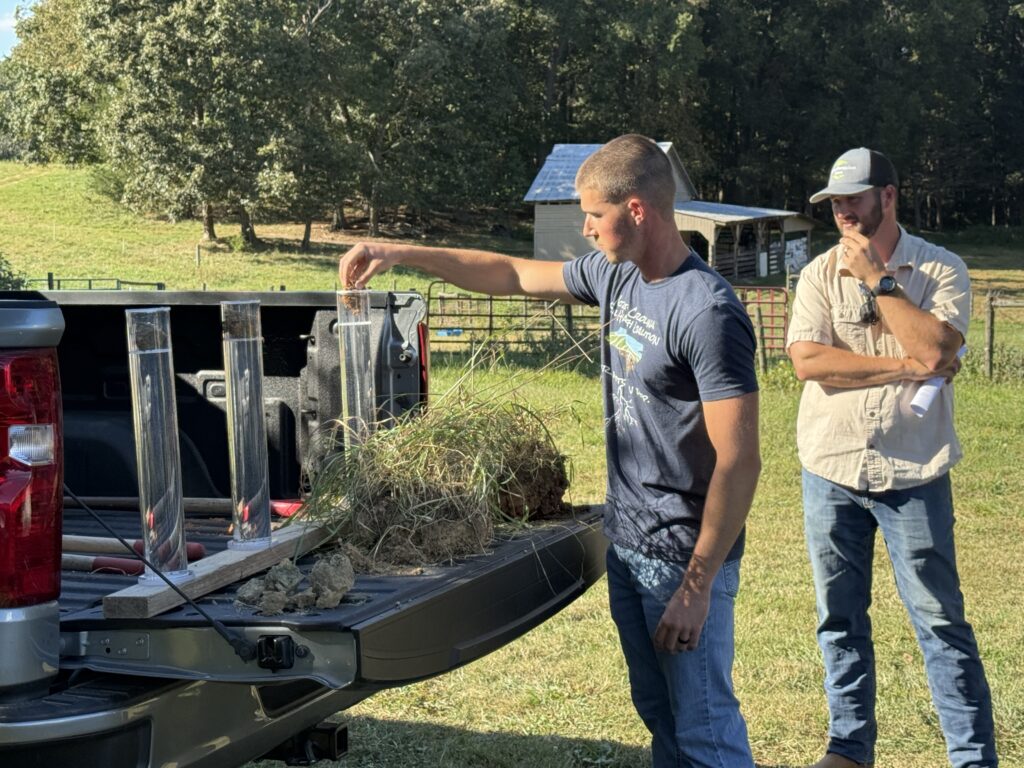
Ben Cauthen (left) and Josh Harris (right), both board members for the North Carolina Soil Health Coalition, present a ‘science experiment’ on soil samples to participants at the first AREA event. Courtesy of Olivia Webb
On Sept. 18, AREA kicked off with a visit to Harris Homeplace Farm. Participants learned how the Harris family has integrated soil health improvement into the production of ecologically raised meats, generated innovative revenue streams by expanding their direct-to-consumer distribution base, and created a more efficient, user-friendly e-commerce presence.
The evening began with a row of test tubes filled with water and lined up in a neat row on the tailgate of a farm truck for an introductory discussion led by members of the North Carolina Soil Health Coalition (NCSHC) board. Participants hypothesized how soil samples, each representing the result of a different land management style, would behave when dropped in water.
A recurring theme throughout the visit was how healthy soil is the first step in significantly reducing the input costs inherent to more traditional farming methods. Through soil management practices, the Harris family aims to work with nature instead of against it — and they’ll show you a farm full of healthy animals as proof of concept.
Allison LePanto, a NCSHC Board member, explained why initiatives like AREA are valuable to her as a small business owner whose revenue is intrinsically tied to the land. Her company, Aterak Nutrition, provides pasture solutions for horse owners, and part of her job is talking to horse owners about how they can restore their pastures to benefit their farms.
“I have learned so much by attending the educational events outside of my industry, because it’s all nature, just in a different application,” said LePanto. “I love coming to these and soaking it all up and taking it home and seeing how I can apply it to the industry that I’m in.”
Tapping into storytelling and agritourism
At Harris Homeplace Farm, Harris and Pappas also emphasized the importance of marketing for current and prospective agribusiness owners. While farmers may not have much free time, giving customers a closer look into business operations, such as through social media storytelling, does not have to be fancy.
Pappas and Harris believe that transparency is an invaluable asset in building the trusting relationship that consumers are looking for, especially when deciding how willing they may be to pay a higher price for a premium product. By simply telling the truth about what they do through social media activity, Harris Homeplace Farm strengthens the familiarity that might not happen through sleeker, paid advertising.
The target market at Harris Homeplace Farm is comprised of consumers who want to know exactly where their food comes from, whose hands it goes through to get to sale, and how those origins shape its nutritional profile, before they feed it to their families. To better tell their story, the farm purchased a drone and a camera to share videos and photos, lending insight into their clean, nutritious, and traceable processes.
“It’s painting that picture,” he said. “It’s showing them that, ‘Hey, this is our family and this is our home.’”
Pappas added that sharing stories like this can help farmers explain why they are charging a premium for their products.
“If you are hearing Josh talk about starting a website and doing social media marketing, and you are rolling your eyes, that’s every business owner,” Pappas said. “No one is going to think they have enough time, but just start small and tell a good story.”
The next AREA event, held at Millstone Creek Orchards in Ramseur, continued this focus on the importance of storytelling. Husband-and-wife team Beverly and Nick Mooney shared insights into the importance of succession planning and their agritourism efforts, including marketing as a critical pillar of revamping their business, the magic of creating innovative guest experiences, and how they evaluate the success of agritourism.
Marissa Devine, marketing manager at Millstone Creek, hails from the Siler City area and started as an intern while studying at The University of North Carolina at Chapel Hill. She first met the Mooneys by coming to the farm as a young girl to pick berries on family outings.
Although the Mooneys have two children, Beverly said that neither has any interest in running the family business, so Devine is “truly the future of the orchard,” and her footprint is built into its succession plan. Devine carries institutional knowledge that has been acquired over years of trial and error.
“This is not something where you go, ‘OK, we died, now you’re running it,’” said Beverly, adding that solidifying a succession plan is extremely important for any business — especially a farm.
Devine uses social media to highlight not only the personality of Millstone Creek but the voices of its customers, including tagging, liking, and reposting, so their connection back to Millstone comes full circle.
“Agritourism equals experience; we are an experience-based business,” said Beverly, who follows her late father’s insistence that guests to the farm should be treated like family. For Beverly, that means they should leave feeling spoiled.
“If you look at statistics out there, at where people are spending their money, they’re spending less money on things they can buy and more on experiences they can have — so that’s who we are,” she said, adding that she believes in the power of agritourism to help landowners find new ways to profit from their assets.
When Beverly’s father passed away and left the farm in her hands, agritourism played a critical role in the farm’s ability to survive the transition.
“Agritourism saved our farm, because I didn’t know anything about the agriculture side yet; however, we were doing field trips, we were doing some U-Pick,” she said. “They weren’t good years, but we lived to fight until I learned, so it was a unique way to look at business and ways to produce revenue.”
Beverly also discussed how agritourism helps protect the farm from environmental risk. Two years ago, Millstone Creek lost 100% of its peaches, 90% of its apples, and 60% of its berries to late freezes. Then, it happened again the next year.
Food and beverage sales, paired with a widening variety of experiences for guests of all ages, gives Millstone Creek the cash flow needed to survive conditions their crops might not. This has also given them the professional confidence and determination to try new events and attractions, see what works, scrap what doesn’t, and move on to learn from the next experience.
Accessing direct-to-consumer markets
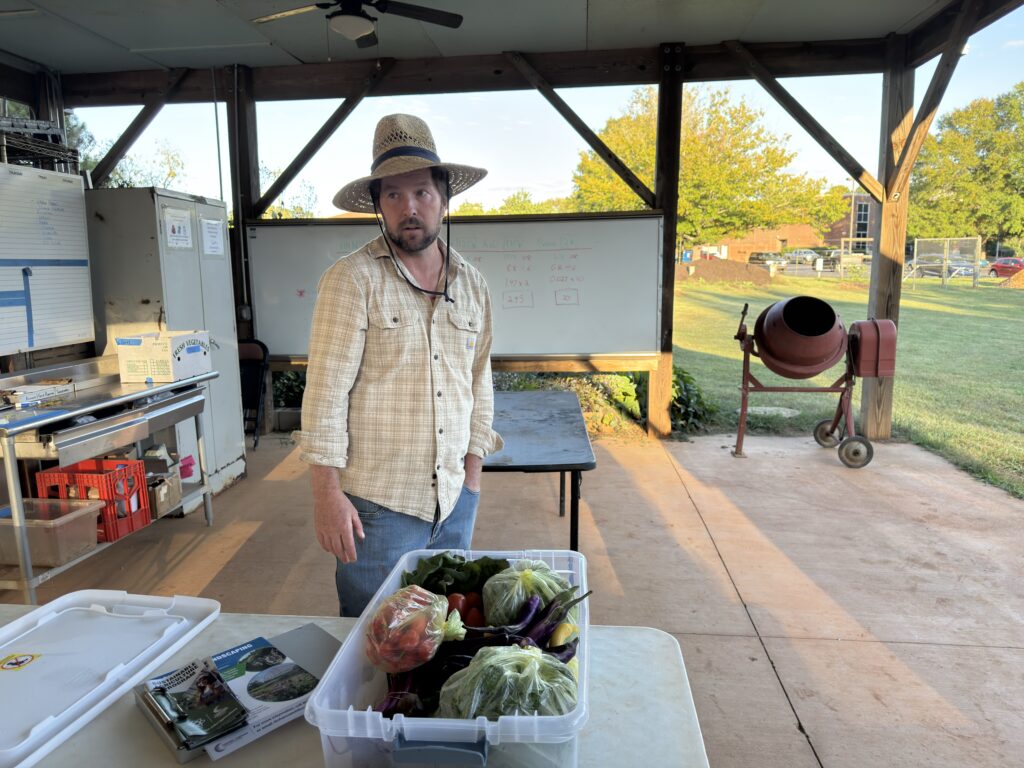
On Oct. 9, AREA attendees toured the CCCC student farm on the Chatham main campus in Pittsboro and discussed strategies for succession planting, diverse crop planning, and scaling crop production to meet consumer demand.
Attendees gathered for a lecture, led first by CCCC Farm Manager/Instructor Farrell Moose. He then introduced owners from two local farms that are moving toward better bottom lines through direct-to-consumer markets, including Community Supported Agriculture (CSA) sales and local farmers markets: Evan and Nicole Diamond of Deep River Flower Farm in Staley and Ben Shields of In Good Heart Farm in Pittsboro.
The group discussed CSAs as a viable way for steadily producing farmers to gain more consistent revenue while also building community and relationships. The CCCC Student Garden provides enough bounty for faculty CSA boxes, the colorful contents of which Moose showed off for the crowd at the end of the tour.
Where and how to sell is a choice that each farmer must make based on their individual situation, but this AREA session provided participants with insights into the array of options. While Shields uses both CSAs and farmers markets to sell produce at a small scale, the Diamonds sell their flowers solely through farmers markets. They are able to meet their still-growing goals by selling at two markets per week, as well on the farm itself by appointment.
Speakers and participants shared their trials and successes with farmers markets, admitting that the sometimes-complex rules, geographic location, and sheer number of farmers markets in an area like Chatham County can be barriers to getting the foot traffic small farmers need to meet their numbers. Advantages, however, include free consumer research, face-to-face advertising, and real-time customer service.
“Farmers markets are a great way to get feedback, because you have customers who come pretty often and they will tell you if they like something or if something needs improved,” said Shields.
Nicole shared that, due to the high-speed traffic that passes their farm on Highway 64, it’s difficult to get people to come to their farm, and providing a traditional delivery service is not a sustainable option for their operation. Farmers markets play a crucial role in filling that gap.
Robin Kohanowich, CCCC’s sustainable farming coordinator, led the tour of the student farm, explaining the planning and consideration that goes into every single row. According to CCCC’s website, the sustainable agriculture offerings at CCCC began as an idea from local farmers in 1996 and grew into a “one-of-a-kind collaboration” that includes farmers, CCCC, the N.C. Cooperative Extension Service, and more. CCCC’s offerings in sustainable agriculture now include a two-year Associate in Applied Science, certificates, and noncredit classes.
“It’s pretty varied, but our average (student) age is about 28,” said Kohanowich of the sustainable agriculture degree cohort at CCCC. “They’ve done college, they don’t like what they chose to do in college, and they want to be outside … they have somehow gotten introduced to sustainable farming, and they’re interested.”
Pamela Chavez and her husband Ron came to the AREA event to get ideas for next steps for their small flower farm, which they’ve been growing for three seasons. She described the first growing season as “research and development,” while subsequent seasons have yielded enough product for her to provide flowers for church, special events, and then some.
“Now, I just need to start making money,” she said.
Pamela always wanted to be a farmer, “but life didn’t take her that way.” Recently retired, she arrived at the AREA event by way of a continuing education class offered through CCCC’s sustainable agriculture program.
“We had a class here at the community college, and I loved them,” she said of CCCC’s sustainable agriculture program faculty. “They were personable, friendly, and willing to help.”
Knowing your numbers
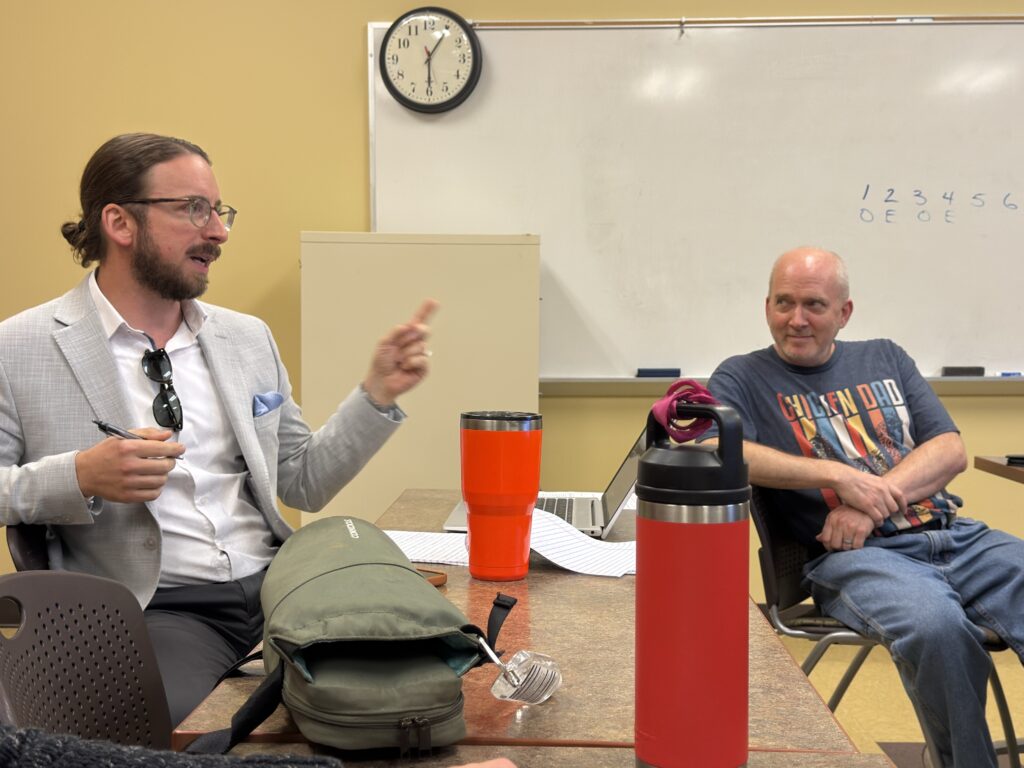
The AREA series concluded with a two-hour seminar on financial management and bookkeeping for agribusiness at the CCCC Siler City Center. Crystal Wambeke, a certified bookkeeper, fraud examiner, and owner of Wambeke and Associates in Southern Pines, provided the training. While the baseline knowledge of attendees varied, they all shared the common goal of becoming more familiar with their numbers.
Wambeke cited perishability, timing of sales, pricing decisions, and the overall ups and downs of the market as some of the issues farmers face when it comes to turning a profit.
“Every industry has ups and down, ebbs and flows, busy seasons and slow seasons, but rarely do people have to plant and grow and hope that Mother Nature is cooperative. It’s not just a border crossing or a supplier getting things to them on time, but actually depending on the earth to make a product, the months it takes to create it, and then people being interested in buying it and having a market for it,” said Wambeke.
Wambeke encouraged attendees to not shy away from their numbers.
“They can be very scary and they can be something you avoid at all costs when you don’t think they’re going well, but that’s the best time to dig into them, because then you can know and you can make a plan,” she said. “You can’t track what you don’t know.”
Over the next two hours, she covered everything from the basics of revenues and expenditures to different types of bookkeeping software, including an interactive group analysis of a mock profit and loss report.
AREA attendee Johanna Contreras came with questions and an enthusiasm for finance. She started a small gardening business two years ago with the help of Pappas at the SBC.
“You can just go to the Small Business Center, and they will give you a lot of stuff, and for me especially it was pricing stuff,” said Contreras. “It was one meeting, but it was a lot of help, and I really recommend it.”
Looking ahead
Harris and Pappas plan to build upon what they have learned to inform the future of the AREA initiative. They want more people to know that this type of collaboration is both possible and necessary to shape the future of agricultural areas like west Chatham County and beyond.
The AREA initiative drew praise from Dr. Dale McInnis, N.C. Community College System Board member, in a recent interview. McInnis was recently honored as president emeritus of Richmond Community College, whose campus is less than 30 minutes from the multigenerational family farm he grew up on.
For McInnis, programs like AREA raise expectations for future innovation at the intersection of agribusiness and education — and that benefits every North Carolinian.
“Our Small Business Centers are hyper-efficient engines of job creation and economic development, especially in agribusiness,” said McInnis, praising the effectiveness of the state’s 58 community colleges and their counterpart chambers of commerce in recognizing specific needs and developing solutions for the communities they serve.
“This great story out of Chatham County is an example of how rural communities succeed through their anchor institutions.”

Recommended reading