
Hundreds of leaders discuss the strength of rural places at Richmond Fed conference
Dr. Robin Gary Cummings grew up on a 25-acre farm in Robeson County, a Tier I county in southeast North Carolina. As a boy, he rode past the university in Pembroke more times than he could count and wondered what went on in there. Now he runs it.
“If you look at investing in rural America, I believe it starts with education,” the UNC Pembroke chancellor told a full ballroom at the Omni Grove Park Inn in Asheville on Oct. 2. “I’m the product of education.”
The 2026 Investing in Rural America Conference, hosted by the Federal Reserve Bank of Richmond (Richmond Fed) in partnership with the Federal Reserve System and Rural LISC, drew nearly 650 registered attendees from at least 47 states, plus Washington, D.C., Puerto Rico, and Guam.
Opening the conference on Wednesday, Sept. 30, Tom Barkin, president and CEO of the Federal Reserve Bank of Richmond, looked back nine years.
“I totally expected to have a conversation about inner cities,” he said. “But the data told a different story.”
Small towns in the Richmond Fed’s district, which covers the Carolinas, Virginia, Maryland, D.C., and most of West Virginia, were lagging nearly 10 points in the share of prime-age adults working. That led to the bank’s Center for Rural Economies and its Rural Investment Collaborative.
Western North Carolina after Helene shows what rural strength looks like, Barkin said. Gov. Josh Stein, by video, noted North Carolina has the nation’s second-largest rural population, about 3.5 million people.
 Sign up for the EdWeekly, a Friday roundup of the most important education news of the week.
A coin flip
Keynote speaker Raj Chetty, director of Harvard’s Opportunity Insights, followed, starting with a simple test of the American dream: Do children grow up to earn more than their parents?
For kids born in 1940, 92% did. For kids born in 1980, it’s a coin flip.
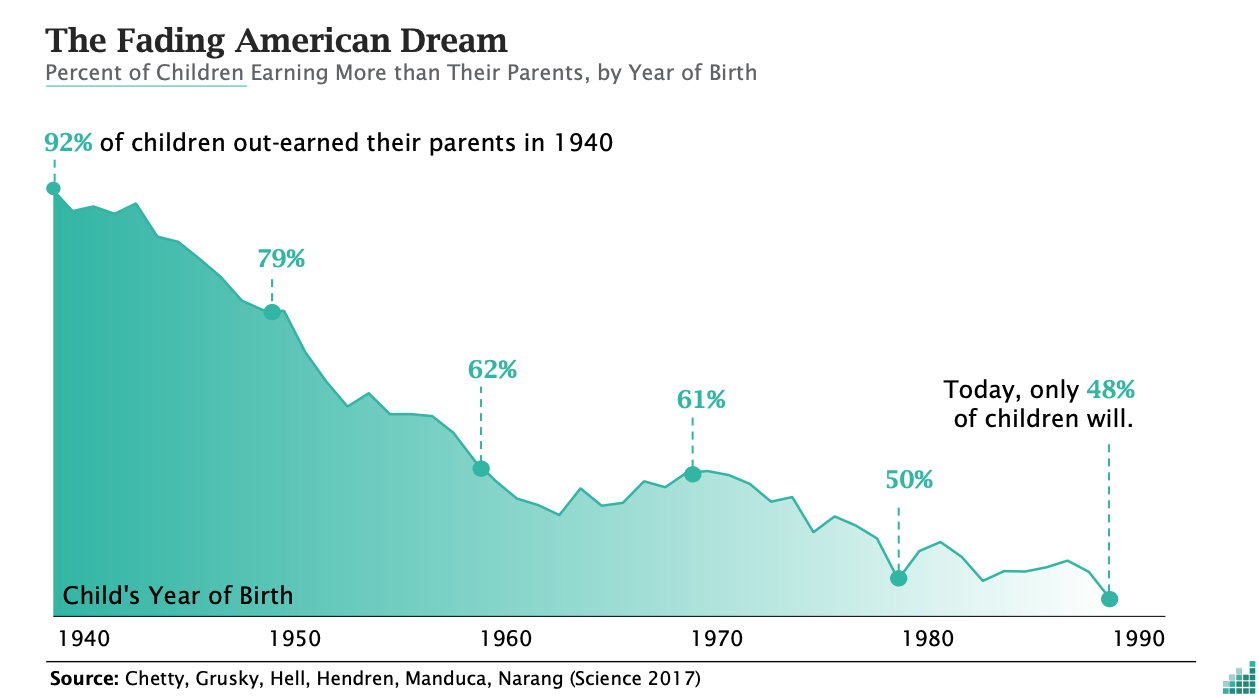
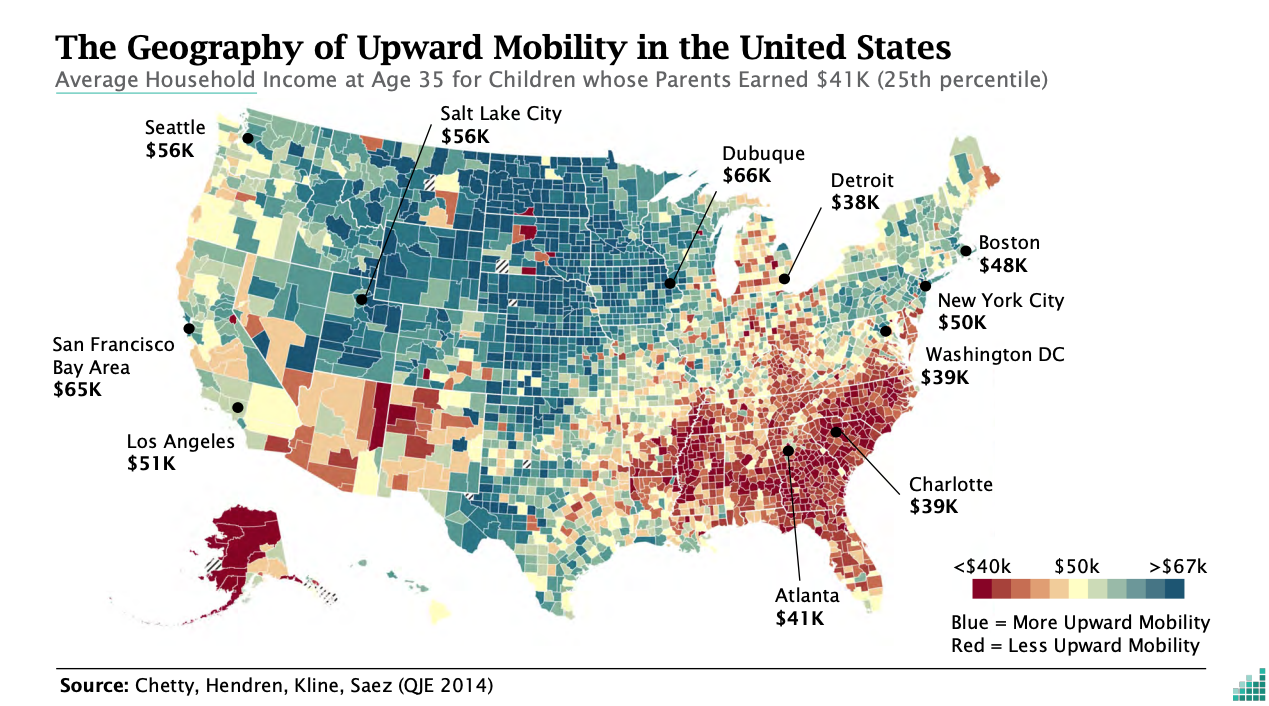
Chetty’s team tracked roughly 20 million of those kids through tax records until age 35. Geography mattered a lot. In parts of rural Iowa, a child whose parents made about $41,000 a year was likely earning $70,000 or more as an adult, while the same child raised in much of the rural Southeast, including here in the mountains, often fell well short.
So why the gap? Poverty plays a part. Chetty also pointed to family stability and school quality. But the strongest signal his team has found is who people know.
They looked at Facebook friendships for about 70 million people and found kids did better in places where lower-income families counted higher-income people among their friends, something Chetty calls economic connectedness. Some of that is practical, since more than half of jobs come through referrals. He thinks the deeper reason is what a kid can picture for themselves when nobody around them has gone to college or started a business.
Rural Midwestern towns have more of those friendships, and their kids tend to move up. The rural Southeast has fewer. Chetty traced at least some of that to a long history in the Southeast of separating people by race and class.
Even in the Midwest, though, success comes at a cost. Many of the kids who do well there don’t stay. In parts of the rural Midwest, more than 70% of the kids in his data grew up and moved away, and the ones who left usually earned more than the ones who stayed home. That’s a hard trade for a small town.
Those numbers come from kids born in the 1980s, so Chetty also looked for early signs of whether things are changing.
Test scores are one, and in the rural Southeast they’re climbing. He held up Mississippi’s reading gains as an example, though he didn’t seem to think “miracle” was the right word. The state did slow, deliberate work on coaching and science-based reading instruction.
“They put in a lot of effort,” he said. Better scores won’t automatically mean more mobility, he cautioned, but it’s a sign change is possible.
Chetty also talked about what has worked, including one example from North Carolina. Winston-Salem’s old Happy Hill Gardens public housing was rebuilt as a mixed-income neighborhood, now Alders Point, and by his team’s count, a child raised in a place like that from birth earns about $500,000 more over a lifetime.
Job training can pay off, too. Year Up, a job training program for 18-29 year olds without a bachelor’s degree, costs about $10,000, and in a randomized trial, it raised earnings by roughly $8,000 a year. Chetty’s team’s estimate for nursing programs at Western Governors University and Dallas College was higher, more than $30,000 a year. Chetty thinks private investors could pay for more training like that and get their money back from the extra income taxes graduates end up paying.
Chetty closed on the map he opened with, the country shaded by how likely kids are to move up, with much of the rural Southeast in red.
You could read that as a list of problems, he said. He reads it another way: “The red areas are the places where we have the opportunity to make a difference.”
The pond and the lasagna
That afternoon, Suzanne Anarde-Devenport of the Rural Community Assistance Corporation encouraged funders to rethink return on investment. Put money into a big city, she said, and it’s like tossing a stone into a lake, with only a tiny ripple to show for it. But drop that same bundle of money in a rural community, which she likened to a pond? “The ripples go all the way to the edge,” she said.
The idea was that funders need to adjust their ideas of scale for rural America, looking at “not the number of units, but the percentage of the community that’s going to be impacted.” Panelists noted that rural communities currently receive just 3% of philanthropic dollars nationwide.
On Friday morning, Farah Ahmad, president of Partners for Rural Transformation, used an analogy to demonstrate the necessary ingredients for leading community change in rural America.
“I skipped breakfast this morning, so I’m gonna use a food analogy,” she warned the audience, and decided on lasagna. Noodles are strong local leadership — without it, you can’t have any of the other stuff. Sauce is capital, but not just any sauce. Communities need “good capital” that will flex with them over the years. And cheese? She said cheesy goodness is regionalism, spreading across every layer.
At the end, she cautioned the audience to be mindful of who gets to tell the story of rural America. If rural communities don’t do it, Ahmad warned, others will, and, “It’ll be a story of poverty, a story of risk.”
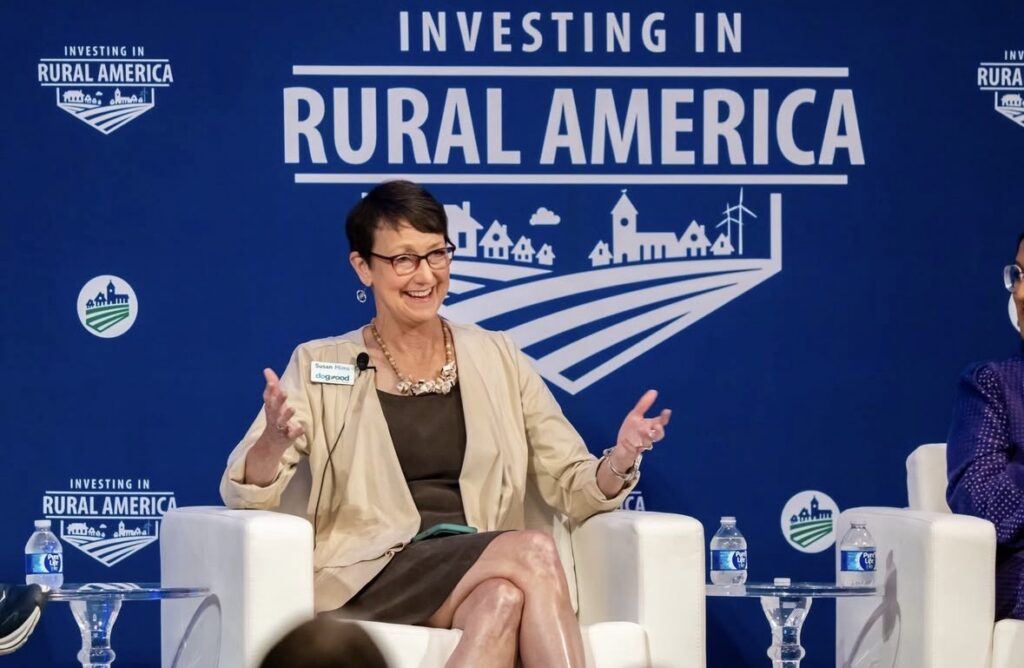
Susan Mims of North Carolina’s Dogwood Health Trust spoke about two years of Hurricane Helene recovery, and she started with relationships.
“Immediate post-disaster is not the time to kind of go meet somebody new,” Mims said.
A lot of philanthropy shows up after a storm like Helene. “It can be rapid, it can be flexible,” Mims said, “but it is not at all sufficient.”
Philanthropy can’t do it alone, she said, and communities can’t either. It takes partnerships, government dollars, and people working together to get resources to a community and keep them there.
“This is long-haul work,” she said. “We think about the immediate relief work, then the recovery work, and then the long-haul work of rebuilding.”
In Spindale, she said, a group fixed up one run-down house, then another, until neighbors across the street started on theirs. A brewery followed, then a bakery, a coffee shop, and a pump track in the middle of town.
Spruce Pine native Joe McKinney, executive director of the National Association of Development Organizations, said the nation is watching western North Carolina recover. His advice works for schools, too: keep track of your graduates, wherever they go.
“Those people are part of your community for the rest of their lives,” McKinney said.
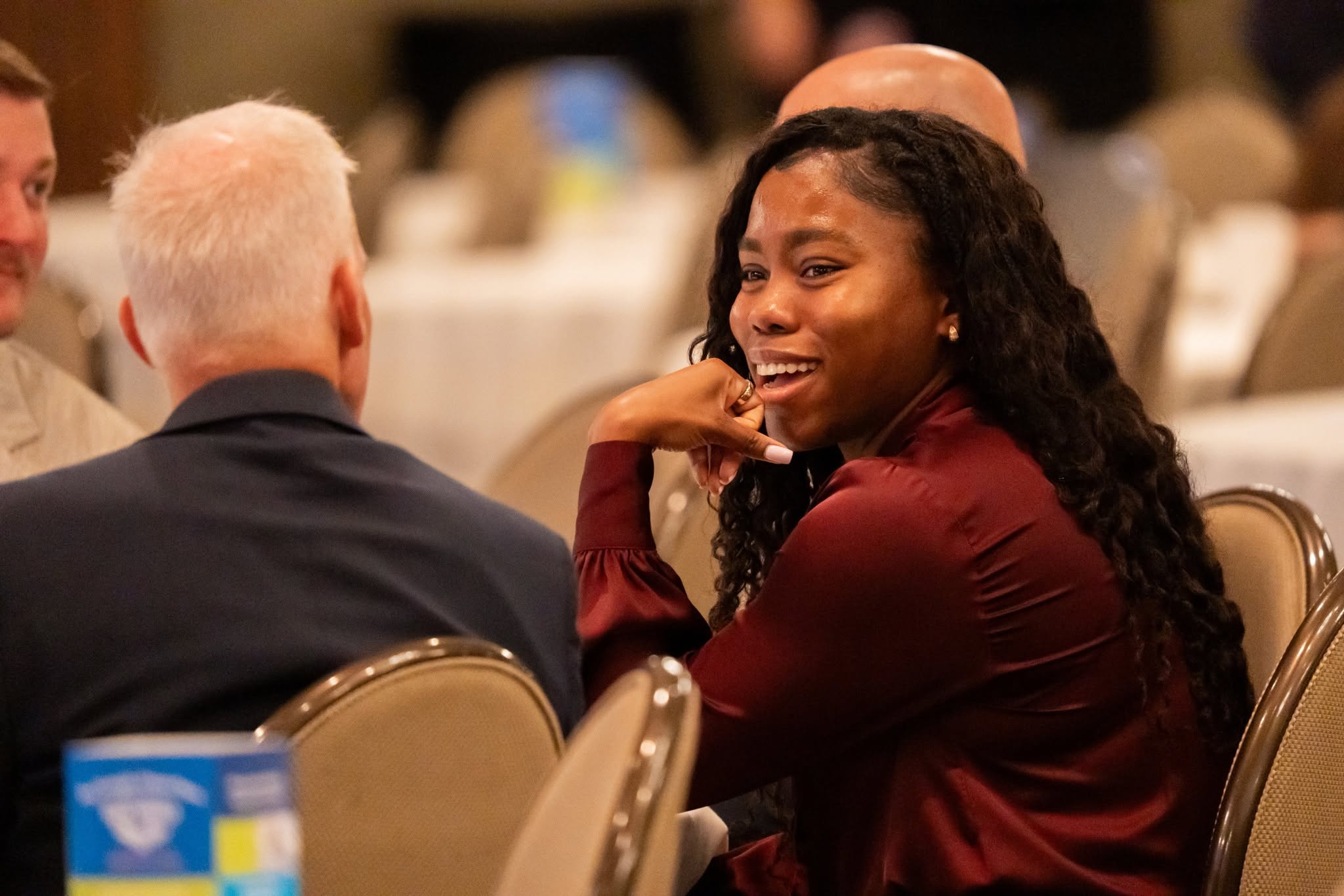
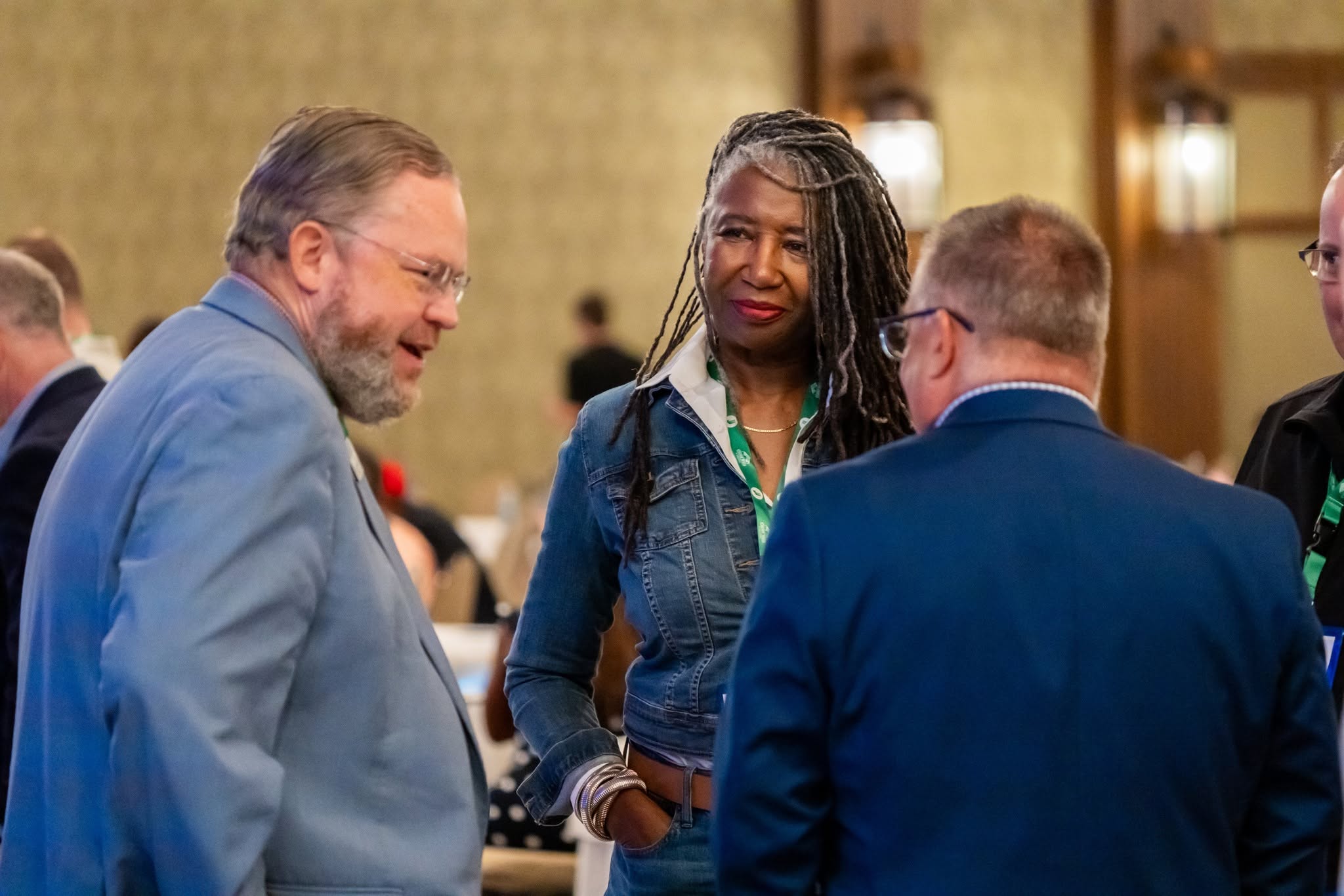
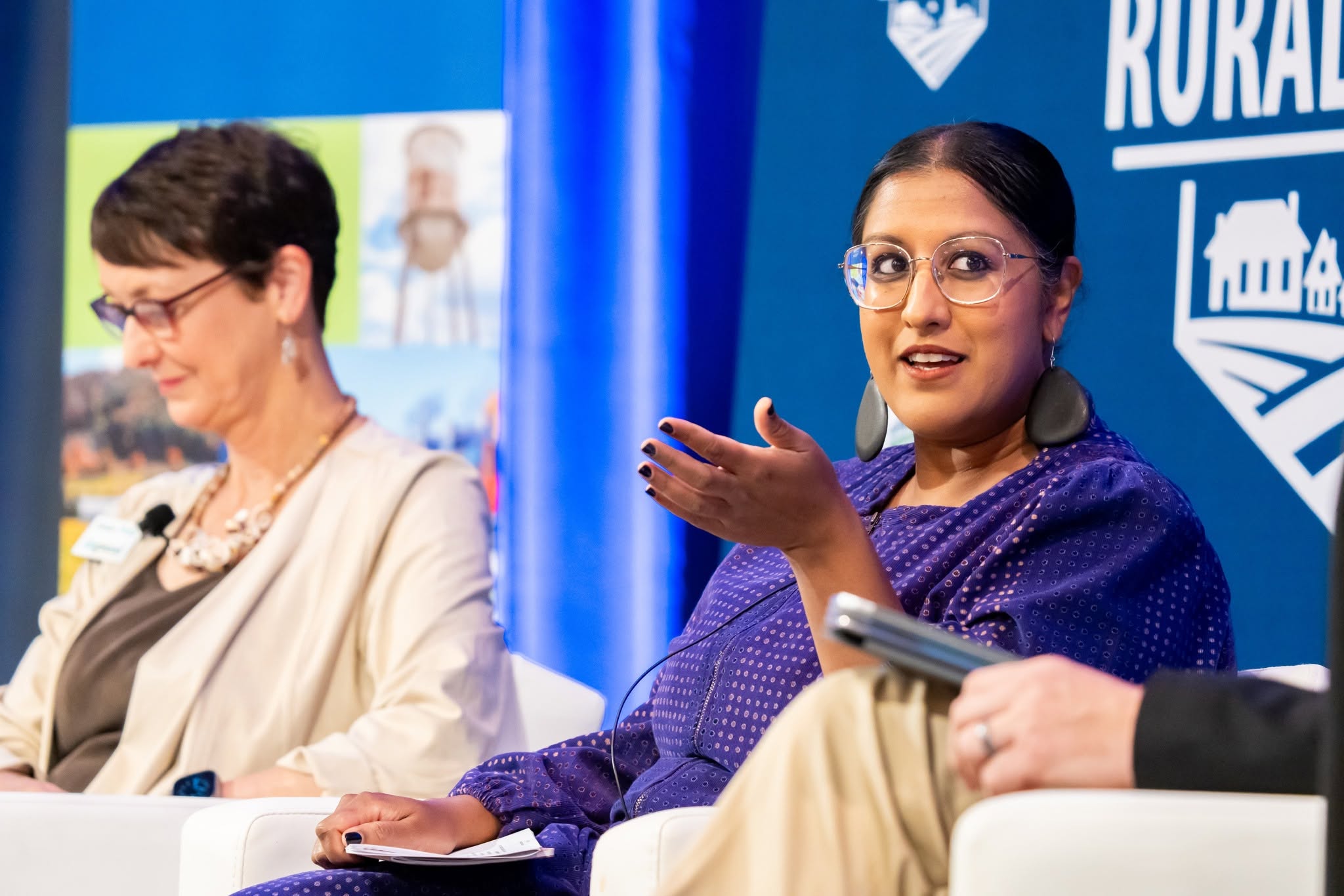
Courtesy of the Federal Reserve Bank of Richmond
Grow your own
Friday’s second panel belonged to three university presidents: UNC Pembroke Chancellor Cummings, University of Tennessee System President Randy Boyd, and Appalachian State (App State) Chancellor Dr. Heather Norris.
Cummings went back to 1887, when seven Native American men in Robeson County went to Raleigh with a local legislator, Hamilton McMillan, and returned with $500 and a charter for a school to train Native teachers. Today, UNC Pembroke has 8,000 students and remains the nation’s only four-year public university founded by Natives to educate Natives.
A physician by training, Cummings said a person born in Robeson County will on average live 14 years less than one born two hours up the road in Wake County. To address this, UNC Pembroke has doubled its nursing program; added doctor of nursing practice, family nurse practitioner, and occupational therapy degrees; and plans an optometry school for 2028. Eighty-three percent of its nurses stay in Robeson County and southeastern North Carolina.
“When I grew up in Robeson County 70 years ago, it was the poorest county in North Carolina,” Cummings said. “Today, it’s the poorest county in North Carolina.” If anything can change that, he tells legislators, it’s UNC Pembroke.
Boyd said Tennessee Promise, a last-dollar scholarship at any of the state’s community colleges and colleges of applied technology, has had a major impact on rural Tennessee.
Norris traced her university to 1899, when the Dougherty brothers opened a teaching academy in Boone to serve what people then called the lost provinces. There was no electricity, so they started a power company, which the university still runs. App State, with 21,000-plus students, keeps two-thirds to three-quarters of its graduates working in North Carolina. Nursing slots grew about 50% in under three years, and its Office of Rural Promise tells rural middle and high schoolers: “Yes, you can afford a college degree, and yes, that dream is attainable for you.”
As Watauga County’s largest employer with 3,600 people, App State runs two childcare centers and is adding student and employee housing. Norris bragged on a student-built solar car team that places near the top nationally, at a school with no engineering program.
“This is rural America at its best,” she said.
Three days of maps, panels, and even lasagna kept circling back to what Cummings learned as a boy riding past that campus in Pembroke. A kid has to be able to picture a future before reaching for it, and in rural places, the people and institutions nearby help draw it.
Chetty’s maps are online at opportunityatlas.org, where readers can enter an address to see how local kids have fared. The Richmond Fed’s Center for Rural Economies shares research and rural success stories at richmondfed.org/rural.
Editor’s note: Dogwood Health Trust supports the work of EdNC.