
How can community colleges market to adult learners? ‘Reach out to people’s fears, not just their goals’

Archie Bacud, a medical laboratory technology student at Southeastern Community College, immigrated to the United States from the Philippines with his family in 2018 and is now raising his three children in North Carolina.
Adjusting to a new country while juggling his children’s school work and other family responsibilities, he said, was overwhelming and left him unsure of what his next step professionally would be.
Then, in 2019, Bacud and his wife were involved in a car accident, and it was the professionalism and compassion Bacud experienced from emergency medical personnel that inspired him to pursue a career in health care. Only a few days after the accident, Bacud received a course catalog in the mail from Southeastern Community College. In it, he recognized the name of a former neighbor who was, at the time, the college’s director of continuing education.
“So I reached out, enrolled, and that one step helped me in my journey to change my life,” he said, adding that he will graduate from his program later this month.
Bacud was one of two adult learners who shared their stories during the John M. Belk Endowment’s (JMBE) fourth annual adult learner convening on April 16 and 17. Since 2022, the convening has gathered community college leaders and other educational stakeholders from across the state.
In the 2024-25 school year, adult learners — or those ages 25 and older — comprised more than half of the students enrolled at North Carolina community colleges. According to research from the Belk Center for Community College Leadership and Research, adult learners often balance their studies with employment, caretaking, and a myriad of other responsibilities that accompany adulthood.
This year’s event primarily focused on how colleges can effectively design marketing and communications efforts to successfully reach and reenroll adult learners. The convening also highlighted voices from adult learners themselves and new data on the impact of reenrolling in community college on adult learners’ wages.
NC Reconnect leads to measurable wage increases
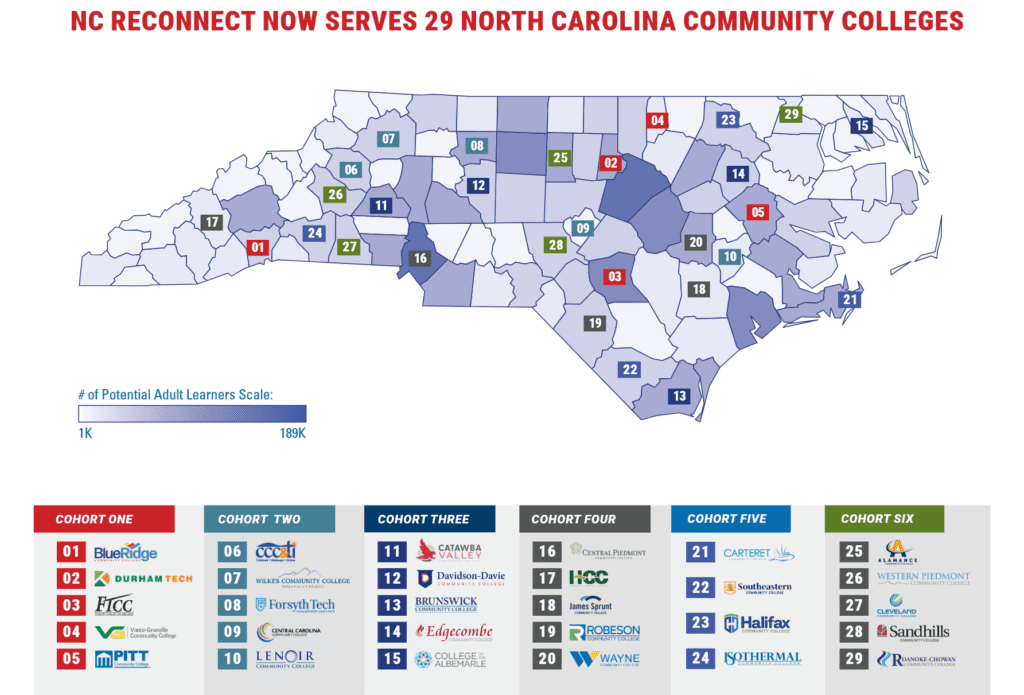
In 2021, JMBE launched NC Reconnect, an initiative designed to engage adult students who previously attended one of the now 29 community colleges participating in the program.
The Belk Center has led NC Reconnect’s program’s evaluation and released the third edition of their Adult Learner Guidebook at the convening.
“The guidebook is a result of you all allowing us to be with you during this wonderful learning process and then to capture those learnings,” Audrey J. Jaeger, executive director of the Belk Center, told NC Reconnect colleges at the convening.
Mike Krause, JMBE’s vice president, also highlighted new research from the Belk Center that provides evidence of NC Reconnect’s return on investment.
To evaluate impact, Belk Center and North Carolina Community College System researchers conducted within-student comparisons of pre- and post-NC Reconnect wages.
Because NC Reconnect’s first cohort of colleges launched in 2021, Krause explained, enough time has passed to now compare students’ wages before and after their NC Reconnect-induced reenrollment.
NC Reconnect cohort one students who completed a continuing education credential are earning a median of $20,700 more per year compared to their wages before reenrolling in community college. Cohort one students who completed a career and technical education credential are earning a median of $17,100 more per year.
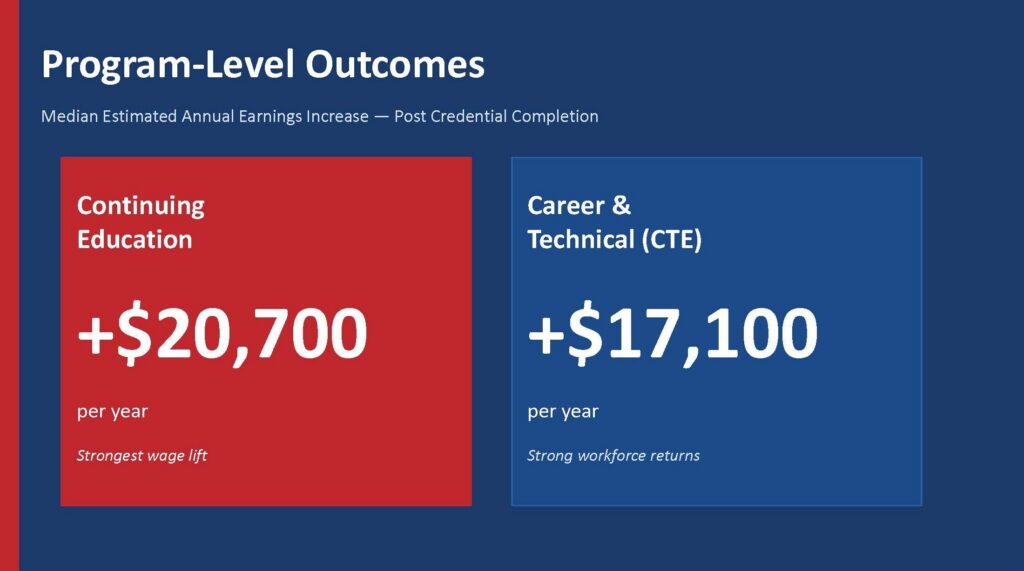
“This is an enormous case for optimism, because this now can be your message, and I hope you embrace it,” said Krause of the wage data.
Dr. Kenyatta Lovett of Education Strategy Group discussed national trends in how postsecondary credentials and degrees are valued, noting a move away from attainment for attainment’s sake and toward attainment that is measured by economic mobility.
Lovett pointed to Workforce Pell as a clear example of this value articulation and as a policy that speaks to adult learners’ desire for affordable, relevant, and short-term programs that lead to higher-paying jobs. Workforce Pell will not “radically transform” institutions when it goes into effect on July 1, 2026, but rather offer a “gradual transformation” as students gain access to its funding, Lovett said.
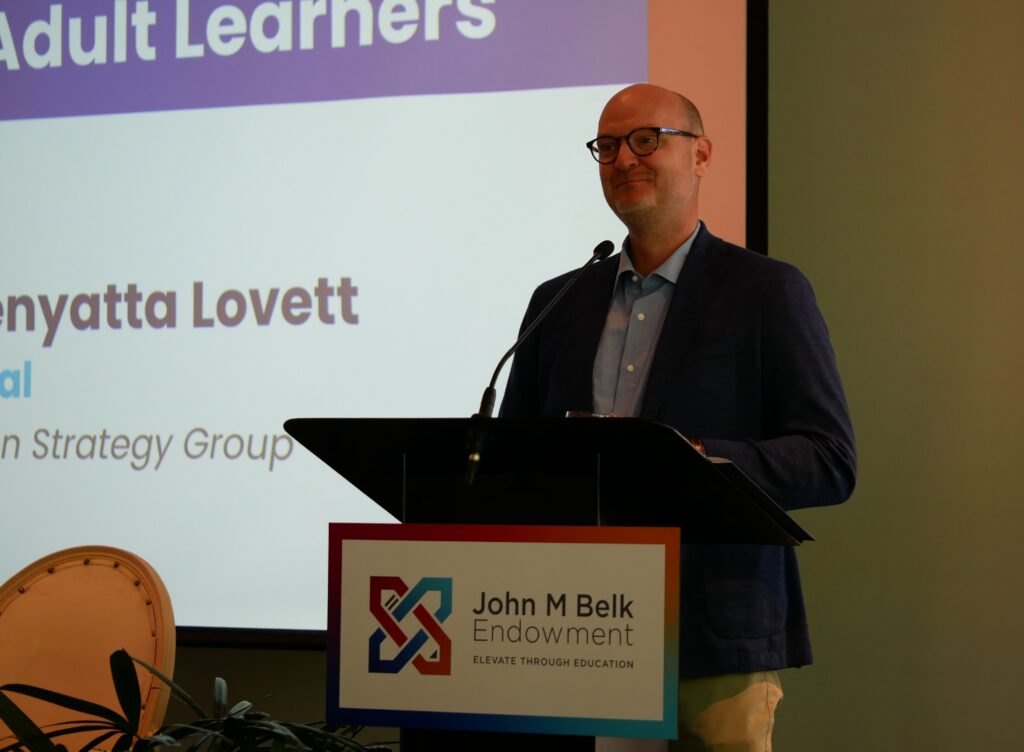
Lovett added that North Carolina is well-positioned to implement Workforce Pell this summer, noting that the ongoing work of organizations such as the Governor’s Office and JMBE are aligned with the program’s workforce development goals.
“What we’ve been able to see and what we’ve been able to work with at the North Carolina team has been nothing short of phenomenal,” said Lovett.
The way people consume information is changing — here’s how community colleges can respond
Ryan Kellett, a former Washington Post reporter and co-founder of Journalism Atlas, a company focused on creating an ecosystem of journalism creators, told attendees that the way people find news and information has “fundamentally changed.”
In his presentation, Kellett highlighted several ways the flow of information has changed. As it relates to community colleges, he highlighted the fact that, generally, people have shifted from trusting brands to trusting individual people, or internet “influencers” and “creators.”
Research Kellett shared from the Pew Research Center reports that 37% of adults under 30 regularly get their news from influencers on social media, and 21% of all adults get news from social media influencers regularly.
“Why this matters for you is your audience is learning about you from someone else before they ever reach you,” Kellett told attendees.
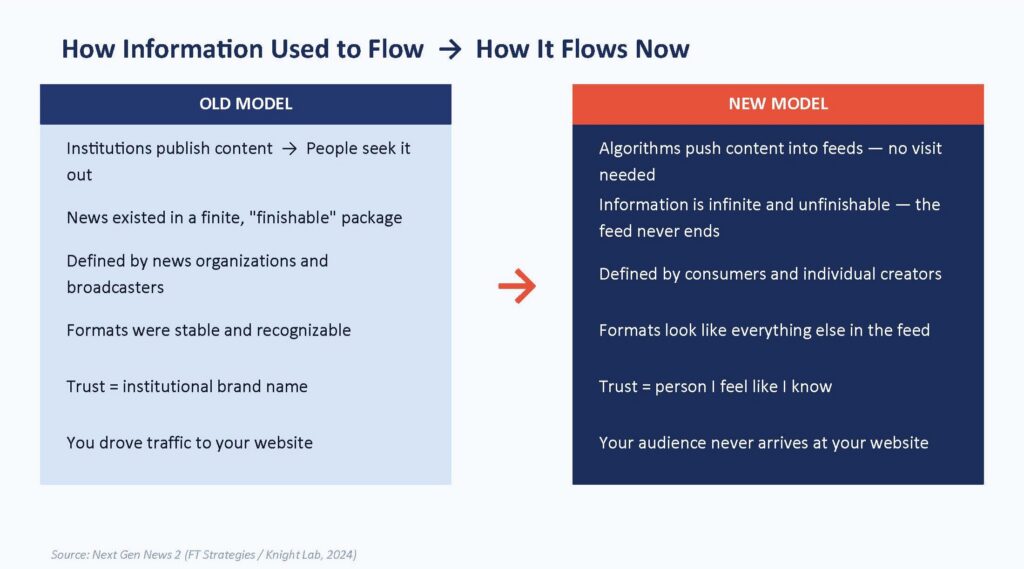
Kellett further explained how community colleges might get their marketing information in front of adult learners, citing recent research that unpacks three ways consumers find and act on what they see online:
- People sift through content on their various feeds, and an algorithm decides what content is put in front of them.
- When something catches a person’s attention, they turn to studying the topic, building knowledge through long-form YouTube videos, forums, and trusted creators. This, Kellett said, is where decisions get made.
- People sensemake the information they’ve consumed. They fact check what they learned with peers, community groups, and creators they follow. Here, Kellett said, peer voice and creator endorsement carry more weight than institutional authority.
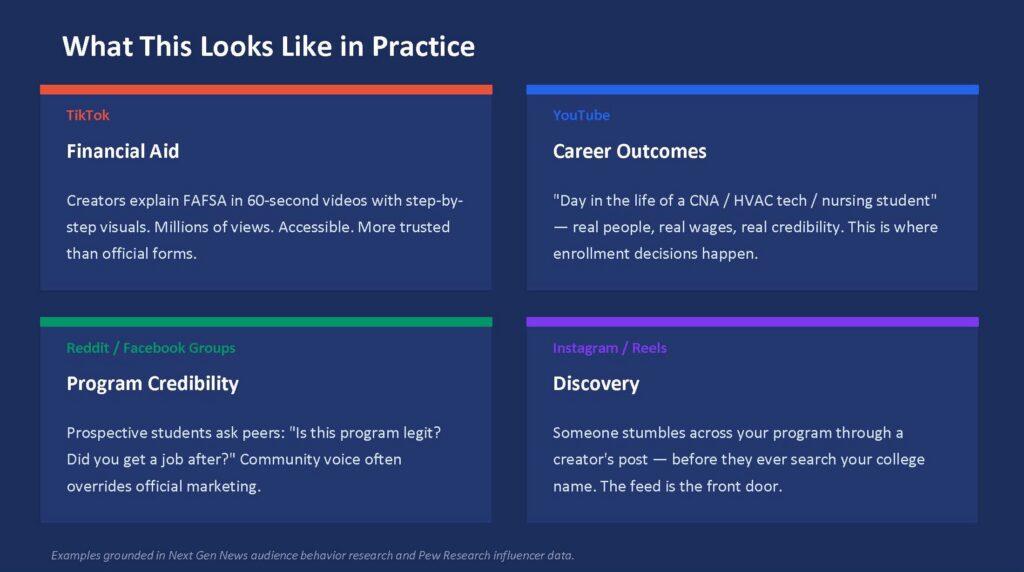
In practice, Kellett’s recommendation is to create an internal and external team of creators who can help build and communicate community colleges’ messages. This could include faculty, administrators, college presidents, and students. But, he said, community colleges can also identify and co-create their own database of trusted creator partners.
Bacud’s advice to community colleges about the kinds of advertisements and messages that resonated with him echoes the research Kellett presented.
“For outreach, I suggest that you reach out to people’s fears, not just their goals. Show real stories, real faces, people who have responsibilities and doubts,” Bacud told attendees.
He noted it would be particularly helpful to see students of all ages, not just traditional high school graduates, in materials from community colleges.
“When people would see themselves in that message, it would start feeling like it’s not just marketing, but it would feel like it’s an invitation for them to enroll themselves in that college,” Bacud added.
For outreach, I suggest that you reach out to people’s fears, not just their goals. Show real stories, real faces, people who have responsibilities and doubts.
— Archie Bacud, medical laboratory technology student at Southeastern Community College
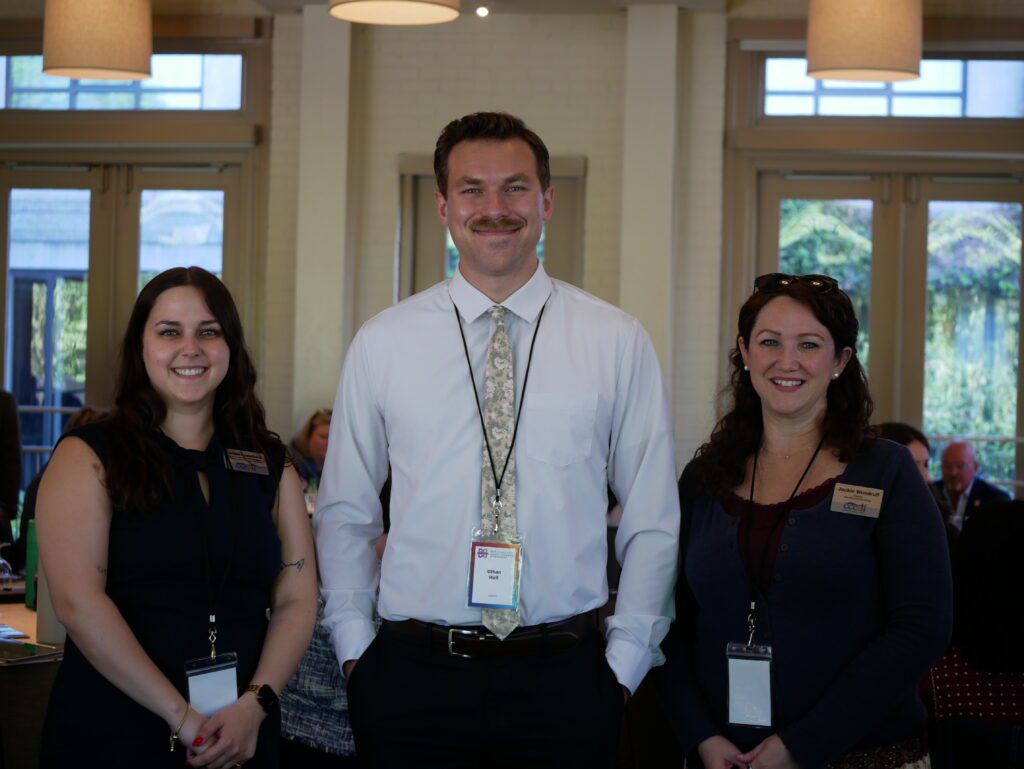
One college already putting the advice Kellett shared into action is Caldwell Community College & Technical Institute (CCC&TI). In a presentation, the college’s marketing team shared how they’ve reached more prospective students by enlisting the help of current students to create content.
Jackie Woodruff, director of branding and marketing at CCC&TI, said the team designed a work study position for one of the college’s students to act as a student influencer. Part of the student’s work is to create weekly recap videos highlighting the college’s on-campus environment.
According to Carlee Lunsford, CCC&TI’s digital content and web designer, the recap videos typically receive between 4,000 and 8,000 views.
What community college marketing teams want presidents to know
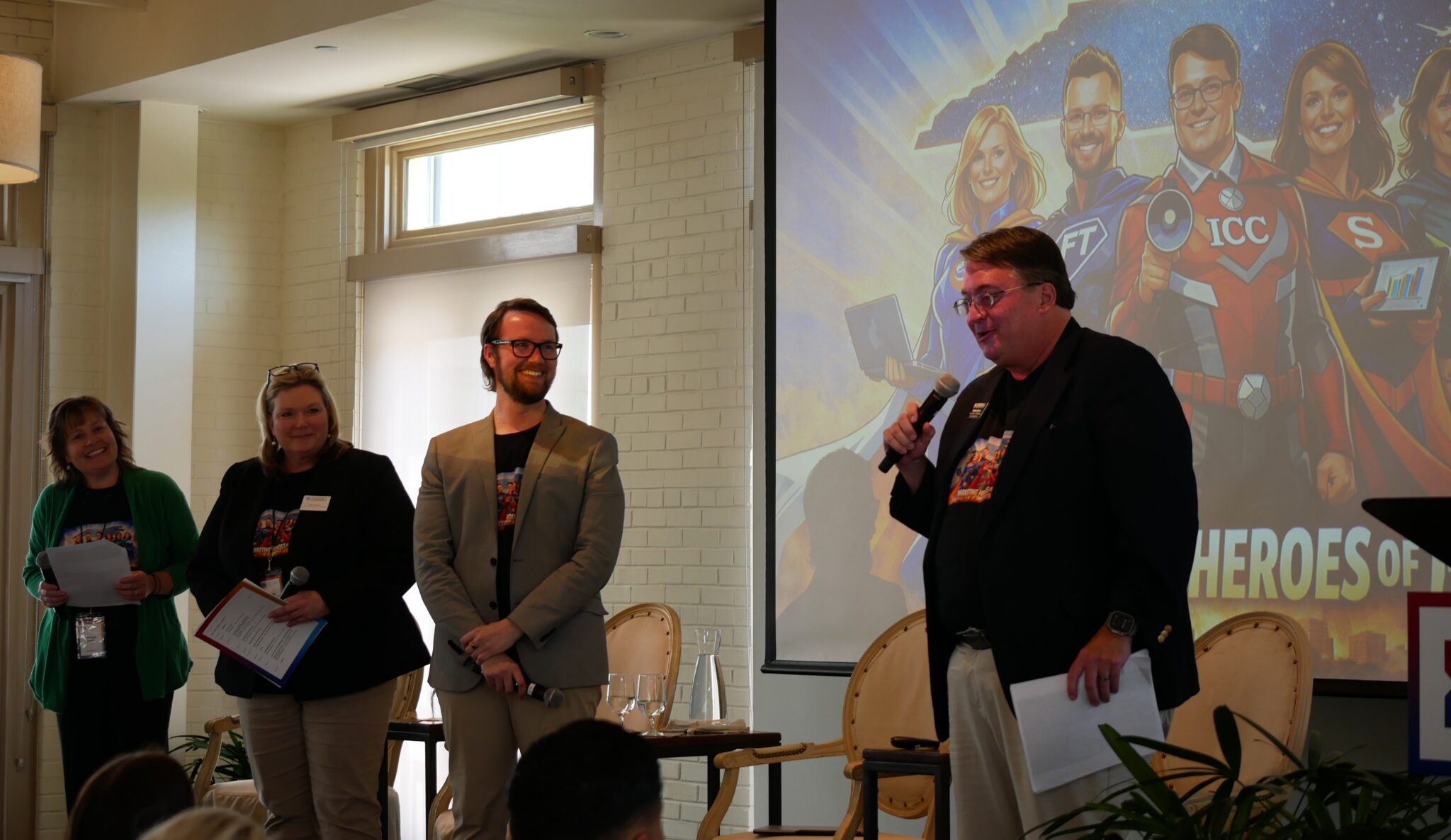
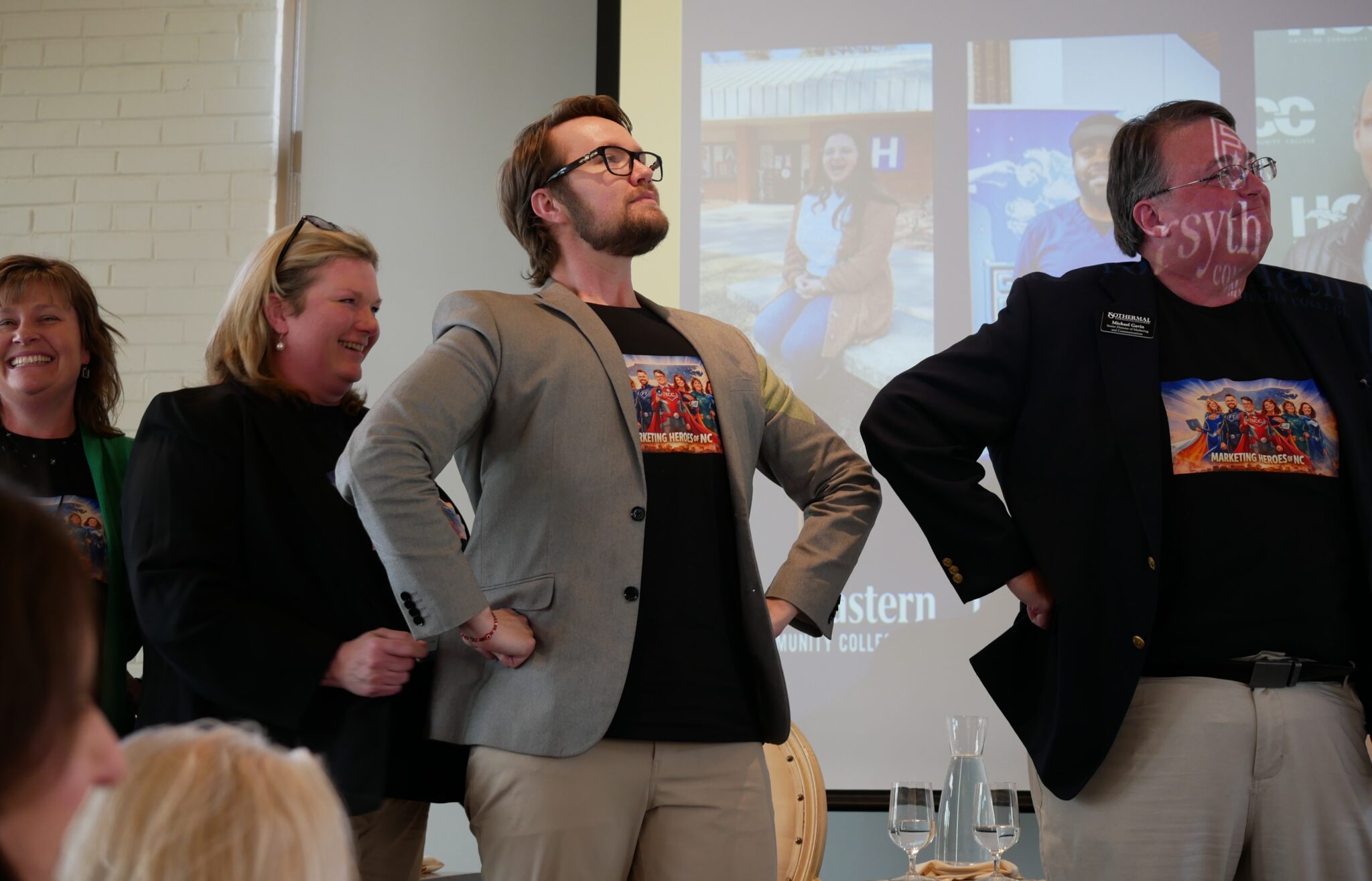
Complementing Kellett’s presentation on national research on how marketing teams can adapt their strategies to reflect trends in information consumption, a team of six community colleges involved in NC Reconnect surveyed marketing leaders from all 58 community colleges to surface what college leaders can do to better support marketing teams.
First, marketing brings students into a colleges’ “front door” and drives enrollment, said Michelle Harris, executive director of enrollment and communications at Haywood Community College.
This is particularly true for adult learners, as research from the Belk Center shows that the statewide adult reenrollment rate is 2.7% without targeted outreach. At NC Reconnect colleges, where colleges introduced targeted outreach to their some-college, no-degree population, that number is 20%, according to the Belk Center’s third edition Adult Learner Guidebook.
The panel emphasized that sustained, multichannel campaigns are a necessary investment to move a cautious audience toward enrollment.
“Adult learners need to see you everywhere,” said Tammy Sawyer, College of The Albemarle’s director of communications and marketing. This means putting advertisements on billboards, gas pumps, pharmacy prescription bags, movie theater previews, restaurant menus, and 18-wheeler trucks.
“Every impression you make, it may not be something you can measure, but it’s important because you’re keeping it in front of people,” said Sawyer.
Once adult learners have decided to enroll, Harris said, it’s also important to make sure they remain enrolled. Marketing teams, she said, can reduce friction that might cause an adult learner to stop out by helping other college departments refine and highlight their work.
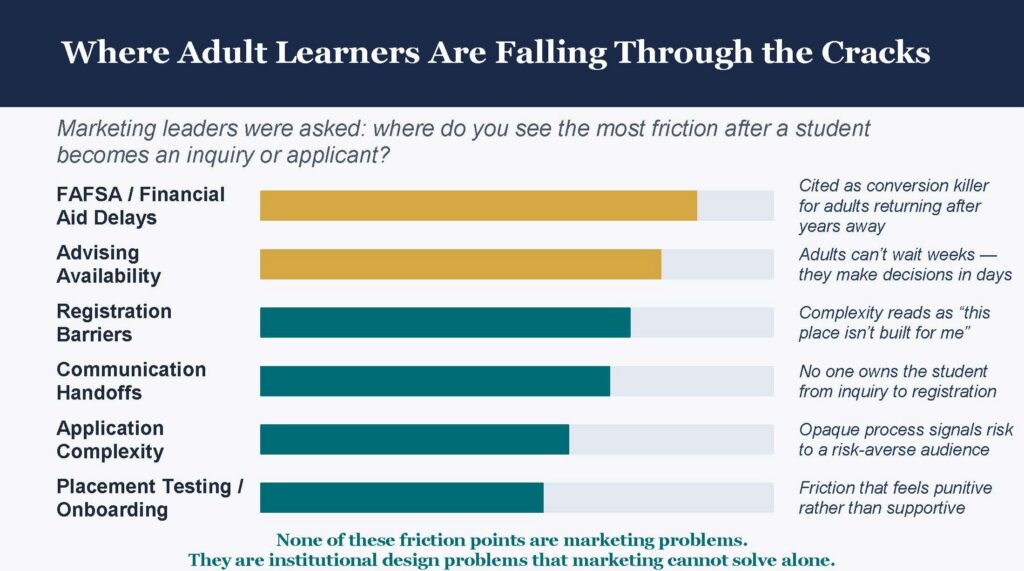
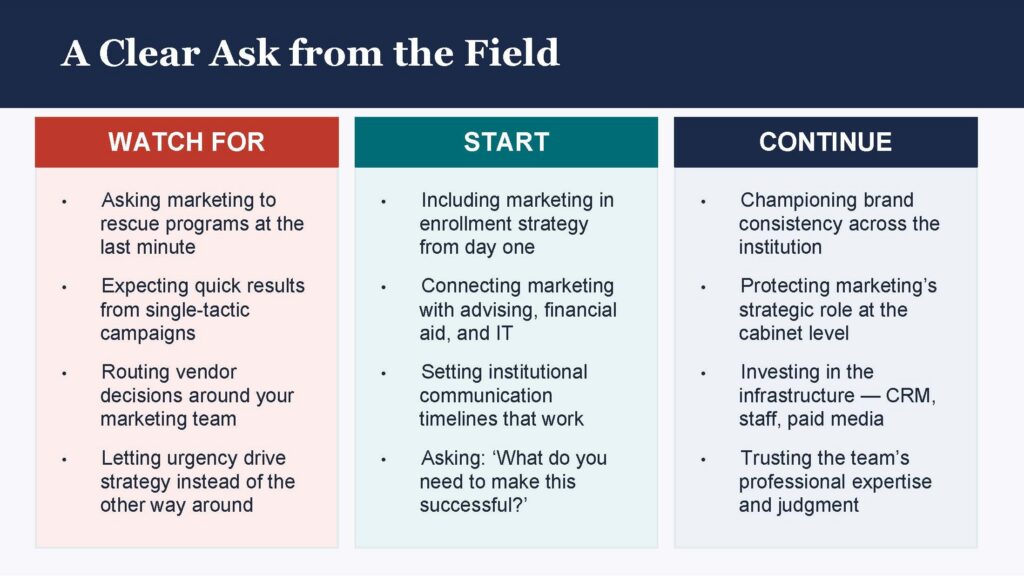
The survey also surfaced four marketing-friendly behaviors common among community college leaders:
- Include marketing at the table early. Institutional strategy should shape messaging, not the other way around.
- Bring problems to marketing teams, not prebaked solutions. Allow the marketing team to build a strategy.
- Trust data over personal preferences. Marketing teams’ campaigns are often targeted toward specific demographics within one college’s service area, so what speaks to one person might not resonate with someone belonging to a different demographic.
- Ask “What do you need?,” and mean it. Protect timelines, clear approvals, and shield teams from last-minute pivots.
NC Reconnect colleges reflect on marketing strategies that can address adult learners’ fears
Following the convening, representatives from NC Reconnect colleges gathered for their penultimate Community of Practice meeting hosted by the Belk Center.
Similar to the themes the convening brought to light, the gathering discussed marketing and communication strategies that colleges can use to reach adult students in continuing education programs.
Broadly, the group’s discussion surfaced three key themes that reflected the convening’s discussions:
- Colleges can integrate marketing strategies across their institution to improve adult learners’ collegiate experiences.
- Colleges can communicate the high return on investment, such as the $17,100 wage increase for NC Reconnect CTE credential completers, to address adult learners’ desire for short-term upskilling.
- Colleges can use institutional data to guide targeted marketing efforts and speak to different needs within service areas.
NC Reconnect colleges also discussed what it looks like in practice to address adult learners’ fears.
Kris Burris, College of The Albemarle’s vice president of student success and enrollment management, said one takeaway is to move away from generic messaging and toward addressing the actual challenges adult learners face.
“Why are we afraid to say the things that might be causing adult learners to feel fear?” she said.
Burris added that a key part of the Belk Center’s NC Reconnect research has been its focus on identifying and lifting up adult learners’ strengths and motivators.
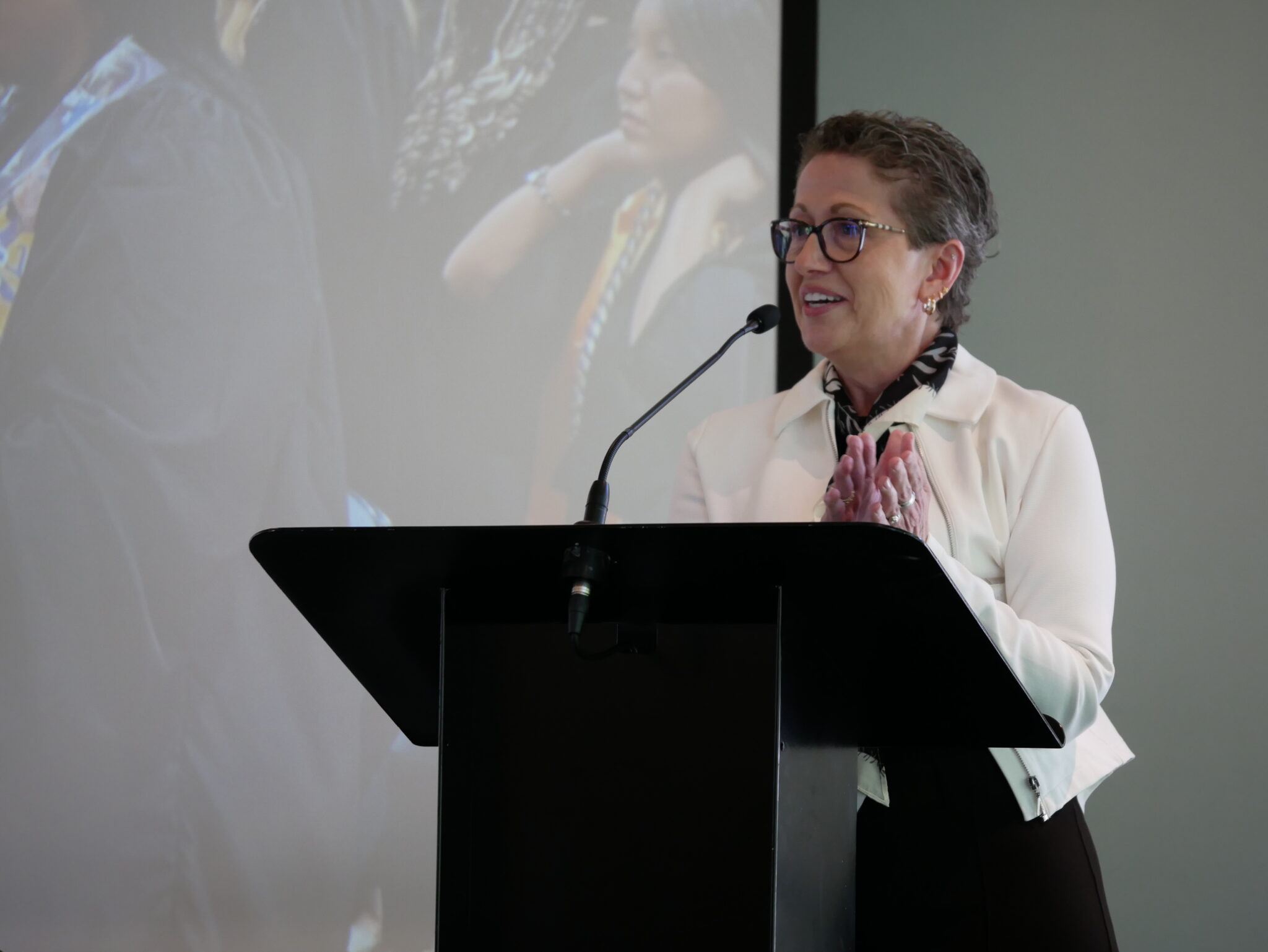
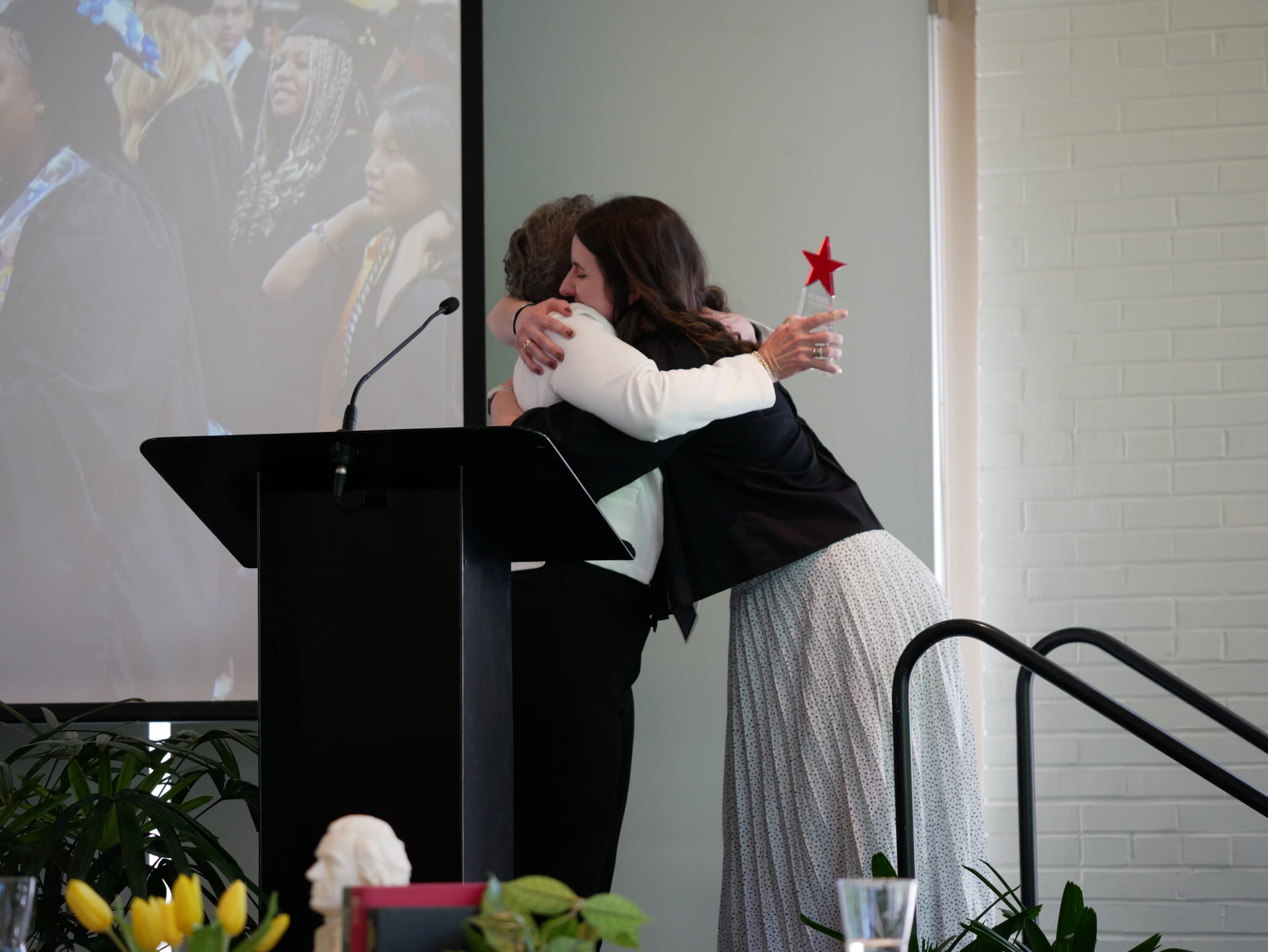
Marketing efforts, attendees said, provide an opportunity to recognize anxieties an adult learner might have about returning to school and assuage these fears by making it clear the college has resources in place to support them through program completion.
During the student panel, Bacud was asked what he would change if he were a community college president for a day. His answer was that he would want to create a culture of belonging — a sentiment echoed during the NC Reconnect Community of Practice gathering.
“So if we change this feeling of adult learners to being encouraged, being held, being supported by the college — we’re not just helping them enroll, but we’re also helping them stay. We’re helping them succeed and we’re helping them believe in themselves again,” said Bacud.
Adult learners say flexibility means grace and compassion
Brandon Burnett, a former adult learner and student success coach at Isothermal Community College, joined Bacud in sharing his story during the convening’s opening panel. His journey, like Bacud’s, represents the resilience adult learners demonstrate daily at community colleges across the state.
Burnett enrolled at Isothermal after high school, but stopped out twice after struggling with math courses and balancing school with providing care for his mother amid health challenges. Shortly after the pandemic began, he decided to enroll again, and soon encountered similar challenges. But before finalizing his decision to drop out, Burnett reached out to one of his instructors via email.
“Almost instantly, I get that call,” he said. “Her response, still to this day, says, ‘You’re not dropping out on my watch.’”
Now, Burnett’s approach to his work as a student success coach, and his advice to community colleges as they approach marketing to adult learners, mirrors that commitment from his instructor.
“Even if you only reach one student, you have mastered your skill,” said Burnett.
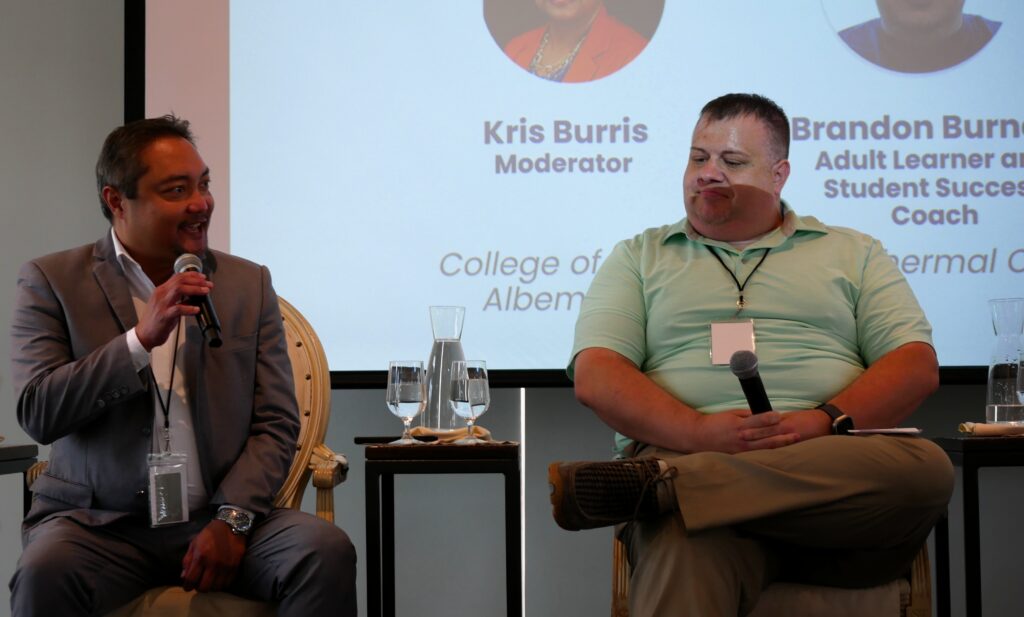
Bacud and Burnett also said that what mattered most in their journey was for colleges to acknowledge the humanity behind their experience as adult learners.
“To me, flexibility is more than just online options. It’s compassion,” said Bacud.
He said it helps most when instructors understand that “sometimes life hits hard,” making space for family emergencies, transportation problems, and other unexpected challenges that might result in a missed test or class.
“I’m going to use one word as my answer,” said Burnett when asked what flexibility looks like in practice. “I want to use the word ‘grace.’”
Burnett, who is now pursuing a master’s degree in business administration, said that the hardest experience he’s worked through as an adult learner was taking a quantitative analysis exam while sitting with his mother in a hospice care center.
Unless you have followed an ambulance with your mother, who I love and will always love, and have your school books right there beside you because you know you have an exam coming up — it would just help if instructors understood that life happens. Yes, we’ve got some students who have excuses from time to time, and they will take advantage of it, but you also have adult students, as I still am, who have a high level of respect for education.
— Brandon Burnett, student success coach at Isothermal Community College and former adult learner
Editor’s note: The John M. Belk Endowment supports the work of EdNC.