
Homeless in Hickory
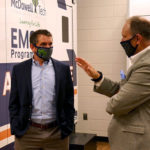

Last week, the Jamie Kirk Hahn Foundation (which I co-founded in honor of my late wife), Clark’s Promise (a Raleigh-based nonprofit focused on easing the suffering of the homeless), and the Raleigh-Wake Partnership to End and Prevent Homelessness launched a Fresh Food Challenge.
The $25,000 Fresh Food Challenge seeks innovative, partnership-based solutions to redesign how meals and nutrition reach our community’s most vulnerable. The innovation challenge offers the winning team $25,000 for implementation along with additional support from mentors and distribution partners. The winning team will design how the Oak City Outreach Center, a food distribution center supported by the City of Raleigh, and Clark’s Promise’s can enhance their culinary offerings to the homeless population.
Since the start of the Great Recession, the homelessness rate has risen in North Carolina from 4,356 people in 2008 to 11,448 people in 2014, or an increase of 162.8 percent, according to the North Carolina Coalition to End Homelessness.
Numbers alone do not tell the tale.
Gene Nichol, Boyd Tinsley Distinguished Professor of Law at UNC Chapel Hill and the head of the N.C. Poverty Research Fund, shared stories from Hickory.
I am from Lenoir, just a short thirty minute drive north of Hickory, and I have seen the ravages of the economic downturn on the area, but I have not been to the woods around Hickory where entire families live in campsites.
Nichol described the conditions:
For the first time, homelessness has become a daunting problem in the small, North Carolina city of Hickory. The Salvation Army Shelter of Hope is pressed well beyond its capacity. As a result, some 150 or so wounded souls live in the woods surrounding town. They patch together makeshift, cardboard lean-tos and dilapidated tents – keeping a wary eye for police and complaining neighbors. Some camp set-ups are simple, little more than a milk-crate for sitting and a tarp to fend off the rain. Others string together more intricate, if feeble and often porous, designs. Many campers gather in groups, though the safer course seems to be in smaller, less attention-provoking numbers.
In summer, the camps bear the oppressive markers of the South – intense heat, draining humidity, sudden rainstorms, relentless mosquitos, yellow jackets, gnats, and snakes. In winter, snow and frost pose distinct and more direct dangers. More than one homeless struggler has perished against the cold. About a third of those “living out” are women. Some are kids – though their parents work hard to hide them – fearing abuse and neglect proceedings at the hands of the state. All share conditions and perils that are deplorable. Their circumstances make it hard to remember Hickory is an “All-American City” and even tougher to recall this is the richest major nation on earth.
Roger Cornett and the fifteen or so volunteers of the Open Door Homeless Relief Project – run out of the basement of a tiny Baptist Church in nearby Conover – spend much of their days and nights, and almost all of their resources, trying to keep those living in the woods of Hickory whole, safe, well, warm, and alive. Cornett is a 61 year old, retired executive who suffers from a debilitating neuromuscular disorder. He doesn’t look the part of the heart-on-the-sleeve-do-gooder, as he crisscrosses the county in a battered pickup truck, NRA sticker prominently displayed. But Cornett and his fearless cohorts venture into often-dangerous campgrounds distributing tents, tarps, food, cook stoves, blankets, trash bags, clothing, portable heaters, and even dog food. “I never took well to retirement,” Cornett explains. “I couldn’t believe people were being left to live like animals in my own home county.”
“God calls us to do what we can,” Cornett allows, “I’m no angel.” The shelter is “overwhelmed,” he says, so folks can’t stay. “We’re not spoken of very openly,” Cornett reports, “because what we do is technically illegal – there’s a law against urban camping in Catawba County.” Thankfully, they don’t always enforce it.
The stories of those living in the camps are tough to hear. A young pregnant woman indicates she’s living in a tent until the baby comes. Cornett says he “has four pregnant women in the woods now – we try to help with medicine and transportation to the doctor or the hospital.” In an August heat near 100 degrees, before one of my visits, he spends much of a day getting fresh water and an ice cooler to a difficult to locate young woman living with two children.
This reality runs counter to the narrative I hope is true for our state and our communities.
I plan to visit these woods, Mr. Roger Cornett, and the families of Hickory soon enough.
Note from the author: Donations can be made to the Open Door Homeless Relief Program, PO Box 51, Conover, NC 28613