
Federal health officials update child immunization schedule, reducing number of recommended vaccines

The Centers for Disease Control and Prevention (CDC) updated the U.S. childhood immunization schedule this week, reducing the number of routine recommended vaccines for all children from 17 to 11.
The move followed an announcement of the recommendations by federal health officials on Monday, citing a scientific review “of the underlying science, comparing the U.S. child and adolescent immunization schedule with those of peer, developed nations.” In December, President Donald Trump directed the secretary of the U.S. Department of Health and Human Services (HHS) and the acting director of the CDC to “examine how peer, developed nations structure their childhood vaccination schedules and to evaluate the scientific evidence underlying those practices.”
“After an exhaustive review of the evidence, we are aligning the U.S. childhood vaccine schedule with international consensus while strengthening transparency and informed consent,” said HHS Secretary Robert F. Kennedy Jr., who has long advocated to reduce the number of required childhood vaccines. “This decision protects children, respects families, and rebuilds trust in public health.”
 Sign up for the EdDaily to start each weekday with the top education news.
The new schedule “represents one of the most dramatic changes in childhood disease prevention policy in decades,” according to the Yale School of Public Health.
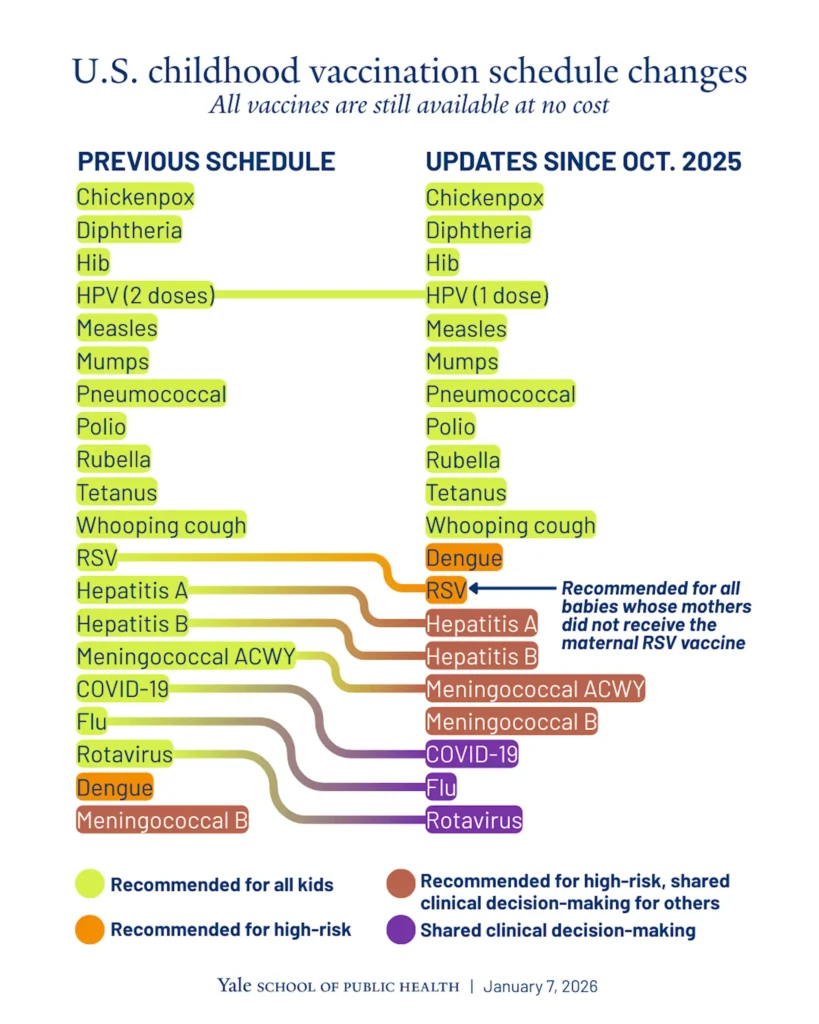
As of this week, HHS and the CDC no longer broadly recommend vaccines for six viruses: rotavirus, COVID-19, influenza, hepatitis A/hepatitis B, some forms of meningococcal disease, and respiratory syncytial virus (RSV). Instead, the vaccines will only be recommended for certain high-risk groups or involve shared decision-making between parents and health care providers.
The CDC still recommends children get vaccinated for the following illnesses: measles, mumps, rubella, polio, pertussis, tetanus, diphtheria, Haemophilus influenzae type B (Hib), pneumococcal disease, human papillomavirus (HPV), and varicella (chickenpox).
Under the new recommendations, the CDC said it will continue to organize the childhood immunization schedule in three categories:
- Immunizations recommended for all children
- Immunizations recommended for certain high-risk groups or populations
- Immunizations based on shared clinical decision-making
Insurance companies are required to cover all vaccines in the three categories, a press release from the CDC said, meaning that insurance will continue to cover the vaccines no longer recommended for all children.
“All immunizations recommended by the CDC as of December 31, 2025, will continue to be fully covered by Affordable Care Act insurance plans and federal insurance programs, including Medicaid, the Children’s Health Insurance Program, and the Vaccines for Children program. Families will not have to purchase them out of pocket,” a CDC fact sheet says.
States have the authority to mandate vaccinations, but recommendations from the CDC greatly influence state regulations. According to a report from The New York Times, the new schedule “circumvents the detailed and methodical evidence-based process that has underpinned vaccine recommendations in the nation for decades.”
“The abrupt change to the entire U.S. childhood vaccine schedule is alarming, unnecessary, and will endanger the health of children in the United States,” Dr. Helen Chu, a physician and immunologist at the University of Washington, told the Times.
Chu, who is also a former member of the federal vaccine advisory committee, said federal officials did not present evidence for the changes or incorporate input from vaccine experts.
“Already, parents are worried about what they are hearing in the news about safety of vaccines, and this will increase confusion and decrease vaccine uptake,” Chu said.
In North Carolina, before the updated CDC guidance was announced, the N.C. Department of Health and Human Services (NCDHHS) published an updated immunization schedule in October.
State officials say they don’t anticipate any changes to clinical guidance regarding childhood vaccines following the CDC changes, according to a report by ABC 11.
“People need to be aware that the risk of being exposed is growing,” said NCDHHS Secretary Dr. Dev Sangvai.
You can view the new CDC immunization schedule on the CDC website. You can also view a CDC fact sheet with information about the changes, insurance coverage, and more.
Below, you can find the N.C. immunization schedule. You can also find more information on the vaccine requirements for North Carolina school-aged children on the NCDHHS website.
Increase in spread of respiratory illnesses
The CDC immunization changes come as North Carolina is experiencing an increase in the spread of the flu and other seasonal respiratory illnesses.
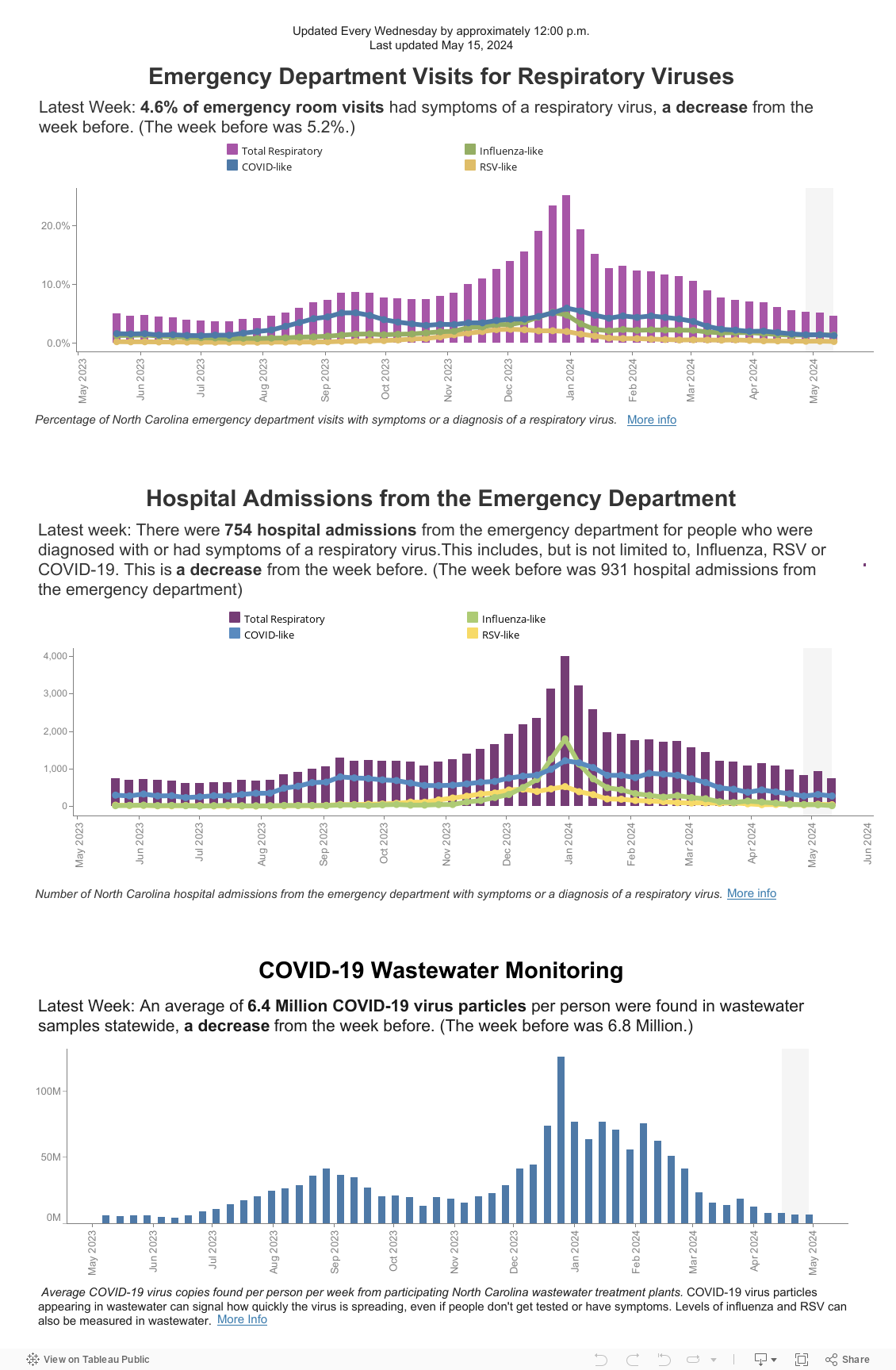
The North Carolina Respiratory Virus Summary Dashboard tracks the spread of respiratory illness in the state, including COVID-19, flu (influenza), and RSV.
As of Jan. 7, 20.4% of emergency room visits had symptoms of a respiratory virus, the dashboard shows, a decrease from the week before, at 25.3%. This week represents the first decrease since Nov. 1, when the percentage was 5.4%.
Hospital admissions from the emergency department for people with symptoms or diagnoses of a respiratory virus followed the same trend, with 3,419 hospital admissions last week — up from 841 the week of Nov. 1.
Last month, NCDHHS also reported an increase in flu-related deaths compared to last season.
“Flu is spreading quickly across North Carolina,” said State Epidemiologist Zack Moore in a press release. “The influenza vaccine remains the most important tool to prevent serious illness or death from flu. It’s not too late to protect yourself and your loved ones.”
At the time, no flu-related deaths in children had been reported in North Carolina. However, one week later, on Dec. 17, the department reported the first pediatric flu-related death for the 2025-26 flu season, from western North Carolina.
In response, NCDHHS urged families to vaccinate their children six months and older for the flu.
“This is a tragic reminder that flu infections can be serious or even deadly,” Moore said in a press release. “If you or your loved ones have not received the flu vaccine this season, I hope you will consider doing so to help protect yourself and your community.”
At the same time, North Carolina — like many other states — is also seeing an increase in measles cases.
According to the New York Times: “Mistrust of vaccines has already led to a steady decline in vaccination rates and a resurgence of preventable diseases like measles and pertussis, or whooping cough. In 2025, the United States recorded more cases of measles than it had in any year since 1993. Later this month, the country may lose its official measles elimination status, which it has held since 2000.”
In North Carolina, on Dec. 17, NCDHHS announced possible measles exposure in Wake County due to a person who traveled through the Raleigh-Durham International Airport while infectious. On Dec. 31, NCDHHS announced a case of measles in an unvaccinated child in Polk County, following a visit to Spartanburg County, South Carolina, where there is a large ongoing measles outbreak. The child has since recovered, a release said. On Jan. 3, the department also announced possible measles exposure in Gaston County.
And on Tuesday, NCDHHS and the Buncombe County Health and Human Services (BCHHS) Division of Public Health announced additional cases of measles in three siblings in Buncombe County. According to a press release, the family had also visited Spartanburg County, approximately 1-2 weeks before the children became sick.
“NCDHHS has been in communication with the South Carolina Department of Public Health since the beginning of their measles response,” the release says. “NCDHHS recommends all unvaccinated individuals ages one year and older receive measles vaccination to protect themselves and those around them.”
As of Dec. 30, 2025, the CDC has reported 2,065 people from 44 states as confirmed measles cases, the release said. This marks the highest number of measles cases reported in the U.S. since the second dose of the MMR (measles-mumps-rubella) vaccine became widely used in the early 1990s. One other case of measles was identified in a North Carolina resident in 2025, the release said.
“People need to be aware that the risk of being exposed to measles is growing,” Moore said in a press release. “Measles can be a very serious disease, so staying up to date on all recommended vaccines by checking with your health care provider is an important step we can all take to protect the health and well-being of our loved ones and our communities.”
You can learn more about vaccine recommendations in North Carolina here. You can also view the NCDHHS Respiratory Illness Communications Toolkit, available in English and Spanish.