
During ‘Arts in Our Schools Month,’ how one NC district is prioritizing arts education
As North Carolina recognizes Arts in Our Schools Month, the state’s largest public school district aims to set an example with its new five-year plan for arts education.
Wake County Public Schools System’s (WCPSS) visual and performing arts strategic framework, titled “Elevating Arts Education,” was presented and backed by the district’s school board and superintendent in May 2025. The plan came after almost a year of gathering data and meeting with stakeholders to form goals and priorities, the district said.
“Supporting the arts is not optional — it is an investment in the whole child, in school culture, and in the future of our communities,” Robert Taylor, WCPSS superintendent, said in an email. “When districts prioritize the arts, students become more engaged, confident, and capable, and the impact lasts a lifetime.”
 Sign up for the EdDaily to start each weekday with the top education news.
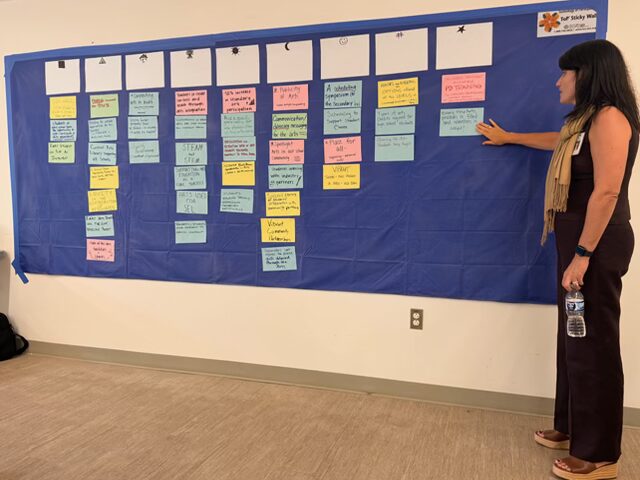
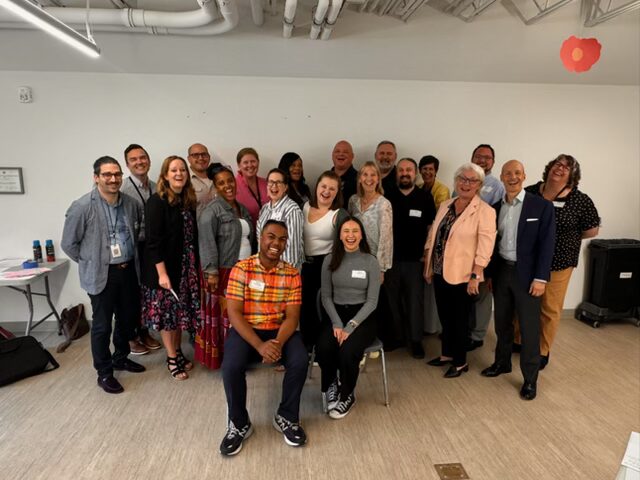
In a presentation to the WCPSS board, Jeremy Tucker, district arts education director, described the two-day planning session that got the framework off the ground. The planning committee consisted of teachers, administrators, and community members. Their initiative was grounded in the belief that arts are essential to a well-rounded education, Tucker said.
As defined in the presentation, the goals were to ensure equitable, high-quality arts instruction for students across the district and to create a unified path for learning in all the arts disciplines.
According to James Daugherty, who heads the southern division of the National Association for Music Educators, the planning process was set up to be successful from the beginning. He said this was because of the diversity of perspectives and experiences brought to the table.
“I know that if this model were kind of duplicated and replicated in other school systems in the state, the audience that gathers to do the work might not be as large, but the kind of people that came to the table are very important,” Daugherty said.
‘Equitable access to arts’
Tucker also presented how the visual arts strategic framework was intentionally aligned with WCPSS’ strategic plan. The framework was particularly aligned with the priorities of student knowledge and skills, and student dispositions and well-being.
Some of the data the committee used for planning included a qualitative survey with over 300 responses from principals, assistant principals, and art teachers.
According to the survey, the top strength of WCPSS arts programs is the quality of instruction. However, there are a few barriers educators said they face. The presentation of the survey results highlighted the number of qualified teachers, support from administrators and the school board, equipment, instruments, and facilities as challenges.
Barina Bailey, a music instructor in WCPSS who was on the planning committee, said that there was still so much to be done. The teacher encouraged arts educators to continue advocating for their programs. An example Bailey gave was inviting administrators, community members, and board members to concerts.
“Students of WCPSS will definitely benefit from equitable access to arts opportunities in all schools and communities,” Bailey said. “Students will be able to grow in confidence, engagement, and a sense of belonging, which result in better attendance rates.”
The plan presented has four strategic directions with specified goals and actions.
- Investing in human and physical resources, like establishing baseline data on student access to the arts and participation metrics.
- Aligning resources and leadership for growth, including developing a needs assessment.
- Educating essential partners on the value of the arts, by forming messaging and a marketing strategy.
- Maximizing opportunities in the arts for students outside of coursework, including internships and externships with arts teachers and industry partners.
More on arts education
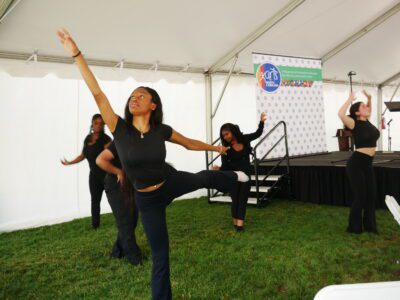
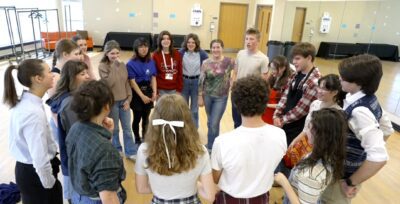
The planning committee also analyzed all of the arts education courses WCPSS offers and student participation. Student participation in arts courses drops between the sixth and eighth grade, the committee found, as students get more elective options available to them. The decline is more significant in high school because there is a limited availability of advanced arts courses and high schoolers have competing academic priorities.
When EdNC asked about best practices for districts who want to build their own framework, Daugherty emphasized the importance of collecting data. Data collection could look like analyzing how equitable arts education opportunities were and course scheduling, for example.
“I had a principal once — who became my superintendent, and she said, ‘You value what you measure, and you measure what you value.’ And if you don’t get some data, you don’t measure what’s going on in your arts program, how do you know that it’s effective?” Daugherty said.
The framework lists several points for WCPSS to achieve in the next three to five years:
- Equitable access to ample resources,
- Vibrant community and industry partnerships,
- Dynamic arts-rich Classrooms,
- Increase in artistically engaged students,
- Focused celebratory advocacy,
- Accessible and comprehensive creative programming, and
- Well-supported exemplary educators.
‘Arts in Our Schools’ Month 2026
In North Carolina, arts education means students taking courses in music, dance, theater arts, visual arts, and more.
State leaders take time this month to highlight the strides of arts students and educators. In his proclamation of the month, Gov. Josh Stein said, “all students participating in arts education courses benefit from the skills and processes developed through the arts and apply those skills in a variety of disciplines and settings no matter their intended career path.” You can read the full proclamation here.
The Department of Public Instruction (DPI) is partnering with the North Carolina Department of Natural and Cultural Resources to host eight local school groups in performance venues around downtown Raleigh to celebrate the month. See the performance schedule below, with each performance starting at 11:30 a.m. and available to stream on DPI’s YouTube.
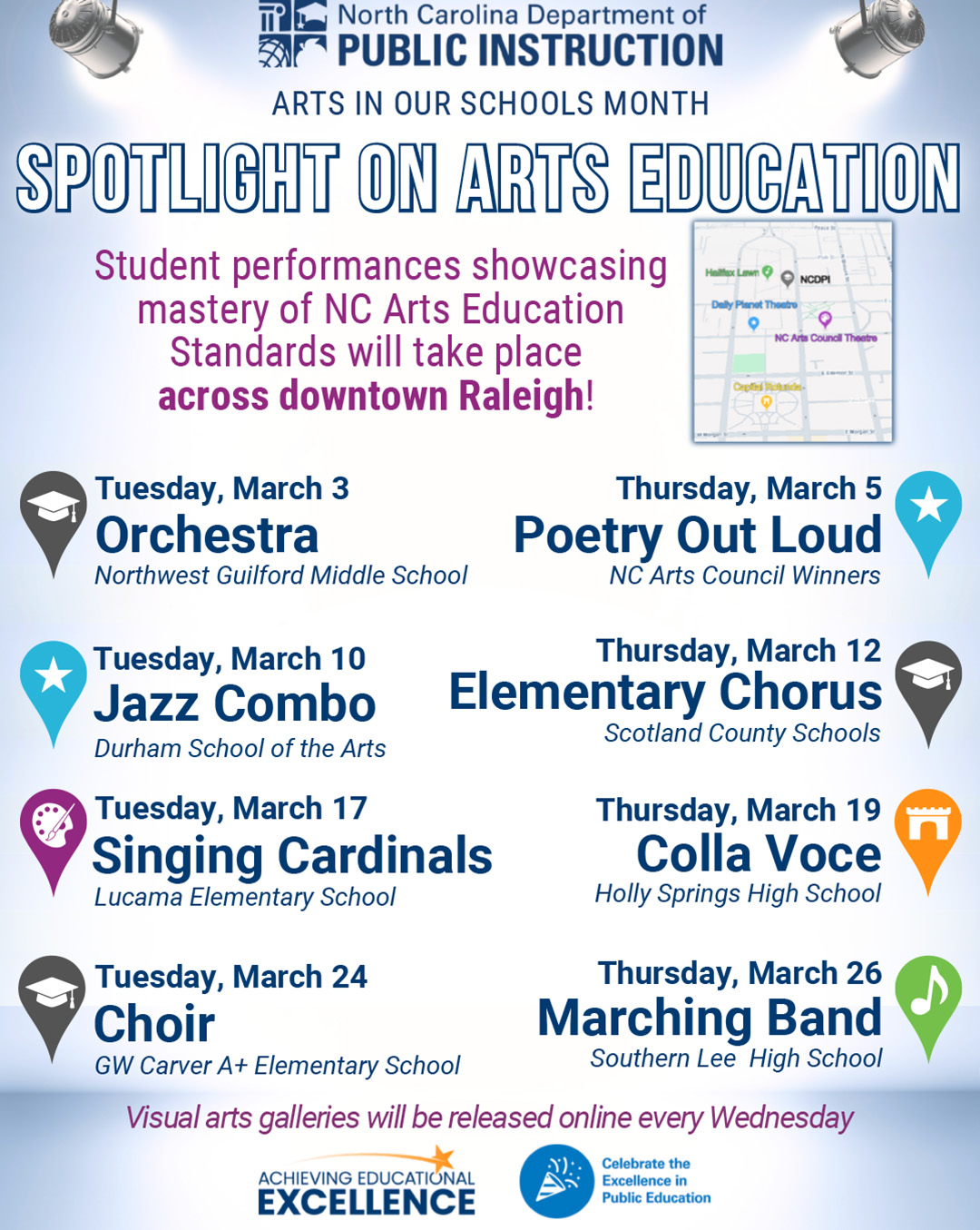
“We are looking forward to celebrating the excellence in public education and recognizing the importance of arts programming in our K-12 schools as we showcase the artistic talents of these North Carolina Students!” DPI said in a newsletter.
More information is available on DPI’s arts education website, Comprehensive Arts Education Guide, and NC Arts Education newsletter, which is available for public sign up.
To support arts education, arts exposure, and arts integration, DPI also works with the N.C. Symphony, N.C. Art Museum, N.C. Arts Council, A+ Schools of North Carolina, and N.C. Arts Education Leadership Coalition (AELC).
Arts North Carolina will be hosting its annual conference on May 12, followed by a legislative day on May 13. Attendees of the conference will get to network with arts educators and stakeholders and learn how to navigate funding in a changing environment.
Several national organizations are also working toward recognizing the importance of arts education.
The National Art Education Association has a five-year grant to create nationwide virtual Professional Learning Communities (PLCs) with educators in visual arts, music, theater, dance, and media arts called Connected Arts Networks (CAN).
And the Arts Education Partnership is a national network of more than 200 organizations dedicated to advancing arts education. Here is the AEP website. AEP offers a 50-state analysis of arts and education policies.
How you can get involved in arts and education
The North Carolina Arts Council
The N.C. Arts Council leads and invests in innovations in arts education, including A+ Schools; Poetry Out Loud; Traditional Arts Programs for Students (TAPS), a hands-on after-school program; and artist residency grants.
The council curates this comprehensive list of arts education resources in North Carolina and nationally.
A+ Schools
“Established in North Carolina in 1995, A+ Schools is a signature program of the North Carolina Arts Council. A+ is the longest-running, arts-based whole-school reform model in the nation,” according to the council’s website.
Find out what your school’s assets and barriers are for implementing effective arts education, what they suggest, and work with your principal to address the challenges and create opportunities for more students. From principals to Congress, Arts North Carolina provides an interesting analysis of who does what when it comes to arts and education policy.
Have additional arts education resources to share? Tell us what we missed by emailing me at cbrown@ednc.org.