
Emma Adam: The role of discrimination in health and attainment

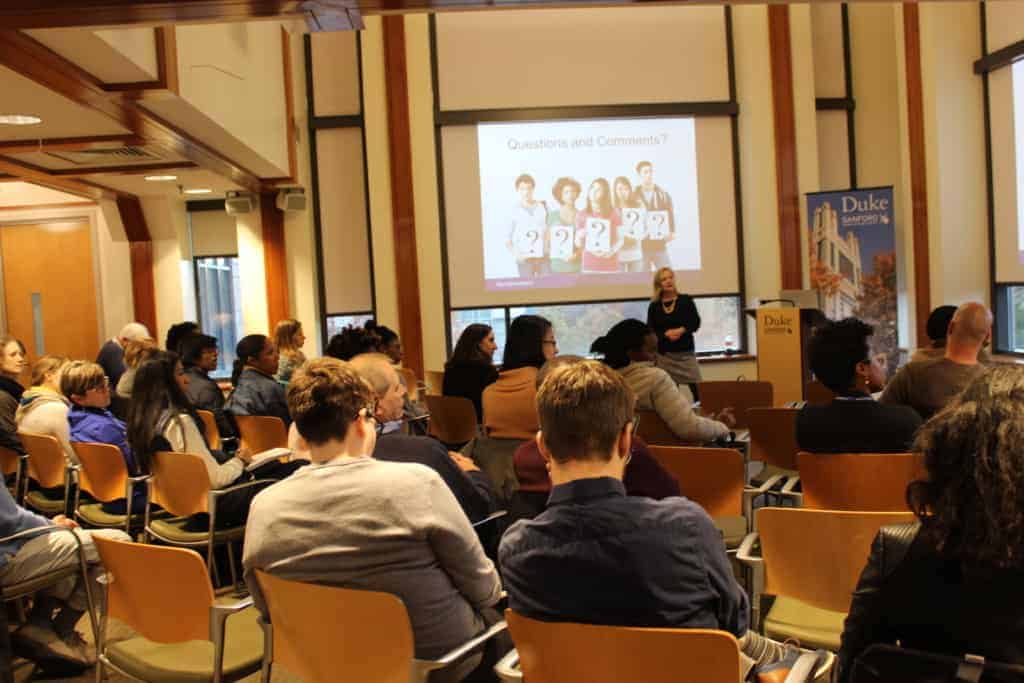
Emma Adam, professor of human development and social policy at Northwestern University, came to Duke on Dec. 5 to share her research in a lecture titled, “How Discrimination Seeps In: Implications for Health and Attainment.” Hosted by the Duke Center for Child and Family Policy, Adam provided insight on racial and ethnic disparities remaining in health and educational outcomes.
“African Americans have higher death rates than whites for 12 of the 15 leading causes of death,” Adam stated in her presentation. Her research aimed at examining a reason for these disparities outside of factors like socioeconomic status or structural reasons.
She asked the question, “What about racial disparities in experienced stress?” Her hypothesis was that psychological stress associated with being a member of a racial or ethnic minority and the biological responses elicited by that stress may be one factor contributing to disparities.
“Stress is more than a feeling,” she said, explaining measurable health responses to stress. Her research, including a 20-year longitudinal study, found that acute and chronic stress is associated with shorter sleep and lighter sleep, which leads to increased fatigue, moodiness, and impaired attention, cognition, and memory.
These disparities in sleep are also measured. “African American kids sleep about half an hour less per night compared to white kids,” Adam said.
Adam’s research also focused on one factor: perceived racial discrimination. Through her studies, she found that the largest differences in perceived racial discrimination were in young adulthood. Still, Adam said, the differences in perceived discrimination had impact across the lifetime of those individuals.
This matters because early perceived racial discrimination during adolescence is the stronger predictor of adult stress biology, and her studies discovered racial differences in cortisol levels throughout the day.
Is there a solution to a person’s #stress response to #racial #discrimination? Yes! : A positive racial and ethnic #identity. @DukeSanford
— Yasmin Bendaas (@yasminbendaas) December 5, 2018
But can these lifelong stress impacts be mitigated? Is there a solution to a person’s stress response to racial discrimination?
Adam said yes, through a positive racial and ethnic identity. And having a positive ethnic identity also didn’t just lead to better health outcomes, it led to higher levels of academic attainment, too.