If you’ve attended a conference or training related to infants and toddlers in the last few years, you’ve likely heard someone use the term Early Relational Health (ERH).
“Early Relational Health is the state of emotional well-being that grows for a child when there’s an emotional connection between them and their parents or caregiver,” said Kelsey Smith, executive director of the North Carolina Infant and Early Childhood Mental Health Association.
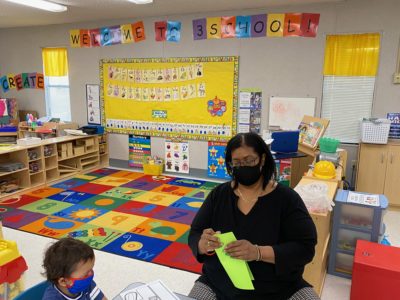
Because early childhood educators spend so much time with the infants and toddlers in their care, they play a crucial role developing those feelings of well-being that set young learners up for a lifetime of healthy relationships.
 Sign up for the EdDaily to start each weekday with the top education news.
Understanding Early Relational Health
The term Early Relational Health first emerged in 2011 from the American Academy of Pediatrics (AAP), which defines it as:
A framework that explores the role of early relationships and experiences in healthy development across a child’s lifetime. Relationships, especially in the early years, are biological necessities to build a foundation for lifelong growth and development.
AAP emphasizes that relationships between infants/toddlers and their caregivers — family, educators, medical professionals, etc. — should be safe, stable, and nurturing. AAP outlines these characteristics:
- Safe: The relationship is free of physical or psychological harm. Children believe their caregivers will protect them.
- Stable: The adult is dependably there for the child. Children believe their caregivers will meet their needs.
- Nurturing: The child’s physical, emotional, and developmental needs are sensitively and consistently met. Children believe their caregivers will use warmth and clear expectations to foster their development.
“When I think about Early Relational Health, it is developing the capacity of a kid to have healthy relationships,” said Dr. Elizabeth Erickson, a Durham-based pediatrician who has embraced ERH in her own practice and through her work with THRIVE Family Health & Education Center.
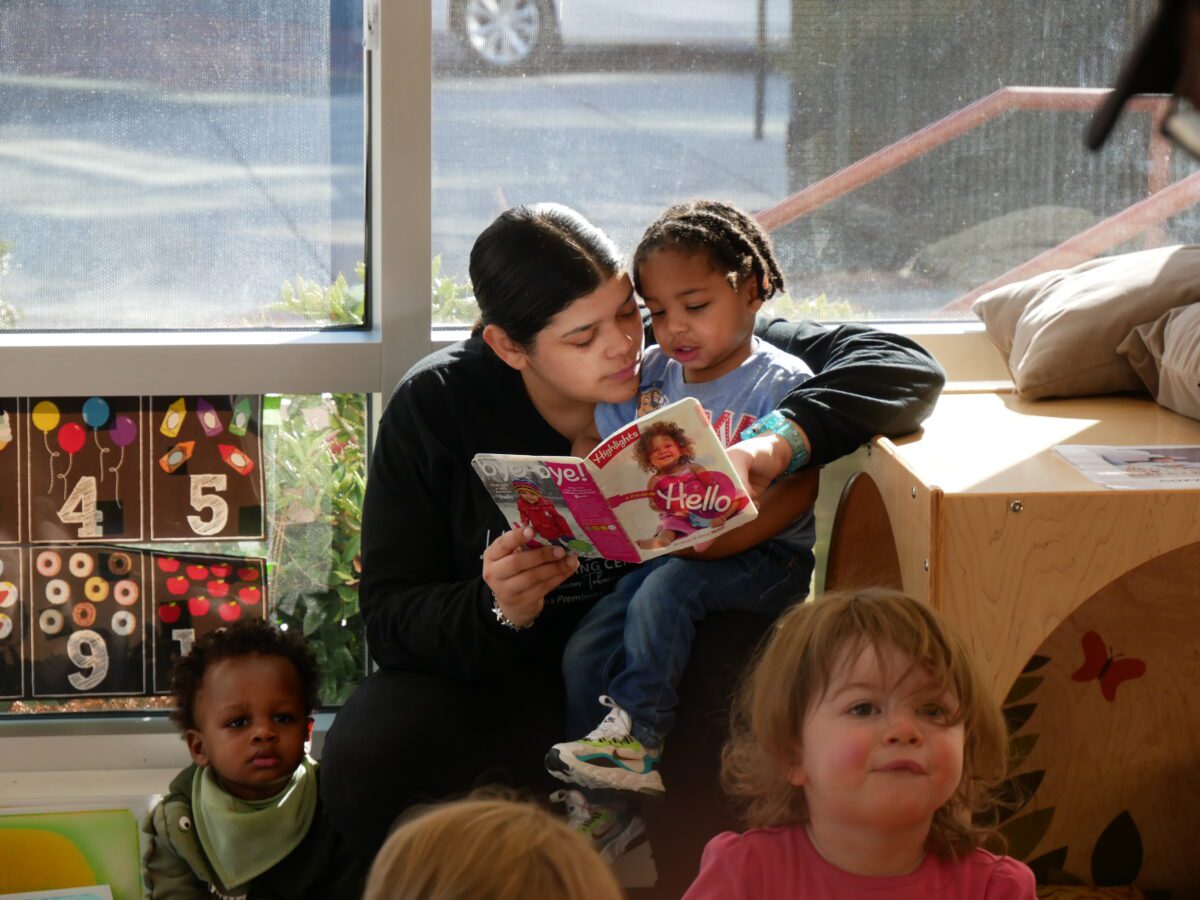
Erickson shared this example of what ERH can look and feel like through the simple act of reading with a toddler:
When you’re sitting on the floor criss-cross-applesauce, and a toddler scoots back and plops in your lap, you’ve got the weight of them, and they’re getting the feeling from you of being a safe and secure place. You are more than a person. You are a place to them.
In this example, both the toddler and the adult feel connected to one another through their shared attention and physical presence. The toddler is getting the added benefit of learning that relationships can be safe, stable, and nurturing.
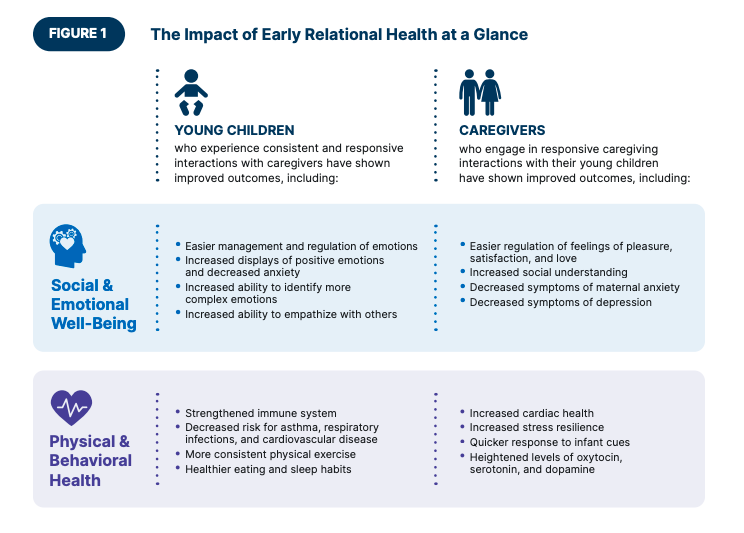
According to a 2025 report from the National Academies of Sciences, “ERH also affects children’s development by serving as a protective factor that can buffer against the adverse impacts of stressors, challenges, and adversities.”
Smith emphasized that any adult who interacts with infants and toddlers can play a part in promoting ERH. She recommends considering a credential such as the Infant and Early Childhood Mental Health Endorsement.
“What it is that protects against the bad outcomes are positive, nurturing relationships,” Smith said. “It is that secure attachment and relationship that’s a buffer against the negative outcomes of trauma and toxic stress.”
She said the more adults in the world who have the capacity to support ERH, the more likely infants and toddlers are to benefit from its protective factors.
ERH in early care and learning
Early childhood educators — teachers at a licensed child care center or a family child care home, as well as friends, family members, or neighbors who care for children — are some of the most important adults in the lives of infants and toddlers.
That’s why Smith and Erickson both say it’s essential to support the well-being not just of parents and families, but teachers too.
“Children spend a lot of time with other adults besides their parents: how well are those people who are taking care of children?” Smith said. “These are the people shaping our young children and our next generation, and if they’re not well, then that really impacts the relationship and how well our children are going to grow and develop.”
Smith said that when families or educators experience stress in their adult lives — such as financial strain caused by low wages and lack of health care — that can reduce their capacity for providing safe, stable, and nurturing relationships for infants and toddlers.
“The way we treat our early learning workforce, we’re diminishing their capacity,” Smith said.
Erickson agreed, and pointed to the instability experienced in the early childhood education workforce as an additional source of concern.
“One of the scariest things for me about all of the turnover in early childhood education is that it prevents those relationships from forming,” Erickson said. “I don’t think we’re talking enough about the disruption of the early childhood care system, and how that leads to a disruption in caregiver continuity, and how hard that makes it to have Early Relational Health for our little kids.”
Erickson said that while ruptures are normal in relationships — think of adults going through romantic breakups, or having falling outs with friends or family members — it’s vital that children also have the opportunity to experience repair of relationships in their earliest years.
When a licensed child care program closes or a teacher leaves the field for one with higher wages and better benefits, that’s a rupture without a repair.
The 2025 report on ERH from the National Academies of Sciences outlines several principles for embedding ERH in early childhood programs, such as:
- Co-design with family participation, local resources, and solutions to challenges in a way that is community driven and culturally specific.
- Provide sustainable reflective supervision and practices, including reflective video feedback, to practitioners at all levels of the early childhood system.
- Strengthen and sustain family leadership infrastructures in communities.
While these strategies can strengthen ERH in early care and learning settings, both Erickson and Smith pointed to the need for greater investment in the well-being of adults as the path to improved well-being for infants and toddlers.
They each referenced a quote attributed to famed pediatrician D.W. Winnicott to describe how they think about ERH: “There’s no such thing as a baby; there’s a baby and someone.”
“Invest in the someones,” Smith urged.
How stakeholders can support ERH
“I think people are like, how can we invest in children, right? But Early Relational Health is about the relationships with their grown ups, so the investment needs to be in parents, in child care teachers, in child welfare professionals,” Smith said.
To that end, the National Academies of Sciences pointed to several policy opportunities for supporting ERH, including helping families meet basic needs through paid family leave, anti-poverty tax credits, increasing minimum wage, and expanding support for early care and education by addressing compensation and benefits, livable wages, and pathways for career advancement.
Smith said she thinks policymakers should be making public investments in early care and learning that are on par with investment in K-12 public education.
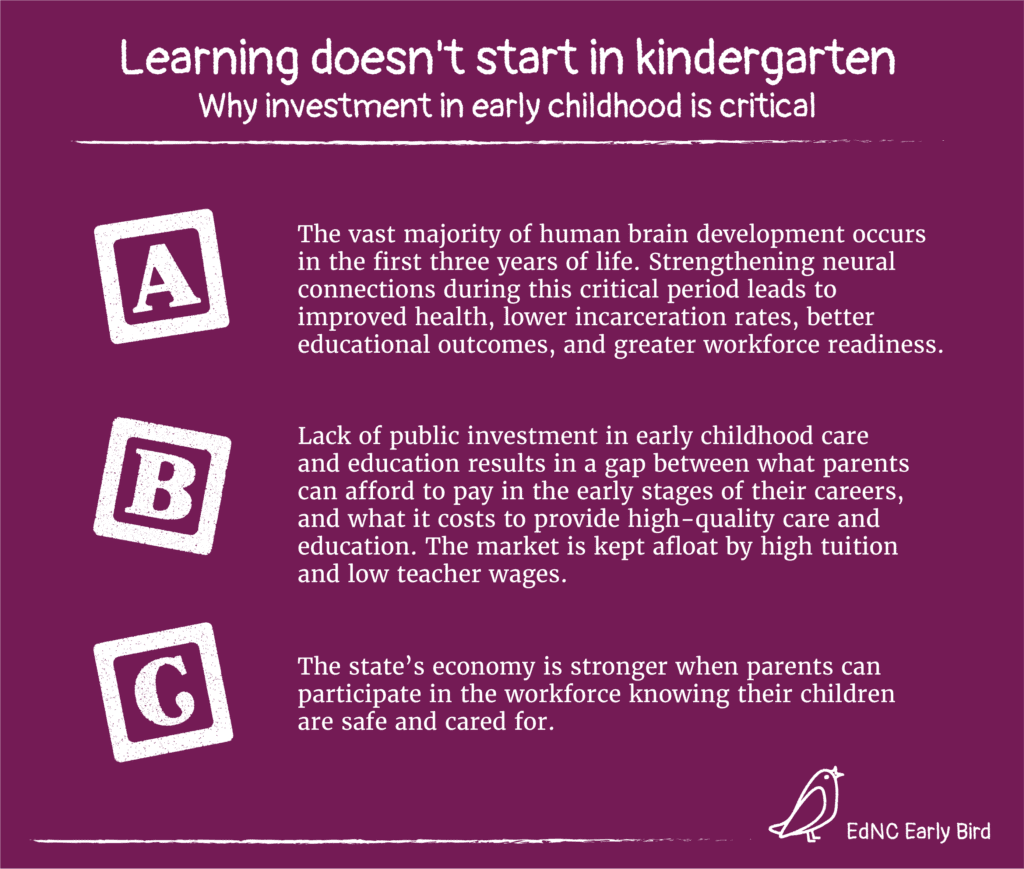
“It can’t be overstated how important the first five years are,” Smith said. “It is the most important time period for our brains’ development.”
Erickson also wants to see greater public investment in policies that support ERH. And she sees an opportunity for philanthropists to rethink how they go about grantmaking in this space, especially when it comes to measuring outcomes.
“One of the things that I think is hardest in this domain is we’ve not figured out how to measure it,” Erickson said. “There’s no Toddler Butt Scoot index.”
In lieu of such an index, Erickson said she would like to see more “trust-based philanthropy,” such as grants that take into consideration the time it takes to build relationships and produce recognizable outcomes.
“Can I measure within a grant cycle that having consistent caregivers in an early childhood education setting changes outcomes for kids?” Erickson asked. “Relationships matter, and the relationships that we in our community have with our babies, and the health of those relationships, is foundational to the health of our society.”
Recommended reading