
Community responses to dual language closures in NC highlight importance of programs

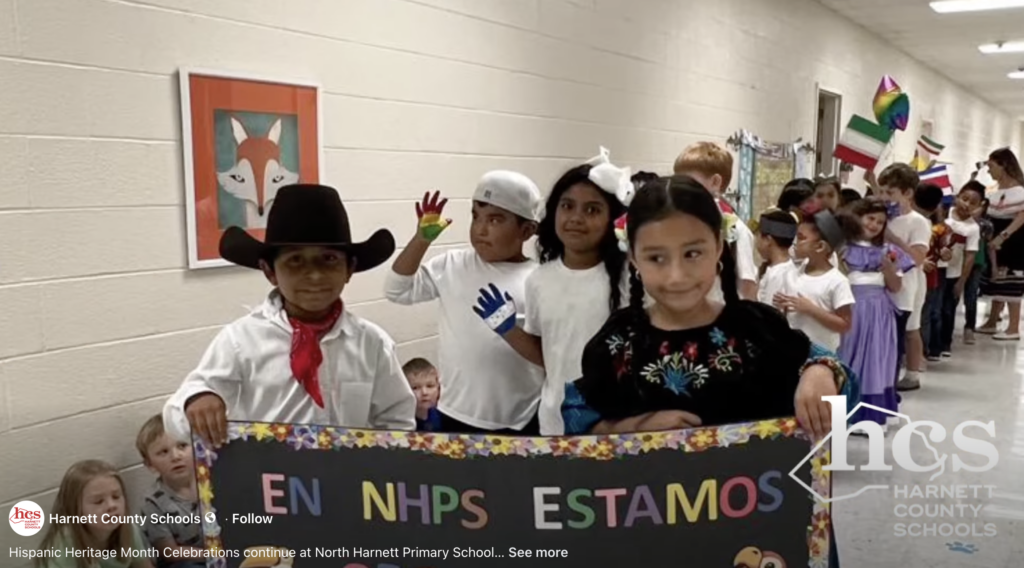
Hundreds of Harnett County Schools (HCS) students began this new school year under a major change.
In March, families of students participating in HCS’ Dual Language Immersion (DLI) programs were notified that the district would be closing DLI at 12 schools after “thoughtful review of enrollment trends, students’ needs, and school and district priorities.” Two elementary schools — Dunn Elementary School and Highland Elementary School — will maintain their programs.
This left families with a difficult decision: Transfer to a new school and continue DLI or remain at their current school without the program.
 Sign up for the EdWeekly, a Friday roundup of the most important education news of the week.
HCS has had DLI programs in place for over a decade, with some families even considering the programs when buying homes in Harnett County.
“This is the reason why we purchased this home in this area, because we wanted our kids to have this opportunity,” said Francisco Prieto, whose children participated in the program at Coats Elementary School, according to WRAL.
“My children didn’t fail in this program. They trusted it,” Patrick Riley, another Coats Elementary School parent, said per Enlace Latino NC. “They entered a pathway. Now they’re being told that pathway no longer exists at their school.”
The interest in DLI programs is not unique to families in Harnett County. Demand for the programs has increased significantly in recent years, in part due to an understanding that bilingualism is an asset and an “increasingly attractive professional quality.”
Related reads
DLI program context
DLI programs provide instruction for students in both English and a partner language — commonly Spanish, Mandarin Chinese, Arabic, or French. They are intended to help native English speakers develop proficiency in the partner language and help English learners as they develop proficiency in English and the partner language (which may also be the language they speak at home).
Research on DLI programs has shown positive effects on student reading achievement and no harm to their achievement in math and science. Learning a second language can also help improve memory, problem-solving, and make it easier to learn additional languages down the road.
Increasingly, research has also made clear that DLI programs are an ideal way to serve students learning English (ELs). These programs have been growing consistently and are now one of the most popular trends in U.S. public education.
However, staffing DLI programs can be difficult and costly for districts — these programs require more bilingual teachers, of which there are few. U.S. Census data shows about 13% of teachers in the U.S. speak a language other than English at home, compared with about 21% of all children in the U.S.
According to a report from the Century Foundation, “Many states experience persistent shortages of bilingual teachers, and DLI administrators around the country regularly identify the limited supply of bilingual educators as the key obstacle to growing their programs.”
Data from 2021-22 the federal Office of English Language Acquisition shows there are more than 3,600 DLI programs in schools nationwide — and North Carolina has the fifth-most of any state.
History of DLI in the US
DLI programs have existed in the U.S. since 1839, when Ohio became the first state to enact a bilingual education law, allowing instruction in German and in English. Louisiana enacted a similar law for French and English in 1847.
With the Bilingual Education Act of 1968, the federal government began providing funding to support school districts implementing bilingual instruction.
“We’ve had, in the United States, more than 65 years of work around bilingual education,” said Maria Coady, Goodnight Distinguished Professor in Education at NC State University, who studies multilingual learners (ML), rural communities, and the preparation of educators who work with MLs. She also serves on the board of the National Association of Bilingual Education.
“We see, after five to seven years, the bilingual children outperform monolingual students,” she said. “So we’ve known — like the rest of the world already knows —that bilingualism is good.”
HCS consolidation
When announcing the cuts to the program at a March 2 school board meeting, Chris Pearson, then on his first full day on the job as assistant superintendent of curriculum an instruction for HCS (he previously served as assistant superintendent of auxiliary services), outlined the reasoning:
Based on staffing and a(n)… evolution of that program over the last few years, right now the plan is to continue dual immersion at Dunn Elementary School and Highland Elementary School. At multiple other of our campuses we will want to be phasing those programs out.
The original thought there on dual immersion was some language acquisition for English speakers. It has shifted heavily toward native speakers being in that program and in reality we’re not preparing them for, you know, developing the second language as they need to if they’re a native speaker in that program.
Also, class size components have really become a little bit of a hindrance. If they don’t continue through that program through third, fourth, fifth grade, you end up with a fourth grade class that has whittled down to 12 or 13 students and down the hall is a regular fourth grade class with 31 students. And so as we weighed that out, we felt like that was a transition that needed to be made. We have notified parents that those programs would continue at those two schools if they wanted to kind of seek to continue it.
— Chris Pearson, March 2 board meeting
Many families of students participating in HCS DLI programs were caught off guard. Some started an online petition. Some filed a formal complaint with the district, which was rejected by a three-member panel of the school board.
HCS Public Information Office Natalie Tucker Ferrell responded to requests for an interview with the following email:
“Thank you for your inquiry regarding our Dual Language program. Harnett County Schools remains committed to offering the Dual Language program to our students. As part of ongoing efforts to strengthen and sustain the program, the district is consolidating program locations. This adjustment is designed to ensure continued program quality, consistency, and access to resources for participating students. The program will continue to be offered within the district, with a refined structure to best support student success. Additional information will be shared directly with impacted families.”
Trend of DLI program closures
The closure of DLI programs across the country is becoming more common. As public school enrollment has declined across the country, districts have been forced to squeeze budgets.
Minneapolis Public Schools, for example, announced in 2024 that it would be making cuts to its Spanish DLI program to help cope with its $110 million deficit. Last summer, an Illinois district announced the closure of one school and the consolidation of its DLI program in response to declining enrollment.
HCS’ consolidation, however, is unique in that the decision is not primarily being driven by budget shortfalls — the district is actually experiencing enrollment growth.
But other North Carolina districts facing budget troubles are debating the issue. In June, the Chapel Hill-Carrboro City Schools (CHCCS) board voted unanimously to close Glenwood Elementary School — a magnet school home to the district’s only Mandarin DLI program. In August, the board voted to split Glenwood’s STEAM2 Mandarin program, voting to move the dual language Mandarin immersion program track to Rashkis Elementary. This month, the board voted to end the Mandarin world language program track.
CHCCS, like many other districts nationwide, has faced declining enrollment for over a decade. The state of North Carolina provides public school funding on a per student basis, so with fewer students, school districts have smaller budgets.
In its school closure study document, CHCCS said it was facing “significant financial challenges.” And, “because operating multiple school buildings is expensive, closing an elementary school(s) could assist the district budget gap by reducing the costs associated with building maintenance, utilities, fixed staffing, and ongoing capital maintenance expenses.”
“As a community we felt our program showed strong numbers and we even had families who spoke about how our magnet program specifically brought them the CHCCS district,” said Rachel Rossi, Glenwood’s PTA president, via email in September. “We felt our program was bucking the overall trend the district had been facing with declining enrollment.”
The district’s school closure study did indicate that Glenwood was projected to experience “a slight increase in student counts over the next ten years,” despite the district as a whole dealing with enrollment decline.
“Closing Glenwood has had a profound impact on our community and we understand the financial hardships the district is facing,” Rossi said. “But we feel they are misguided in shutting a school that was drawing new families to the district.”