New charter schools may need to clear higher enrollment hurdles before they’re permitted to open in North Carolina. At its monthly meeting on Nov. 12-13, the Charter Schools Review Board discussed implementing the more stringent enrollment requirements for charter schools seeking to exit the “ready to open” (RTO) planning year.
Catalysts for change include two recent mid-year closures of under-enrolled schools, along with trend data showing nearly three in four new schools fell short of enrollment projections.
 Sign up for the EdDaily to start each weekday with the top education news.
Last month, for instance, the CSRB ordered Triad International Studies Academy (TISA) to close due to enrollment below the state’s 80-student statutory minimum. The CSRB gave TISA until Dec. 30 to shut down, but the school closed immediately.
In 2023, the CSRB closed the School of Arts for Boys Academy mid-year for the same reason.
Such closures exact a high cost from families, CSRB members said.
Following TISA’s closure, members heard from very upset parents, said Bruce Friend, chair of the CSRB. But TISA’s predicament was the fault of school leaders, he said, who were familiar with enrollment minimums and also closed without utilizing the “three-month runway” the CSRB provided.
“We ultimately closed them (TISA), not because of a rule that we made; it’s in legislation that they didn’t have a minimum of 80 students,” Friend said. “Those parents are very upset, as they should be. But they should be upset at the board members of that school. They’re the ones who put your child in that situation, not us. And so, we just have to make sure we avoid that in the future.”
CSRB members also expressed concern about financial impacts and stewardship.
TISA had “a lot of their money drawn back” and couldn’t pay staff, Ashley Logue, the director of the Office of Charter Schools (OCS), said regarding the school’s rapid closure. Now, the school is selling assets to pay back the state.
More broadly, in the case of such closures, taxpayer dollars have gone “to a school that’s not going to exist,” CSRB member Eric Sanchez said.
During its November meeting, the CSRB also denied an application from Little Rock Preparatory Academy for Young Men, which hoped to serve high school boys in the Charlotte area. The CSRB also approved statewide expansion for Sandhills Theatre Arts Renaissance School’s remote charter academy and heard from 17 schools up for renewal in 2026, including North Carolina’s two virtual charter schools.
Trend data
In her presentation to the CSRB, Logue shared a five-year look at new school enrollment trends. Data from that timeframe shows charter schools are enrolling about 13% fewer students, on average, in their first year than they projected. Just 26% of schools met or exceeded enrollment projections over the last five years.
However, over the past two years, the gap between projections and actual enrollment has become “much larger,” she said.
“When we compared 2020 and 2024 … the amount of enrollment they’re able to get is just really different,” Logue added. “If it continues in that same trajectory, then I anticipate more issues.”
What’s driving the drop-off?
“What we’re seeing is that schools are not able to gain the number of students in the summer months as they previously were able to,” Logue said. One likely reason, she said, is that greater school choice options since the pandemic have made parents choosier and less willing to delay crucial enrollment decisions.
Already, OCS has made improvements to streamline the RTO year, Logue said. She proposed a number of changes for the CSRB, including:
- Requiring schools to appear in May as well as June to assess “red flags.” Historically, schools have not come to the CSRB until they’re voted on in June.
- Hearing in-depth “readiness reports” in May and June.
- Establishing clearer minimum standards for enrollment, facility, and budget.
For enrollment, the threshold for schools deemed ready has been 75% of projected enrollment.
“A lot of schools are not meeting the 75% and they’re still going on,” Logue said. “Do we want to change that?”
“I don’t think that anybody has really found the golden ticket to making sure that every school is going to open with great enrollment,” she added. “But I think this is our number one issue that we’ve seen the last couple of years, and I would anticipate we continue to see.”
In addition, Logue said the CSRB’s current reliance on 80 students for a break-even budget is problematic. “You’re too close to not making the state minimum,” she said.
Instead, OCS is proposing a 100-student minimum.
Another problem may be that schools must initiate a delay request. Many do not wish to delay, however, due to what Logue deemed “unrealistic optimism.” To combat that, the CSRB could require an automatic delay for schools that aren’t viable, members said.
Recent trends show CSRB approval levels of RTO schools are high.
“Over the last five June CSRB/CSAB meetings, the vast majority of schools were approved (28 out of 34), with only a few denials or delays, often tied to enrollment concerns,” Logue noted in her presentation.
Her overarching counsel for the CSRB was to prioritize data and be proactive. “A school’s readiness should be assessed based on concrete evidence and data, and readiness criteria should be transparent and shared early in the process,” she said.
CSRB member Rita Haire agreed with Logue’s concerns. “I encourage us to consider some really firm guidelines that don’t just rely on our judgment” when schools don’t meet enrollment projections, she said.
“What I think the data is telling us is if you’re on a trajectory where you’re flying close to the treetops on enrollment, it generally doesn’t get better,” CSRB member Eric Guckian said.
Over the next month, the CSRB will accept public comment and review OCS recommendations. RTO changes will come back to the CSRB in December for a potential vote.
This year’s RTO cohort includes nine schools planning to open in fall 2026, according to OCS. Three other schools have delayed opening.

New applicant denial
So far this year, the CSRB has approved four charter applicants and denied another four. One applicant has withdrawn and four decisions are pending, according to the OCS application overview.
While the CSRB denied Little Rock Preparatory Academy for Young Men, members affirmed the need for the school and encouraged leaders to try again with a more comprehensive application.
“I absolutely love everything about the concept of this school,” CSRB vice chair John Eldridge said. “(But) I felt like this was a rough draft interview.”
Little Rock Prep planned to partner with Elevate Charter Schools, a charter management organization (CMO). However, the CMO agreement was insufficient and unclear, CSRB members said.
“There’s a lot of things lacking” in the services agreement, Friend said. “There’s no section on … who’s liable for what.”
“You do not have to convince me at all about the need,” CSRB member Lindalyn Kakadelis said. However, the application lacked data outlining family interest, she said.
Some CSRB members offered to share lessons learned.
“I run the only single gender public charter school in North Carolina,” CSRB member Todd Godbey said, referencing Girls Leadership Academy of Wilmington (GLOW), where he serves as CEO. He offered his input to school leaders, but said of their current application, “It’s just not ready. There are too many questions that they don’t yet have answers to.”
The school has the right to appeal the CSRB’s decision to the State Board of Education.
Remote academy expansion and other amendments
North Carolina will soon have another statewide remote charter academy. STARS Charter, which currently serves 27 students in fourth through ninth grades through its regional remote charter academy, will expand statewide next year, having secured CSRB approval of its amendment request.
STARS projects an enrollment of 200 students in the academy next year.
According to OCS, six charter schools operate statewide remote academies this year. Two more, including STARS, offer regional options.
STARS has a “pretty in-depth plan to go deep” into getting the word out, Wes Graner, the school’s executive director, said.
“If you are marketing statewide, do not be surprised if the numbers are larger than what you’ve posted here,” Kakadelis said.
The CSRB also approved a relocation for Monroe Charter Academy. The school needed CSRB approval to move to a facility that is more than 10 miles away and located in Mecklenburg rather than Union County.
CSRB approval was urgent. Monroe Charter was unable to obtain necessary paperwork from its landlord to get an educational certificate of occupancy (ECO) for the current facility, leaders said. A temporary certificate of occupancy was set to expire Nov. 14.
Even with a successful vote, school leaders still needed an ECO for the new facility. As a contingency plan for delays, they said they could pivot temporarily to remote learning.
Monroe Charter comes back to the CSRB next month for a renewal update. Members said they expected to hear about the impact of remote learning.
The CSRB also approved a mission statement change for GLOW to align more closely with school programming and vision.
Renewal presentations
The CSRB heard updates from 17 of 40 schools up for renewal in 2026. Prior to school presentations, OCS provided an overview of renewal guidelines.
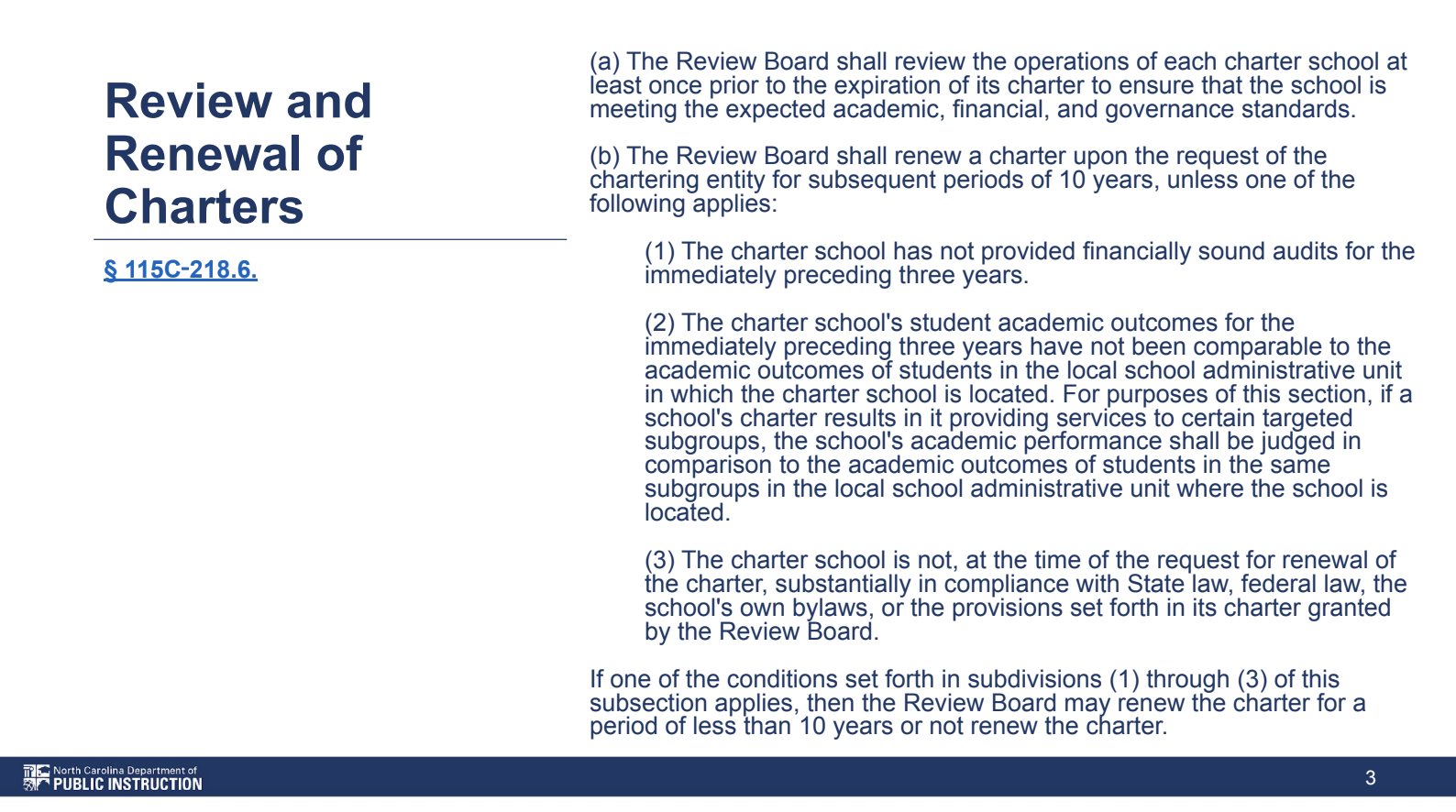

Academic comparability is when “a school’s proficiency score is within 5 points of its local district’s composite score (based on EOG/EOC results),” according to OCS.
Low performing (LP) schools have received a D or F performance grade and growth status of either met or not met, according to state guidelines. Continually low performing (CLP) schools have been low performing for two of the past three years.
While OCS recommends renewal placements based on state guidelines, the CSRB makes the final determination on terms for schools that do not meet statutory criteria for a 10-year renewal based on audits, compliance, and academic comparability.
These are the schools that presented this month, with OCS-recommended placements in parentheses:
- Thomas Academy (3 years)
- Commonwealth High School (5 years)
- Stewart Creek High School (5 years)
- NC Cyber Academy (5 years)
- NC Virtual Academy (5 years)
- The Experiential School of Greensboro (3 years)
- Summit Creek Academy (3 years)
- Classical Charter Schools of Wilmington (3 years)
- Next Generation Academy (3 years)
- Rocky Mount Preparatory (3 years)
- Z.E.C.A. School of Arts & Technology (3 years)
- Paul R. Brown Leadership Academy (7 years)
- Concord Lake STEAM Academy (7 years)
- Iredell Charter Academy of Arts & Sciences (3 years)
- Crosscreek Charter School (5 years)
- ALA Coastal (5 years)
- Raleigh Oak Charter School (5 years)
View data sheets for each renewal school here.
Thomas Academy, Commonwealth, and Stewart Creek are alternative charters operating outside the state’s traditional accountability model due to their student populations. Thomas Academy serves residential foster care students as well as those from the community. Commonwealth and Stewart Creek serve students at risk of dropping out.
“What we really pride ourselves on is identifying barriers to our student success and then also providing them lifelong resources to support their needs, whether it’s academic, social, or emotional,” Tamara Wynn, the principal at Commonwealth, told the CSRB.
Sabrina Johnson, the principal at Stewart Creek, said she had attended the school herself and once lived in her car. “Our average student is over-age and under-accredited,” she said.
North Carolina’s two virtual charter schools, NC Cyber Academy and NC Virtual Academy, are applying for renewal for the first time. They have operated under the state’s virtual charter school pilot since 2015.
Legislation establishing remote charter academies originally said the pilot would last for four years, but lawmakers have since extended that pilot period. Currently, the end of the virtual pilot is set for this 2025-26 school year. The law allows pilot schools to apply for charter renewal as a remote charter academy.
The virtual renewals represent uncharted territory for the CSRB. Legislation does not include specific renewal guidelines, Logue said, but mandates that remote academy terms must be five years.
Related reads

Four schools presenting this month had stipulations on prior renewals, specifying requirements around training, academic growth, and more. Those schools are Next Generation Academy, Rocky Mount Preparatory, Z.E.C.A. School of Arts & Technology, and Paul R. Brown Leadership Academy (PRBLA), a military charter school.
Some of these schools earned praise for notable improvement.
“I think I was the only member of the (former) CSAB (Charter Schools Advisory Board) who didn’t vote to close you,” Friend said to Z.E.C.A. leaders. “Thank you for the work you’ve done since that time.”
PRBLA has recently experienced great success. In 2022-23, the school was designated as CLP. This past year, however, PRBLA exceeded growth for the first time.
“It’s a hard pill to swallow when you’ve got a school that’s been in existence for 12 years and (has) never, ever exceeded growth,” Jason Wray, the PRBLA superintendent, said. Later in his appearance, he added, “I couldn’t come back in front of you guys with the same story about not being successful.”
“This is a heck of a turnaround story,” Guckian said.
Eldridge encouraged boards or schools listening online — especially CLP schools — to visit PRBLA.
“If you don’t think leadership matters, that’s what turned this school around,” he said. “The other thing that matters … is governance. And so, you see a united front at this school.”
CSRB will vote on renewals in February and March.
Other business
Teachers and staff members from Pine Springs Preparatory Academy shared highlights of their recent trip to Tanzania to provide supplies and training to four schools there.
“I could not be more pleased and more excited — (and) proud of the staff at Pine Springs — for making this possible, impacting a lot of lives in the communities that we serve here in North Carolina, but now worldwide,” said Friend, the superintendent there.
The CSRB meets next on Dec. 8-9.
Editor’s note: EdNC has retained Kristen Blair to cover the monthly meetings of the Charter Schools Review Board in 2025. Kristen currently serves as the communications director for the North Carolina Coalition for Charter Schools. She has written for EdNC since 2015, and EdNC retains editorial control of the content.

Recommended reading