
Average teacher pay stats can mislead

RALEIGH — Is North Carolina’s average teacher pay a reflection of the “greening” of our work force? Probably.
In March, the National Education Association released its latest Rankings and Estimates report. Last school year, North Carolina’s average teacher salary ranked 42nd in the nation and trailed No. 41-ranked Louisiana by just over $100. The new edition of the report should be released sometime early next year.
According to the NEA report, North Carolina’s ranking had dropped from 43rd in 2012-13 (revised) to 47th in 2013-14 (revised). The 2014-15 rebound reflected, in part, legislators’ decision to approve an average 7 percent salary increase for classroom teachers. In fact, between the 2013-14 and 2014-15 school years, the percentage increase in North Carolina teacher salaries was the largest in the nation.
But what is even more remarkable is that the average increased despite the fact that North Carolina’s teacher work force is less experienced than it has been in recent years.
The two major components of teacher salaries are credentials and years of experience. Teachers who obtain certain credentials, such as National Board Certification, receive higher annual salaries than those without. Additionally, the more experienced the teacher, the higher her pay.
All school districts and states use some version of the credential- and experience-based model, even though researchers agree that it is not a sensible way to keep excellent teachers in the classroom. We’ll get to that point later.
Because teachers receive pay commensurate with their experience, states that have more experienced teacher work forces will necessarily have higher average salaries than those that skew younger. Basic mathematics says so. The average of a series of relatively high numbers is larger than the average of a series of relatively low numbers.
Last year, early-career teachers made up 23 percent of North Carolina’s teacher work force, an 8 percentage-point increase from just four years before. Similarly, the percentage of teachers who have more than 10 years of experience is at its lowest point in the last eight years. The percentage of teachers in the middle, those with between four and 10 years of experience, is back to 2007-2008 levels.
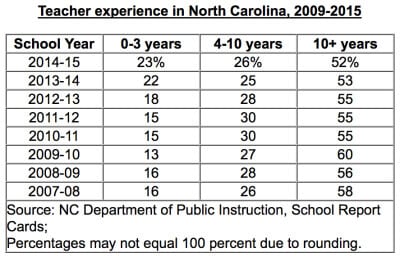
Not only do teachers in the 0-3-year bracket receive lower pay because of their inexperience, they likely do not receive a supplement for advanced degrees or certifications. Admission to the National Board Certification program, for example, requires teachers to have completed three full years of teaching.
In addition, many of these teachers did not begin their careers until after the N.C. General Assembly eliminated supplemental pay for advanced degrees. Otherwise, their supplement would have been guaranteed for the duration of their teaching careers.
Is it a bad thing that North Carolina has a less experienced teacher work force? Herein lies the problem with the way we pay teachers. We assume that the more experienced or credentialed teachers are better teachers and therefore deserve higher salaries. In some cases, this is true. In other cases, it is not.
The problem with the credential- and experience-based model is that it does not differentiate one from the other. As University of Washington professor Jacob Vigdor pointed out in a superb Education Next article, “the available evidence suggests that the connection between credentials and teaching effectiveness is very weak at best, and the connection between additional years of experience and teaching effectiveness, while substantial in the first few years in the classroom, attenuates over time.”
In sum, one should not assume that experience or credentials are indicative of effectiveness.
Finally, partisans will argue that Republican education policies are to blame for the “greening” of our teacher work force. It is possible but unlikely.
A more plausible hypothesis is that, as student enrollment continues to grow, public schools are forced to hire teachers from states that have a surplus of teachers, particularly those qualified to teach math, science, and in special-education settings. Many of these new hires are recent college graduates or relatively new to the profession.
This perspective was originally published on Carolina Journal Online on December 15, 2015.