
Community College System hopes new law will ease recent application issues

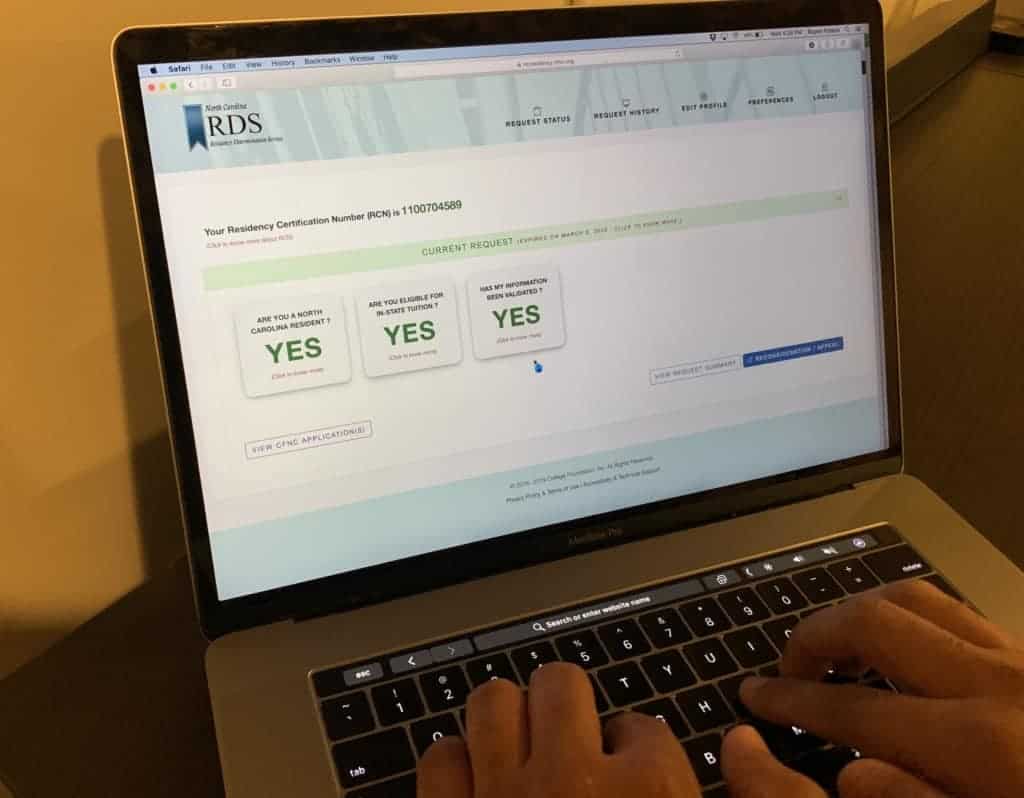
A new law signed by Governor Roy Cooper on Friday amends the statute which governs in-state determination for tuition at North Carolina higher education institutions. The measure comes as a response to complaints from the Community College System, which was feeling tension between its potential applicants and the mandatory Residency Determination Service online system.
Under the new law, graduation from a North Carolina high school is specified as a factor for considering in-state status. On its face, it seems like a small amendment — but officials say it will allow RDS designers to reconfigure the online interview process and get applicants through the online interview more easily.
“I think it was a wonderful thing, and it should remove a majority of the barriers,” said Surry Community Community College President David Shockley, who worked with system leaders on a solution. “If it does, then we are elated as it removes student barriers and allows them to move forward in seeking further education.”
When RDS became mandatory statewide for both community colleges and the UNC System, community colleges began hearing stories from applicants that the RDS system was too complicated or asking too many questions requiring their parents’ personal information — such as tax documents and social security numbers.
Unlike UNC System applicants, who tend to be living with their parents and applying for college a year or several months before they plan to attend, community college students tend to be older, live independently of their parents, and apply weeks or days before they intend to enroll.
“My students, typically, they’re going to be first-generation college students,” Amy Galla told EdNC earlier this year. Galla is the director of college and career readiness at Isothermal Community College and works with adult high school and high school equivalency students on their transition to higher education.
“They’re most frequently living in very non-traditional circumstances, even when they’re 17 or 18 years old. These are living situations that would frequently surprise you. And the RDS system, apparently,” Galla said.
Amid growing complaints from applicants and various colleges, the community college system conducted a study analyzing the experience of more than 280,000 applicants. They found that close to 20,000 applicants stopped their applications before finishing the RDS questionnaire. The biggest complicating factor, they determined, was when applicants were asked a series of questions about their parents’ personal information.
Under the law for determining in-state residency, a person who is under the age of 24 and has a living parent is presumed to be domiciled with their parents. The presumption can be rebutted, but the RDS interview asks for the parents’ information before the opportunity to rebut.
During their study, the community college system determined that 40% of the applicants who had stopped out had done so during the questions about their parents’ information. In interviews with EdNC, applicants and community college leaders shared many stories of frustration with the questioning — particularly because they were independent from their parents, who either lived out-of-state or could not provide their children with the requested information in a timely manner.
Initially, the community college system lobbied for the presumption of domicile with a living parent to be removed from the law. This was met with hesitation among legislators at a Senate higher education committee meeting in March. It also raised concerns with RDS officials.
Shortly after, RDS officials and the community college system began meeting and discussing possible solutions.
“They gave us a head’s up early on,” said Gwen Canady, who is chair of the working group that manages RDS. “I can’t say enough about how collaboratively we worked together to come out with a really good solution.”
They determined a high correlation between graduation from a North Carolina high school and ultimate in-state resident determination. As such, RDS officials said that if the law was changed to include graduation from a North Carolina high school as a factor, the system could be redesigned to further ask such an applicant whether they are living independently of their parents.
Since passage of the law, the RDS system has been redesigned to ask whether an applicant graduated from a North Carolina high school early on in the process. If the applicant has, the system then asks if the applicant is living independent of their parents. If she answers “yes,” she is taken down a line of questioning that does not require parental information.
However, if the applicant answers “no,” she will still need to provide parental information. If this remains difficult to obtain for specific reasons, applicants can skip the parental questions, receive an out-of-state determination, and then request a reconsideration through which they can explain and provide evidence of extenuating circumstances.
“It’s not going to fix everything,” Canady said of the change in law and subsequent reconfiguration of RDS, “because nothing’s going to fix everything 100%. But this is going to help a lot.”
Both RDS officials and the community college system will monitor applications under the new procedure.
“We’re going to watch it,” Canady said, “and if there’s still some issues, I know we’ll work together to figure things out.”