
Exploring postsecondary attainment: Community college to university transfer

The myFutureNC Commission is a statewide education commission focusing on educational attainment for all North Carolinians. This week, we will be highlighting findings from the myFutureNC Commission policy briefs on postsecondary attainment.
To meet North Carolina’s projected workforce needs, more students will need bachelor’s and associate’s degrees than currently exist in North Carolina. One way to do this is by increasing the number of community college to university transfers as well as the graduation rates for those transfers.
North Carolina’s transfer programs have gained national attention, but there is room for improvement, especially with minority and low-income students. The myFutureNC Commission policy brief, “Community College to University Transfers,” (embedded below) explores this issue.
Current transfer landscape in North Carolina
Community college students in North Carolina have been able to transfer to University of North Carolina schools thanks to a Comprehensive Articulation Agreement (CAA) in place since 1997. In Fall 2016, 31 percent of students in UNC system schools were transfer students.
Despite this significant number, only 24 percent of North Carolina community college students transfer to a university within six years compared to 33 percent nationally. Additionally, only 40 percent of transfer students successfully earn a bachelor’s degree within six years compared to 42 percent nationally.
The overwhelming majority of community college transfer students are transferring “vertically,” or from community college to a university, whereas just 16 percent are transferring to other community colleges. In 2016, 10,264 community college students transferred to UNC schools and 2,027 transferred to private institutions.
Of those community college transfers, the largest group is students with no degree and 30+ credit hours, but the fastest growing group of transfer students since 2007 is students transferring with associate degrees.
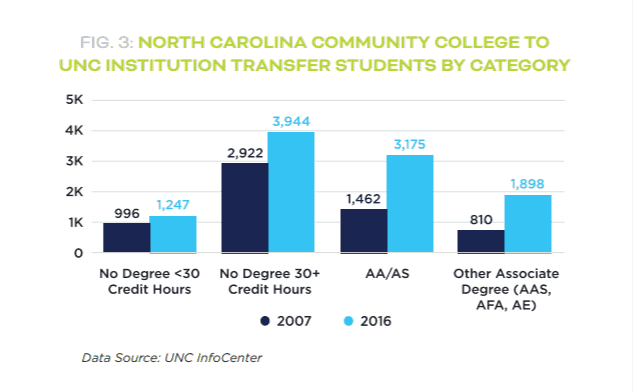
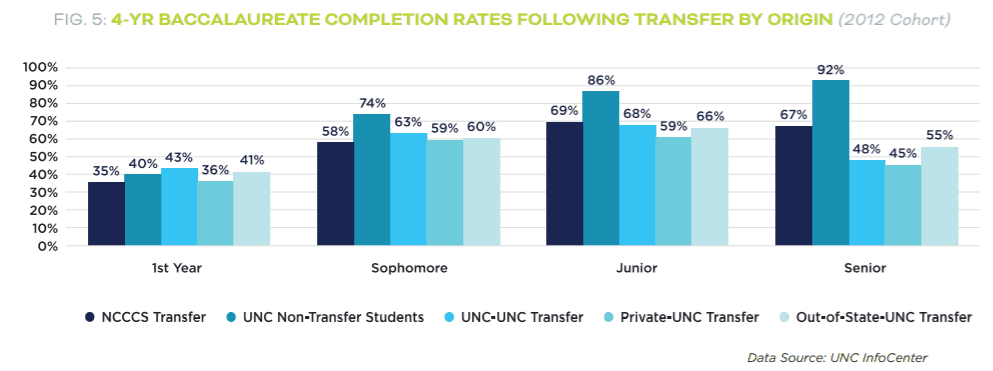
In the 2012 cohort, transfers with an associate’s degree had the highest four-year graduation rate at 71 percent. Transfers with no degree and less than 30 credit hours had a four-year graduation rate of only 37 percent, likely because those students require more time to graduate. Comparisons between four-year graduation rates of community college transfers, UNC non-transfers, UNC-UNC transfers, private-UNC transfers, and out-of-state-UNC transfers can be seen in the graph below.
Finally, in the 2012 cohort, 65 percent of white community college transfers graduated within four years compared to 50 percent of black students and 63 percent of Hispanic students. Pell Grant recipient transfers had a graduation rate of 59 percent compared to 65 percent for non-Pell students.
Improving transfer and graduation rates
The brief authors, Mark D’Amico and Lisa Chapman, highlight several practices that could improve transfer and graduation rates.
- Improved statewide transfer pathways
- Establish statewide agreements, similar to those in Florida, Tennessee, and California, to transfer lower division coursework for several majors.
- A universal course numbering strategy
- North Carolina should join 16 other states in creating common course numbering across public community colleges and universities.
- Increased emphasis on Associate in Applied Science (A.A.S.) articulation
- Catalog existing articulation agreements with A.A.S. earners across the system and incorporate transfer courses into applied courses.
- Enhanced data quality and sharing
- Create data-sharing agreements across institutions to facilitate better student advising.
- Incentivized pre-transfer associate degrees
- Transfer students who complete an A.A. or A.S. degree are more likely to graduate, so schools should create incentives to do so prior to transfer.
- Increased communication during secondary education
- Increase communication to students and parents about transfer pathways and reach a broader audience.
Read the full brief below.