
Governor Cooper weighs in on education issues
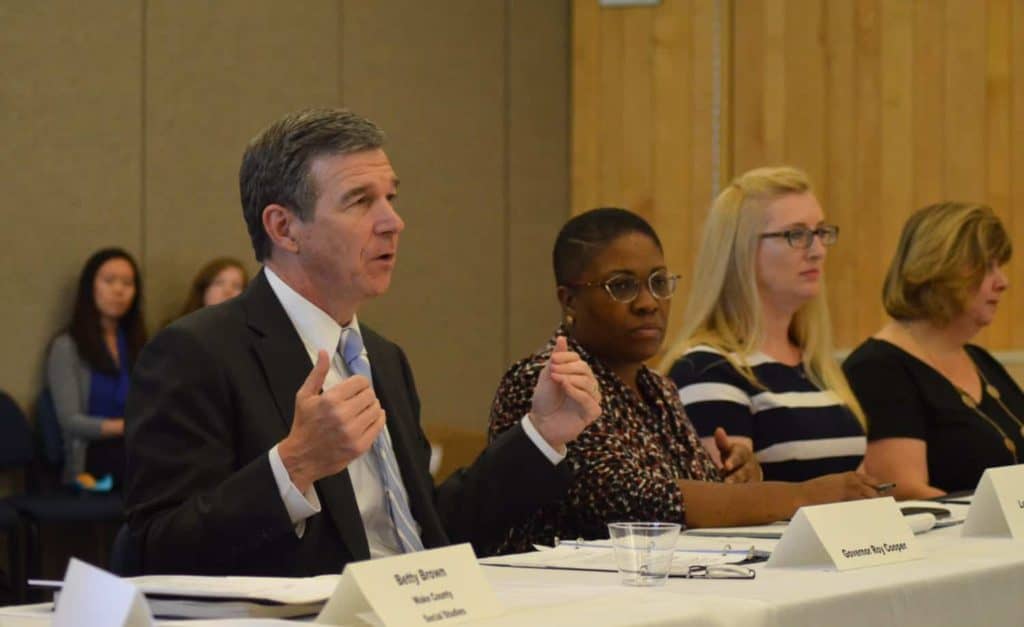
The General Assembly weighed in on education during the special session last week. On Friday, Governor Roy Cooper gave his perspective.
Friday morning, he released a statement criticizing the legislature for not taking action on a few education-related items. One, a fix to the K-3 class size restrictions some districts say are going to leave them strapped for resources next year, was a particular focus of his ire.
“Legislators failed to take action on the kindergarten through 3rd grade class size requirement or fund new teaching positions necessary to prevent schools from eliminating classes and forcing students to move to different schools,” he said in a statement.
“While the General Assembly capped class sizes for kindergarten through 3rd grade at 18 students, legislators failed to provide funding for the additional 4,700 teaching positions necessitated by the smaller class sizes. As a result, students are being forced to switch schools, specialized teachers are being moved into new roles, and programs like physical education, foreign languages, and the arts are being canceled. Parents and students across the state have called for action, but legislative leaders announced they would not take up the issue.”
He also pointed out the General Assembly’s delay in confirming his nominees to the State Board of Education and the Teachers and State Employees Retirement Board of Trustees.
Friday afternoon, Cooper spoke more about his education priorities at his Teacher Advisory Committee meeting, mentioning his desire to make the state one of the top in education by 2025.
“We can do that,” he said. “We absolutely have to do that.”
He said that in talking with businesses considering locating in North Carolina, education is always a concern. They want to know that North Carolina has the worker supply they need.
“Do you have people who can perform the jobs that I want to create?” he said businesspeople ask. “Do you have the educated workforce that can do these jobs?”
He talked about the need to invest more in early childhood education, raise teacher salaries at least to the national level, raise the state’s graduation rate even higher than its current 86.5 percent, and ensure schools have the resources they need.
“I have confidence that our public school system can work, has been working, can always do better, but we know the challenges that are out there,” he said.
He also talked about the visceral experience he has when visiting the state’s public schools.
“My spirits are lifted when I go into our public schools, when I see the passion of the teachers,” he said. “When I walk into a classroom, I know that teachers in that school are making a difference whatever the letter grade the state decides it wants to slap onto that school.”