
Words that tear down, and a picture that lifts up

Over the eight hot July days of oratory at the back-to-back Republican and Democratic national conventions, you heard hardly anything about education from pre-kindergarten through high school. Still, each convention had a small moment that contained a lesson about Americans and their schools.
In his extra-long speech on the final night of the GOP convention, Donald Trump delivered only one sentence about education — “We will rescue kids from failing schools by helping their parents send them to a safe school of their choice” — a portentous-sounding sentence leaving a trail of questions in its wake.
The more interesting moment came earlier in the convention when the candidate’s son, Donald Trump Jr., who attended private schools until studying at the University of Pennsylvania, applied a rhetorical sledgehammer to public education. “The other party,” he said, “gave us public schools that far too often fail our students, especially those who have no options.”
And he went on:
“Our schools used to be an elevator to the middle class. Now they’re stalled on the ground floor. They’re like Soviet-era department stores that are run for the benefit of the clerks and not the customers, for the teachers and administrators and not the students.”
It’s unrealistic, of course, to expect political-convention speeches to deal in subtlety and nuance. They offer broad themes and cues — the Trumps want listeners to know they favor “choice” and “options.” Still, the younger Trump’s speech is instructive not so much for its substance as for its sweeping rhetoric.
It is an example of a widespread American reflex to talk about schools as broken, to smear and besmirch public education as a failed, and failing, enterprise. It’s a reflex not limited to political conservatives, or to Trump-style dark pessimists; indeed, concerned citizens and would-be school reformers across the spectrum often toss out one-liners about dysfunction in public education.
When I was associate editor of The News and Observer in the 1980s, I grew increasingly concerned about the tone of our editorials on education. The newspaper wanted to keep pushing state and local policymakers hard to address the shortcomings and needs of North Carolina schools. But in doing so, I told then-editor Claude Sitton, I worried that our hit-hard approach might be contributing to an erosion of public confidence in their schools.
Finding the right balance is difficult in analyzing such a vast and complex enterprise as U.S. public education: 50 million students taught by 3.1 million teachers in 98,500 schools in 13,500 districts. Over many decades, the United States sustained its democratic-capitalist society as it made the transitions from an agricultural to an industrial economy, and then to the digital, globalized economy, surely in large part through its investments in mass education. Even Trump Jr. recognized education as an “elevator to the middle class.”
Still, the enterprise is replete with problems, dilemmas, issues: shortages of teachers, concentrations of poverty in big cities and small towns, gaps in achievement along lines of race and ethnicity, inadequate and uneven funding, a thirst for educational leadership. Given demographic shifts, accelerated technological change, and the expansion of knowledge, American schools require constant attention, updating, “reform” of one sort or another — and care by political leaders.
The Democratic convention produced a moment that recalled an exercise in public leadership in action, not rhetoric. As Gov. Tim Kaine of Virginia, the Democratic vice presidential nominee, was about to begin his convention address, the TV networks pointed cameras toward his 93-year-old father-in-law, Linwood Holton, seated in the family section.
In 1969, Holton won election as governor of Virginia as a Republican. Before Holton’s election, the state’s politics had been locked in the grip of the Byrd organization of conservative Democrats, and the state had engaged in “massive resistance” to school desegregation. In his 1949 book on Southern politics, V.O. Key Jr. had characterized Virginia as a “political museum piece.”
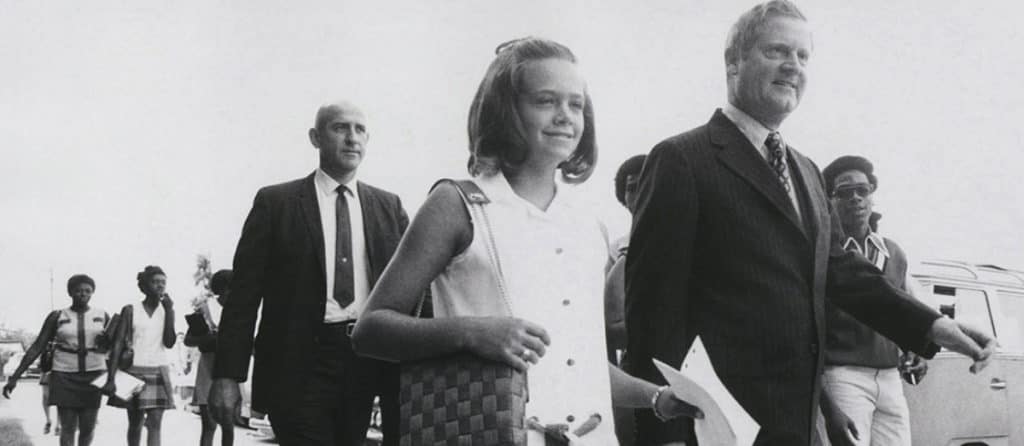
In his inaugural address, Holton declared an end to the “era of defiance,” and he set as Virginia’s goal an “aristocracy of ability, regardless of race, color or creed.” When public schools opened in August 1970, Holton walked his daughter Tayloe into a predominantly black high school in Richmond. Tayloe’s sister, Anne, is now the wife of the Democratic vice presidential candidate, and she just stepped down as Virginia’s secretary of education.
A photograph of Holton with his daughter heading toward a desegregated public school appeared in newspapers across the nation — a picture of political leadership that still speaks louder than words.