
Everything you need to know about the State Health Plan’s new tiered-provider structure


Big changes are coming to the State Health Plan, which provides health insurance for nearly 750,000 teachers, state employees, retirees, and their dependents. Starting in 2027, State Health Plan members will be incentivized by lower deductibles and out-of-pocket costs to seek out “preferred providers” for their care.
“We are asking our members to become shoppers in health care, and we’ve never asked them to do that, really, before,” State Treasurer Brad Briner said at a June 5 State Health Plan Board of Trustees meeting.
The board, at its upcoming July 10 meeting — which Briner said in June will be “the most consequential meeting this board has ever had” — will vote on contracts that will classify providers in one of three categories: preferred, access, or non-preferred. Deductibles, out-of-pocket costs, and other expenses will decrease for members who choose to use providers in the preferred category.
Meanwhile, providers deemed non-preferred, which charge the State Health Plan more for care, will cost more for members. Plan officials have said they aim for the non-preferred category to include no more than 10% of all providers, and that geography will be taken into account so that no areas only have non-preferred providers available.
Most providers will remain in the access tier, where prices for members will be unchanged. Most providers in rural, less competitive markets such as the southwest, northeast, and southeast, will probably be in the access tier, officials have said.
Ahead of the July board meeting, here is what you need to know about the new tiered-provider structure.
 Sign up for the EdWeekly, a Friday roundup of the most important education news of the week.
Changes driven by State Health Plan finances
The State Health Plan faced a financial cliff when Briner, who chairs the plan’s board, entered office. Since then, it has come back from a $507 million deficit through across-the-board cost increases for members, including a recent increase in out-of-pocket costs and copays for retirees on Medicare Advantage plans.
But the State Health Plan is still battling rising health care costs and inflation, said Thomas Friedman, executive administrator of the plan, at the June 5 board meeting. A slide presented during that meeting reads “the status quo of healthcare is unsustainable” and “member health is getting worse because health care is unaffordable.”
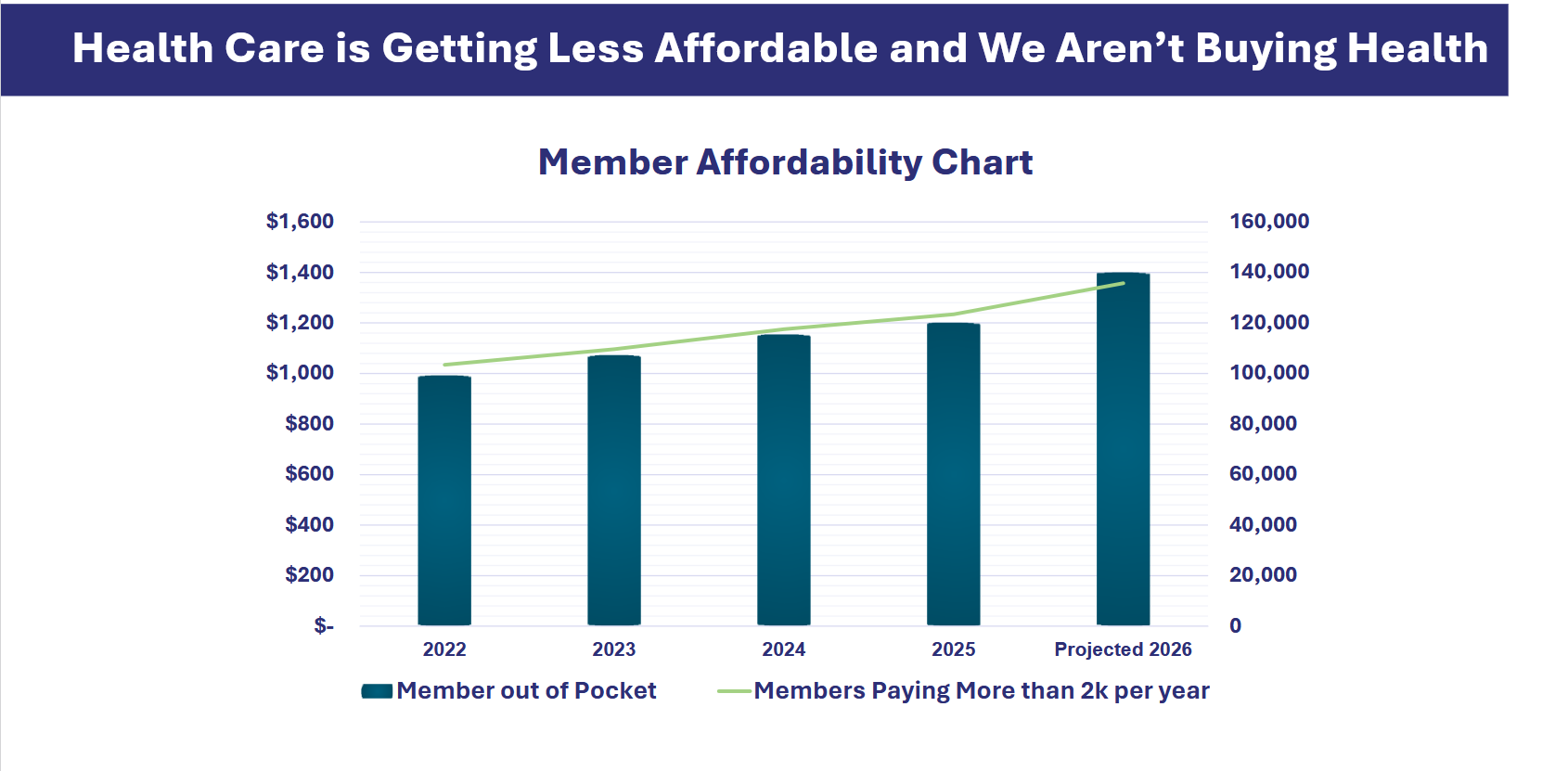
Friedman presented cash projections showing that the plan will end 2026 above its target stabilization reserve, but is currently $58 million short of the target number for 2027 — assuming the legislature funds a 5% employment contribution in fiscal year 2026-27, then 4% annually in following years.
So far, the brunt of the cost increases required to balance the State Health Plan’s budget have been borne by members and by taxpayers. The tiered-provider structure could change that by lowering the amount paid to health care providers.
A secondary savings effect may come from lower health care costs for members, since members paying less will be able to seek more preventative care and be treated early — before sicknesses progress and more expensive services are needed later.
Read more about the State Health Plan



Will the tiered-provider structure reduce costs?
In the past, the State Health Plan has not negotiated with health care providers on the rates the plan pays for services; rather, the plan’s third-party administrator — currently Aetna — interfaces with providers. Through the new tiered-provider structure, the plan will incentivize providers to charge less in order to be designated as preferred.
If things go as State Health Plan officials hope, preferred providers should receive a higher volume of patients, offsetting the lower prices they offer State Health Plan members.
“You won’t believe the magnitude of those potential savings,” Briner said at the last State Health Plan board meeting. “We’re not only able to hold the line on cost, but also, by choosing preferred providers, you will be able to cut your out-of-pocket costs by a third or more.”
Briner said by forcing providers to compete, prices will go down, and that the State Health Plan has reached out to “every major provider in the state” to negotiate. While many providers responded positively, some providers told him they weren’t “in the business of competing.”
Those providers, he said, are the ones in the non-preferred category that will be more expensive for members.
“Every major provider in this state was invited to participate in this competition,” Briner said. “If your current provider is ultimately not in the preferred tier, it will be because your provider does not sufficiently value your business.”
What the new structure will look like
Below, see the proposed benefit changes for 2027, as outlined in the presentation given at the last State Health Plan board meeting.
The annual deductibles and out-of-pocket maximums for the access tier under the new structure are equivalent to the 2026 levels. However, members on the standard plan could save 50% by using preferred providers. A $3,000 deductible this year could be $1,500 next year, for example.
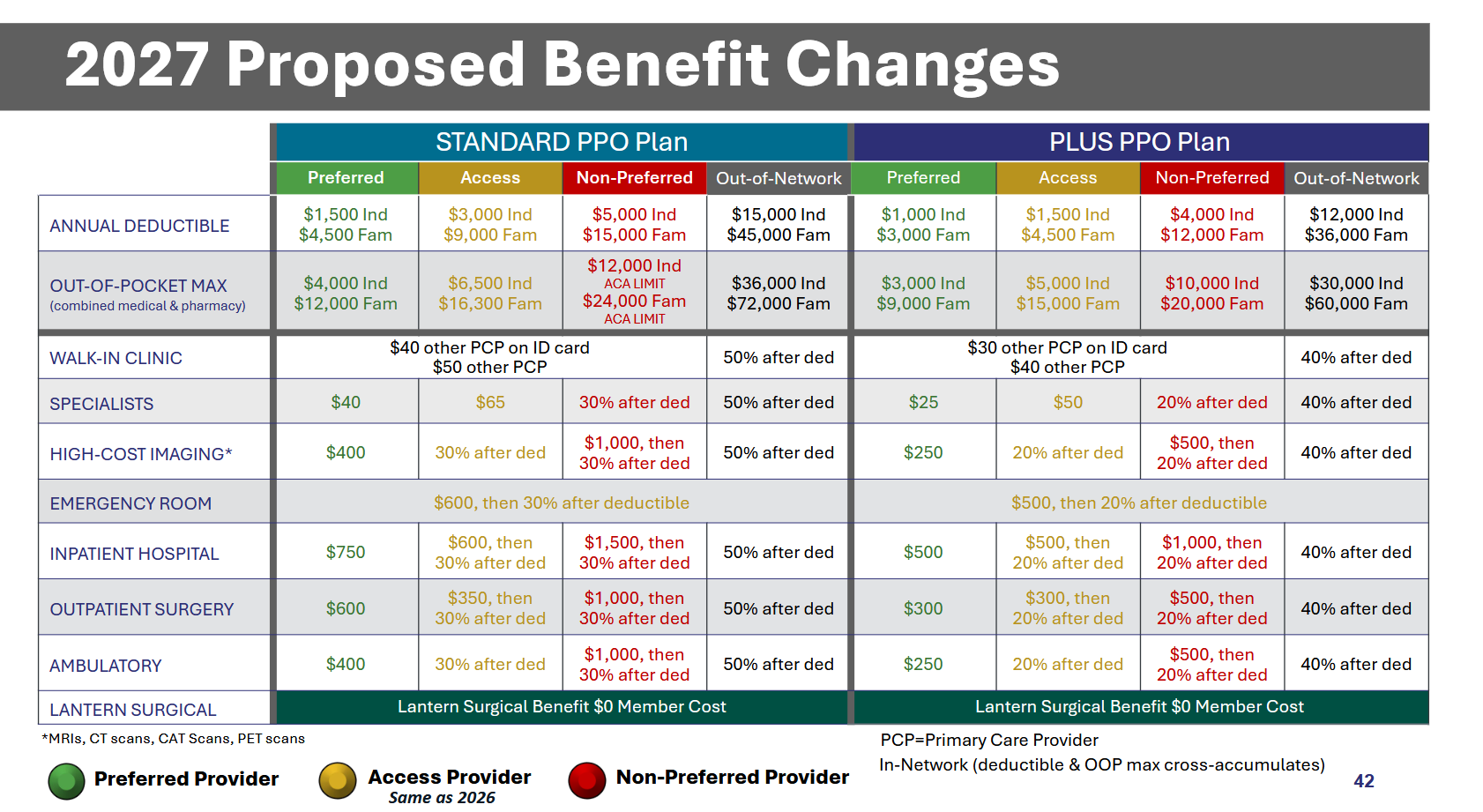
The long-term vision, according to the presentation, is that 90% of members will be using preferred or access providers, and that the savings generated fund population health.
Another part of the long-term vision, plan officials have said, is pairing the tiered-provider structure with other savings mechanisms — like a generic-first strategy and the Lantern Surgical Benefit — and with premiums tied to state employees’ salaries.
Some details for members
The nature of the tiered-provider structure means that the State Health Plan hopes members will switch providers in search of lower costs, at least at first.
But members should note that the State Health Plan intends to have transition of care procedures in place for those in the course of treatment at the beginning of next year. For example, those receiving maternity/NICU care, oncology/cancer care, or transplant care, will be able to stay with their providers, even if they become designated as non-preferred, and only pay at the access tier.
The presentation says that the transition of care timeline will vary member to member.
Additionally, emergency care costs will be the same across provider tiers, as members won’t be expected to shop for preferred providers in emergency situations.
State Health Plan officials have also said that members that use providers in multiple tiers will have their deductibles cross-accumulate, so that preferred provider care costs will contribute to the deductible in all tiers, for example.
Not ‘one and done’
State Health Plan officials have emphasized that the move to a tiered-provider structure is not “one and done,” and that the votes on provider contracts on July 10 are just one step in refining the plan’s new structure.
Friedman has said that the State Health Plan will continue to evolve over time, but that the experience should be consistent and stable for members.
“We learned the lesson that if you muck around and change things up a bunch every year, you lose trust. You lose the provider-patient relationship,” Friedman said. “And then this all falls apart on its head, and everyone is worse off.”
Looking ahead to July
The State Health Plan Board of Trustees will vote on provider contracts that have been negotiated over the past six months at the board’s next meeting on July 10. Those contracts will determine which providers are designated as preferred under the new tiered provider structure.
The board could also vote on a replacement for Aetna, the plan’s current third-party administrator. Earlier this year, the State Health Plan put out a call for proposals from potential replacements. Aetna’s contact currently runs through 2027.
Aetna replaced Blue Cross and Blue Shield of North Carolina, which administered the State Health Plan for over 40 years, at the beginning of 2025. The switch was voted on in December 2022, under former State Treasurer Dale Folwell.
See past board meeting materials here.