
State Health Plan board votes to increase out-of-pocket costs, copays for Medicare Advantage plans


State Health Plan members on Medicare Advantage plans — nearly 177,000 retirees — will have higher out-of-pocket maximums and copays in 2027, after the State Health Plan Board of Trustees voted to approve new benefits on Friday. Officials said the increases will save the State Health Plan $54 million, money they said is necessary to strengthen the plan’s long-term financial sustainability.
The out-of-pocket maximum under the Medicare Advantage Base Plan will increase from $4,000 to $4,500 and the Enhanced Plan out-of-pocket maximum will go from $3,300 to $3,700. Copays will go up under both plans, and pharmacy benefit costs will go up under the Base Plan. See the full changes below.
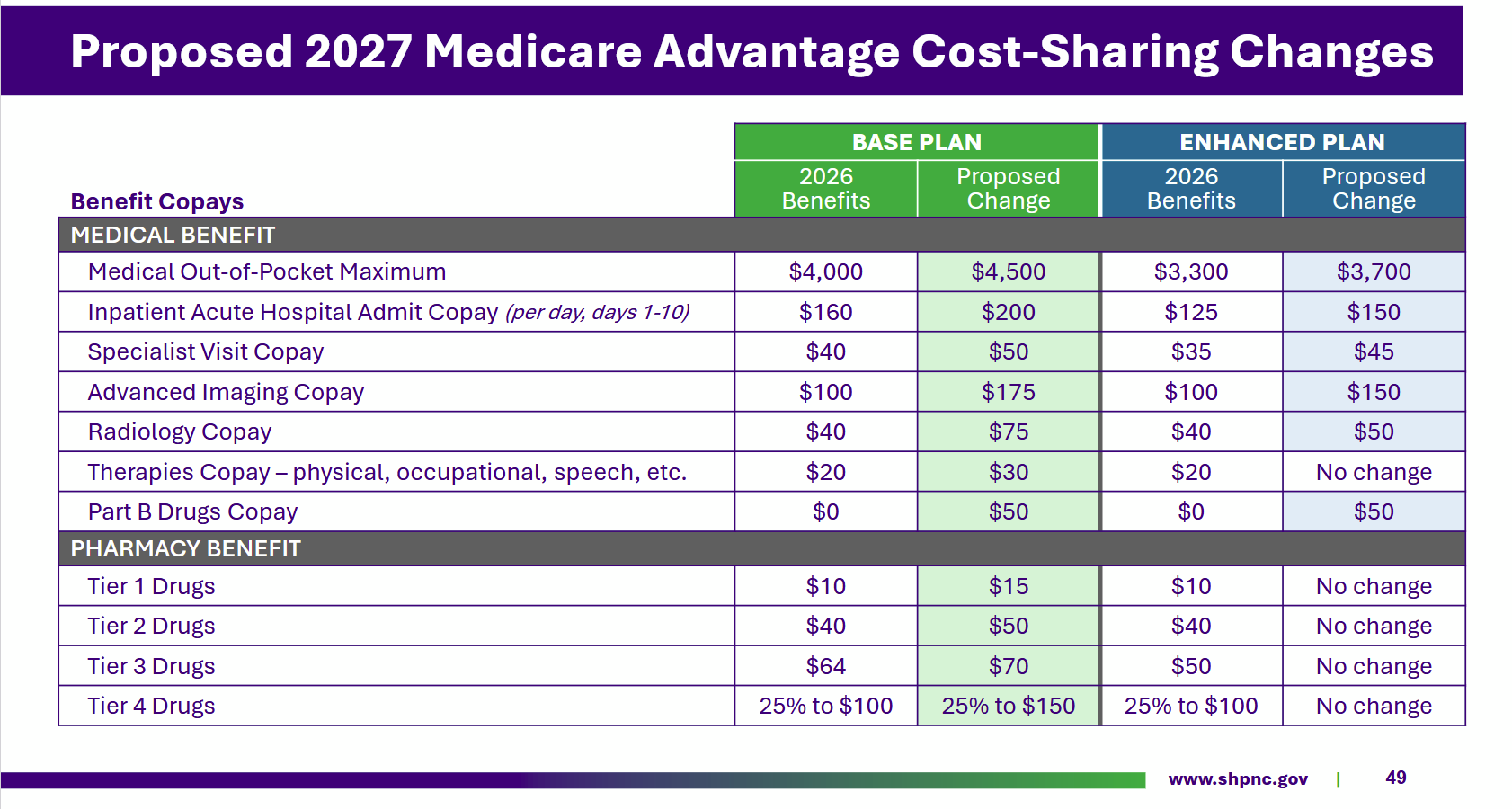
Notably, the copay for Part B drugs, a category that includes common annual vaccines, will increase from $0 to $50 under both plans.
Jackson Cozort, director of government relations for the North Carolina Retired Government Employees Association (RGEA), said during the public comment period before the board’s vote that his organization has “grave concerns regarding the substantial increase in health care costs being proposed for retirees.”
“We fully recognize the financial challenges facing the State Health Plan, and understand that difficult decisions must be made to ensure its long-term sustainability,” Cozort said. “However, we are deeply concerned that substantial cost increases for Medicare Advantage participants would place a disproportionate burden on a population that has very limited ability to absorb all these additional costs.”
Cozort said that for many retirees, health care costs are not just a line item in their household budget — they are “among the most significant expenses that they face.”
Suzanne Beasley, director of government relations for the State Employees Association of North Carolina (SEANC), echoed Cozort.
“These increases are going to turn our folks on their head,” Beasley said.
 Sign up for the EdWeekly, a Friday roundup of the most important education news of the week.
State Health Plan recovering from fiscal cliff
The State Health Plan, a division of the Department of State Treasurer that provides health care coverage to nearly 750,000 teachers, charter school employees, community college employees, other state employees, retirees, and their dependents, was previously facing a fiscal cliff.
Since Treasurer Brad Briner took office, the plan has come back from a $507 million deficit through across-the-board cost increases for members. But the State Health Plan is still battling rising health care costs and inflation, said Thomas Friedman, executive administrator of the plan.
Cash balance projections shared on Friday show that the State Health Plan will end 2026 above its target stabilization reserve, but is currently $58 million short of the target number for 2027 — assuming the legislature funds a 5% employment contribution in fiscal year 2026-27, then 4% annually in following years.
Briner said that the General Assembly is “likely to invest that money.” Right now, negotiators are working on a state budget that is expected to be released next week, after North Carolina failed to pass a state budget last year.
Further complicating the financial picture of the State Health Plan is the potential merger between Raleigh’s WakeMed hospital system and Atrium Health, North Carolina’s largest health provider.
Briner previously said, and reiterated on Friday, that the WakeMed/Atrium deal would increase costs by $10 per member per month. Read more in the EdNC article below.
Board adopts strategic plan, seeking savings from providers
Friedman said on Friday that the many changes the plan is undergoing have resulted in “quite the turnaround” financially, but that the brunt of the cost has been borne by members and the legislature.
“The status quo of healthcare is unsustainable,” a slide presented at the meeting reads.
A cornerstone of the strategic plan adopted on Friday is cost minimization including through biosimilar-first and generic-first strategies — providing equivalent generics in favor of costlier name-brand drugs — and a tiered-provider structure.
Providers will be categorized as preferred, access, or non-preferred depending on the prices they offer the State Health Plan, with the goal of incentivizing discounts for members. Read more in EdNC’s previous reporting on the tiered-provider structure.
The plan has already been negotiating with health systems across the state; the board will vote on provider contracts in July. On Friday, Briner said the July meeting will be “perhaps the most consequential meeting this board’s ever had” and that “you won’t believe the magnitude” of the potential savings that will come from the tiered-provider structure.
“We’re not only able to hold the line on cost, but also, by choosing preferred providers you will be able to cut your out-of-pocket costs by a third or more,” Briner said.