
How can AI tools help students build durable skills?

It has been over two years since the Department of Public Instruction (DPI) released its living document of guidelines for incorporating artificial intelligence (AI) into the classroom.
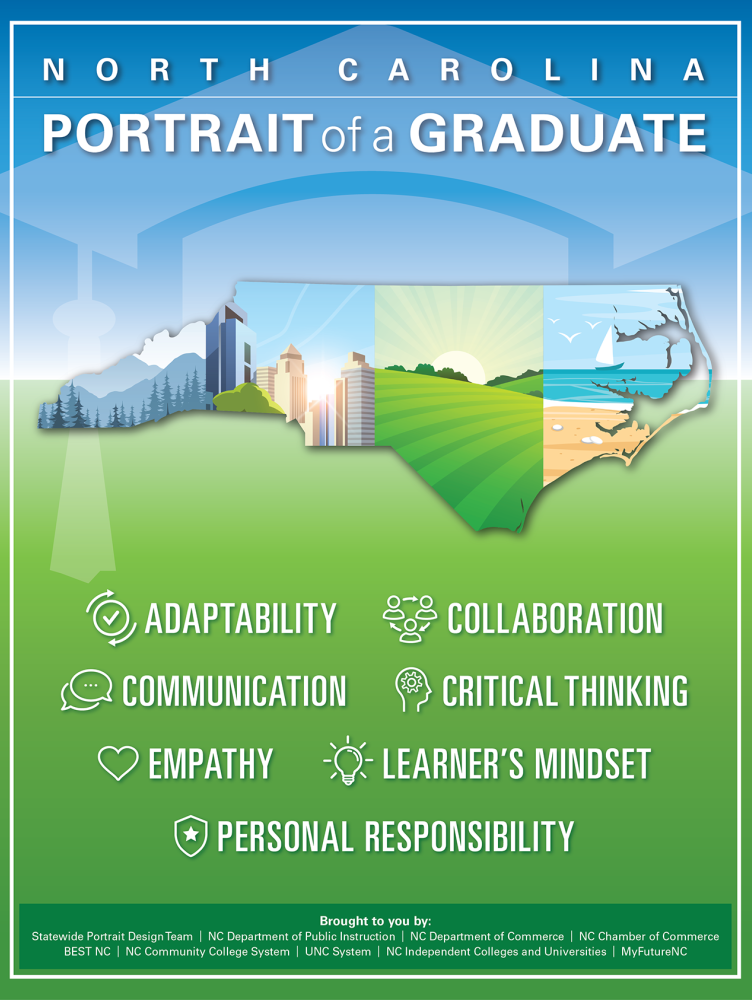
Within the guidelines, DPI describes how the seven durable skills they expect North Carolina students to possess before entering the workforce can coexist with the rising presence of AI tools. The skills — adaptability, collaboration, communication, critical thinking, empathy, learner’s mindset, and personal responsibility — are skills students need to thrive with AI, the document reads.
“They are also the competencies that educational leaders must model in this moment of transformation,” the document reads. “It is through thoughtful, human-centered leadership that schools can remain places of creativity, connection, and equity even as our tools become increasingly powerful.”
 Sign up for the EdWeekly, a Friday roundup of the most important education news of the week.
The DPI guidelines explain how each skill can apply to educators as they incorporate AI. Here are the descriptions below:
- Adaptability: Adjust policies as AI evolves.
- Collaboration: Build cross-functional teams for policy, training, and curriculum.
- Communication: Engage communities with clarity, transparency, and empathy.
- Critical Thinking: Evaluate AI tools rigorously.
- Empathy: Center AI policy, guidelines, and implementation with a human focus, inclusion, and accessibility.
- Learner’s Mindset: Stay curious and iterative as new models emerge.
- Personal Responsibility: Lead with integrity and foresight.
EdNC spoke with school districts to see how the incorporation of AI in the classroom looks in practice and to learn about what challenges still remain.
Kannapolis City Schools
Kannapolis City Schools (KCS) first realized that they needed an AI policy during the 2023-24 school year. Humanities teachers were among the first to voice their concerns.
“What do you mean it could write essays for the student?” KCS educators said at the time.
Retired KCS instructional coach Katie Bogle said a challenge was getting educators to understand that they have to give assignments that can’t be copied from a Gemini response.
“It’s literally an activity-by-activity conversation,” Bogle said. Questions she poses for educators are, “Could that be done on paper-pencil? Could that be done with a conversation? Could that be done with a four corners activity, where they stand up and move around? Could it be gamified?”
By fall 2025, all KCS educators were trained in AI literacy. At that point, the district also had clear guidelines of what was and was not appropriate at each grade level, in line with the guidance released by DPI.
Bogle, who co-authored guidelines before retiring, said that critical thinking is one of the clearest durable skills that applies when incorporating AI tools in schools.
For elementary and middle grades, much of the critical thinking is guided by the educators. DPI and KCS’s guidelines have more restrictions for K-8 students. Prekindergarten through fifth grade students can only learn about AI without direct exposure to chatbots.
“At that age, they don’t know the difference between you and me having a (virtual) conversation on this computer and an anthropomorphized chatbot,” Bogle said.
Grades 6-8 can engage with age-appropriate tools but do so with teacher oversight. After having the time to learn how to use AI tools ethically, high school students can engage with them more directly to create content.
All in all, Bogle said it’s two sides of the same coin. Teachers employ critical thinking skills when using AI in their workflows and creating learning experiences. Students use it to create content and assess its outputs to make sure it fits their needs.
“Are you going to need to iterate that, or did you get the version that you finally want? If you do need to iterate it, how?” Bogle posed as questions students should be asking themselves when using AI.
Another durable skill Bogle alluded to was personal responsibility.
Examples of personal responsibility in the DPI guidelines document say that students can learn to use digital products such as AI tools with integrity. They can look at the content AI generates and assess it for value and potential harms.
“You are critically looking at this output, but what is your responsibility as the human to give credit where credit is due?” Bogle said.
Bogle said one of KCS’ best practices is having students write an AI disclosure statement with their assignments that can be as simple as, “I used AI in this for brainstorming ideas.”
For example, a KCS student was allowed to use SchoolAI, a generative AI system specific to education, and Gemini to create a presentation on the industrial revolution.
“It was a great opportunity to teach how to use AI tools responsibly and be efficient with prompting and class time. Secondly, the students were excited to actually be allowed to use AI in class,” Ute Lentz, a CTE teacher at A.L. Brown High School, said according to a presentation Bogle gave at a statewide conference.
Bogle said that with practice, teachers are adapting the tools to help them with their workflows, but are still adjusting their assignments to go with the times.
“You can’t escape it. You can’t avoid it. So, how do you use it?” Bogle said.
Read more


Davidson County Schools
Districts like Davidson County Schools (DCS) have also been focused on fostering AI literacy amongst students and staff and showing them how to adjust their workflows accordingly.
Sue Tobin, instructional technology director at DCS, said she has had to reassure teachers AI is not there to replace them.
“We have to learn how to manage and how to do school with this capability in place, because it’s not going away,” Tobin said.
The DCS mindset drives home the durable skill of adaptability. Adaptability also applies to educators when it comes to the classwork they assign.
Educators from the district spoke more about shifting instruction to focus on the process of learning opposed to the assignment or ending grade.
“The biggest pushback that we’re hearing from educators, and rightfully so, is that we’re still in a system that’s just rewarding the product, just rewarding the grade,” Libby Moretz, DCS digital teaching and learning coach, said. “We’re trying to be more intentional about how we’re actually measuring student learning and how we can design assessments and instruction to be more strategically focused on, you know, that big picture versus just the end product.”
Another durable skill that DCS found salient was the ability of their students to communicate.
For the skill of communication, DPI guidelines allow students to use AI to draft written material for different audiences and purposes. Then students can verify the accuracy of what AI produces and edit it. Students should also be prepared to explain and defend the final product.
When thinking about life after high school graduation, students are being prepared to compete in the job market. Tobin said employers are using AI to review resumes before students get a chance to even have an interview.
“They need to understand that what they produce and turn in as a resume to these workplaces, it’s getting reviewed by an AI tool. They need to have a resume that can stand up to that, so that they can even get their foot in the door,” Tobin said.
DCS has also leveraged the tool to sharpen the students’ critical thinking skills. Moretz offered the example of a high school English teacher whose class was studying “The Great Gatsby.” The teacher asked ChatGPT for the overall themes of the novel.
With the responses, the teacher then created a video debunking most of the output, thus demonstrating the EVERY framework for students. The EVERY framework is a way of evaluating how accurate the AI response was and its bias.
“It’s easy for them to try to use AI to circumvent critical thinking, but in the end we need critical thinking more than ever if we’re going to be using AI, and that’s really what we want students to understand,” Moretz said.
Tobin said that at first, DCS educators were concerned with students cheating and the legitimacy of the results they would get from AI tools. However, they have seen some staff get more comfortable with it as their prompting improves.
For Tobin, it’s key that educators do not feel like AI is being pushed on them, but also understand how ever-present it is.
“Workplaces are expecting their new workforce to come in knowing how to use this (AI),” Tobin said. “We can pretend it’s not there, but that’s not going to make it go away. So, what we want to focus on is AI literacy, which is helping the teachers and the students understand when they should use it, when they shouldn’t use it.”
Stokes County Schools
Regarding the durable skill of collaboration, DPI’s guidelines suggest an instructional shift from dividing tasks for students to collectively making sense of material. AI can be used to coordinate plans and help generate ideas.
Miranda Ketcham, who teaches fifth grade in Stokes County Schools (SCS), said her class used AI to come up with more creative projects for their annual math fair.
A math fair is similar to a science fair except the creation of the projects is based on functions, equations, and anything else mathematics related. Typically, students would end up googling projects that had been done in the past, Ketcham said. Some of the most common would be restaurants and food trucks that showcase their math skills in budgets. Now students can prompt AI tools to help them come up with ideas that are more catered to their interests. For example, students who liked crafting were given the idea to create a “Volume City” — showing their ability to calculate volume while also being more creative, Ketcham said.
While AI can provide context, care, respect, and relationship building is led by humans. When it comes to the durable skill of empathy, DPI’s guidelines say AI can be used to provide context of real-life situations while students can go a step further by discussing the different perspectives of all the stakeholders involved.
An example provided in the guidelines is using AI to analyze a civic issue. In that example, a student will use empathy skills by identifying what perspectives have not been previously considered.
Another part of building empathy is ensuring accessibility. From a district standpoint, SCS educators have taken advantage of text-to-speech features to help students with learning differences. A particular tool they use called Mote has translation services and allows teachers to go in and record voice notes.
“AI has been able to help us provide equity compared to those districts around us, when it might be hard to get a sign language interpreter or find a Spanish teacher in the middle of the northern part of our district, little things like that,” Brooke Johnson, an instructional technology facilitator for the district, said.
SCS educators also talked about ways they foster a learner’s mindset. For this, DPI’s guidelines suggest that students use AI after coming up with their own conclusions from the material and then identifying inaccuracies and their own knowledge gaps.
“AI-enabled personalized learning platforms adapt to students’ individual needs and learning styles, empowering them to take ownership of their learning journey and pursue their passions,” educators wrote in a conference presentation.
Other educators in the district have also expressed concerns about students cheating with AI tools and not using their own authority in their work. However, Johnson said the presence or absence of AI is not what causes a student to cheat.
Johnson also said that they hosted a panel of middle and high school students to get their thoughts on AI usage.
“They want to use AI creatively and more efficiently themselves, and sometimes they feel like they’re getting their hands slapped,” Johnson said. “So we have really pushed in our district to make sure that our students feel emboldened by AI to push their learning and their knowledge further.”
Stokes County Schools Director of Media and Technology Kimberly Thompson-Hairston said teachers sharing the new tools they learn amongst each other has made the biggest impact on integration in the past school year. As a district, they are also aware of how AI is changing the job landscape. The changes can be even more challenging for dual enrollment students who may have one professor that welcomes AI and one that doesn’t, Thompson-Hairston said.
“When they step off of our campus, we know that employers are more likely to hire someone with AI skills than if they have no AI skills, so we have to be cognizant of what the career and industry landscape is looking like, and they are wanting these skills,” Thompson-Hairston said. “We’ve really had an intentional focus on the durable skills, and how AI supports those durable skills.”