
4 charter schools slated for 2026 opening deemed ‘not ready,’ Charter Review Board hears

Four of seven charter schools hoping to open this fall are “not ready” to open, with just one month to go before a final vote from the state’s Charter Schools Review Board (CSRB). The assessment, shared by Natasha Norins of the Office of Charter Schools (OCS) at the CSRB’s meeting on Monday, May 11, highlighted the schools’ significant, ongoing challenges with enrollment or facilities.
Some of the schools are better prepared than others on non-enrollment criteria. But all four failed to enroll 75% of their projected enrollment, earning the “not ready” designation from OCS on this all-important variable tied to financial viability. Norins provided “readiness reports” for each school in the 2026 pipeline as part of her presentation to the CSRB. The reports are new this year for the schools closing out their Ready to Open (RTO) planning year.
The readiness reports offer a proactive way to prioritize data and address recent enrollment trends, Ashley Logue, the OCS director, told the CSRB last fall. As she noted then, five-year trends show only 26% of charter schools met or exceeded enrollment projections. Over the past two years, the gap between projections and enrollment has widened.
Enrollment deficits are pervasive nationwide, CSRB Vice Chair John Eldridge noted during Monday’s discussion.
“Enrollment is an issue just about everywhere, right? There’s so many choices out there,” he said. “We used to build (schools) and they would come,” he added. “It’s not that way anymore.”
Now, under the new protocol, schools deemed “not ready” by OCS must also appear before the CSRB in May, rather than June.
As a result, leaders from BH2 STREAM, Focus Academy, RYZE Academy, and IDYL-Wake attended this month’s meeting in person to provide updates and answer questions.
 Sign up for our monthly roundup of news and updates about North Carolina’s charter schools.
More on readiness reports
BH2 STREAM’s lack of preparedness on multiple fronts prompted extended discussion with CSRB members. The school still does not have a ready facility, and enrollment on April 25 was below 50% of the school’s projection, according to OCS data.
Kristian Herring, BH2 STREAM’s school administrator, sought to reassure the CSRB that leaders were working intensively to prepare for opening.
“We have been very busy since our last conversation,” he said.
Still, the school has struggled for months to find a suitable facility. In April, the CSRB denied BH2 STREAM’s second request to change its location, so the school reverted to the original location. Herring said school leaders had sought other locations based on cost-efficiency.
Now, they have a “really aggressive” construction schedule to open with modulars, Herring said. School is slated to launch in early August, but that date could be pushed back if needed, he added.
Enrollment has also been an uphill battle. However, Herring said new numbers as of May 10 show 209 students have enrolled.
CSRB Chair Bruce Friend asked why leaders weren’t asking for a one-year delay, pointing out that the school’s aggressive timeline left “no room for any hiccups.”
Local families are driving urgency, Herring responded, fueled by the lack of high-performing K-8 schools in Edgecombe County.
“I appreciate how student-centered you are and the fact that you have a sense of urgency for students,” CSRB member Eric Guckian said. But he ultimately advised a delay. “Perhaps the most student-centered thing you could do is to press pause for a year.”
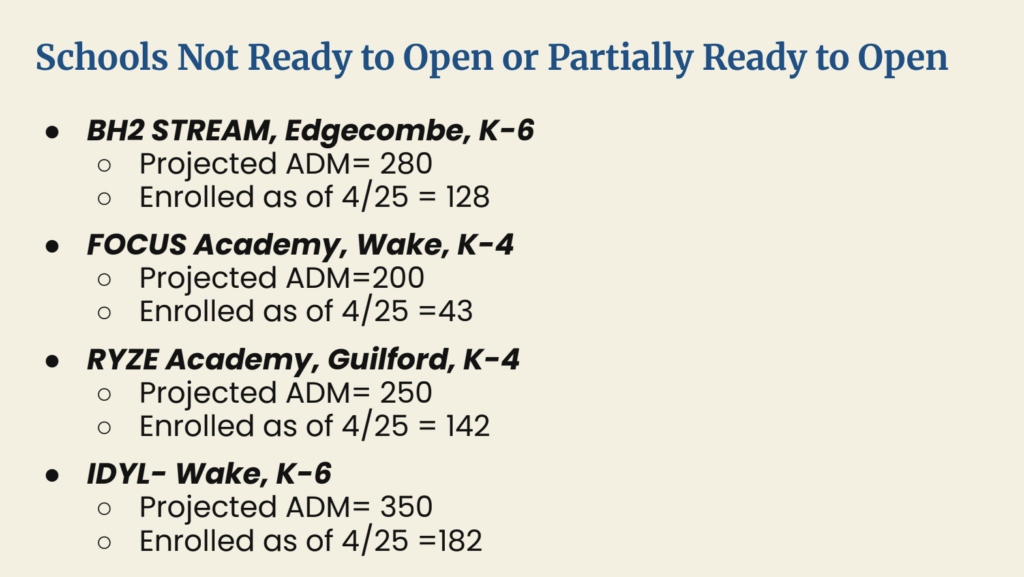
Focus Academy leaders highlighted challenges in converting student applications to registration. OCS figures from April 25 show Focus had enrolled just 43 of 200 students, 21.5% of projected enrollment. Enrollment, leaders said, is now at 53 students.
A slow start and the school’s proximity to two charter schools contributed to sluggish enrollment, leaders said. However, they implemented a new strategy that has included engaging in person with parents and contracting with a marketing company. Over 50 new applications have come in within the last two weeks, leaders said.
Friend warned Focus leaders about statutory enrollment requirements, mandating an 80-student minimum, and told them to prepare for attrition.
“There’s recent history that we just cannot repeat, and that is schools who came before us who were not at even the state minimum of 80 or slightly over,” he said. “For those of us who operate schools, we know when 100 families say they’re sending their child to your school on day one, it’s 75 that show up.”
Leaders from RYZE Academy also shared progress on readiness criteria, including staffing and busing. According to OCS, enrollment is a key concern, with the school enrolling just 142 out of 250 students, or 56.8% of projected enrollment as of April 25.
On Monday, however, RYZE leaders said the school has 171 students fully enrolled, and they expect to hit 200 students by the end of the month — close to 70% of projected enrollment.
IDYL-Wake, a replication of IDYL-Durham, is substantially or fully ready on major criteria except enrollment, which OCS pegged at 182 students, or 52% of projected enrollment.
Yvette Munroe, IDYL’s CEO and superintendent, provided updated numbers, confirming 217 enrollments. The school has engaged a customer relationship manager to do marketing and branding. A key performance indicator, she said, was to have 100 enrollments within one month.
“We have many applications that have not converted yet, and we have folks in the community working on going to those addresses and collecting documents,” she said.
The three other schools in the 2026 RTO cohort — NC Connections Academy, Carolina Collegiate High School, and Warren YES — are “substantially or fully ready to open,” according to OCS, and are on track with enrollment, facilities, and other benchmarks.
You can view readiness reports for the seven RTO schools in this folder.
Amendments, including a low-performing school’s expansion
CSRB members also approved a mission statement revision request from Mountain Discovery Charter School, while noting it lacked substance and warranted clarity.
However, the CSRB denied a mission statement request from Central Park School for Children, with members saying the statement needed greater detail.
The school’s original mission statement was “to create a community rooted in justice and equity where all children thrive.” The revised mission statement was simply, “All children thrive.”
The revision did not specify what the school was going to do, Friend said.
“It seems an awful lot like the previous mission statement,” Guckian said. “So, I just want us to be more consistent as a board … We are definitively in the weeds right now, but these are important weeds, I think.”
In another amendment request, TMSA Charlotte received CSRB permission to expand enrollment by more than 20% for 2026-27. Statute requires low-performing schools to obtain CSRB permission before growing enrollment by over 20%, as this is considered a material revision to the school’s charter.
The school currently serves over 1,300 students but hopes to expand to 1,806 students.
In 2025, TMSA Charlotte was low-performing and continually low-performing, earning a school performance grade of D.
Low-performing (LP) schools have received either D or F performance grades and a growth status of met or not met, according to state guidelines. Continually low-performing (CLP) schools have been low-performing for two of the past three years.
TMSA Charlotte’s amendment request cited “a combination of academic, operational, and financial factors” as drivers for expansion.
School programs including STEM labs are popular, TMSA Charlotte’s secondary school principal Mustafa Aydin said, noting, “We have a huge demand from the community.”
As of May 10, the school had received over 2,000 applications for the upcoming year, he said.
Expansion would help reduce the waitlist, which included 207 students as of May 10, Aydin said. In addition, he noted, TMSA Charlotte is receiving 60-70 applications a week.
Some CSRB members expressed reservations about the school’s poor academic performance.
“There is a concern that the school needs to focus on the academic performance before trying to grow,” CSRB member Rita Haire said. “I think that’s why the legislators wrote this into the statute that you come (before the CSRB), because you’re trying to grow and expand something that’s not working optimally yet.”
TMSA Charlotte narrowly missed C status, Aydin said. Academic growth has increased, and internal assessments are promising.
“If there wasn’t a waiting list, I wouldn’t suggest this,” CSRB member Lindalyn Kakadelis said. “But if there’s parents that want to go there, knowing the situation in Mecklenburg County, I want to give them options.”
Two charter schools in the planning process also secured CSRB approval for amendment requests.
Carolina Collegiate, a member of the 2026 RTO cohort, received permission to decrease enrollment from 200 to 165 students. Leaders requested the decrease due to facility capacity, family demand, and other factors.
Carolina Collegiate’s request noted:
Current enrollment data support this revision, as the school has received 262 applications, with 159 accepted offers (plus 9 pending) and 147 families already engaged in registration. Application flow remains steady, and the school expects to reach full enrollment by August. The school has developed a revised budget to align with the lower enrollment while maintaining financial health and compliance with facility requirements.
While Carolina Collegiate plans to operate as a high school at capacity, it will serve ninth grade students only in in its inaugural year.
Bettis Academy, a member of the 2027 RTO cohort, received CSRB approval for several requests:
- A mission statement change emphasizing “leadership and entrepreneurship.”
- A revision to year one enrollment and grade span (reducing projected enrollment from 420 to 150 students, and serving students in kindergarten and ninth grades only, rather than K-6).
- Implementation of a weighted lottery, enabling educationally disadvantaged students to comprise 45% of enrollment.
Starting with smaller enrollment is a “necessity” based on the temporary facility’s capacity, said Allison Brown, Bettis Academy’s founder and board chair.
The kindergarten and ninth grade entry points represent “the peak interest of our community,” Brown added. Separate wings in the potential facility would enable leaders to keep the two student groups separate.
NC SECU scholarship recipients
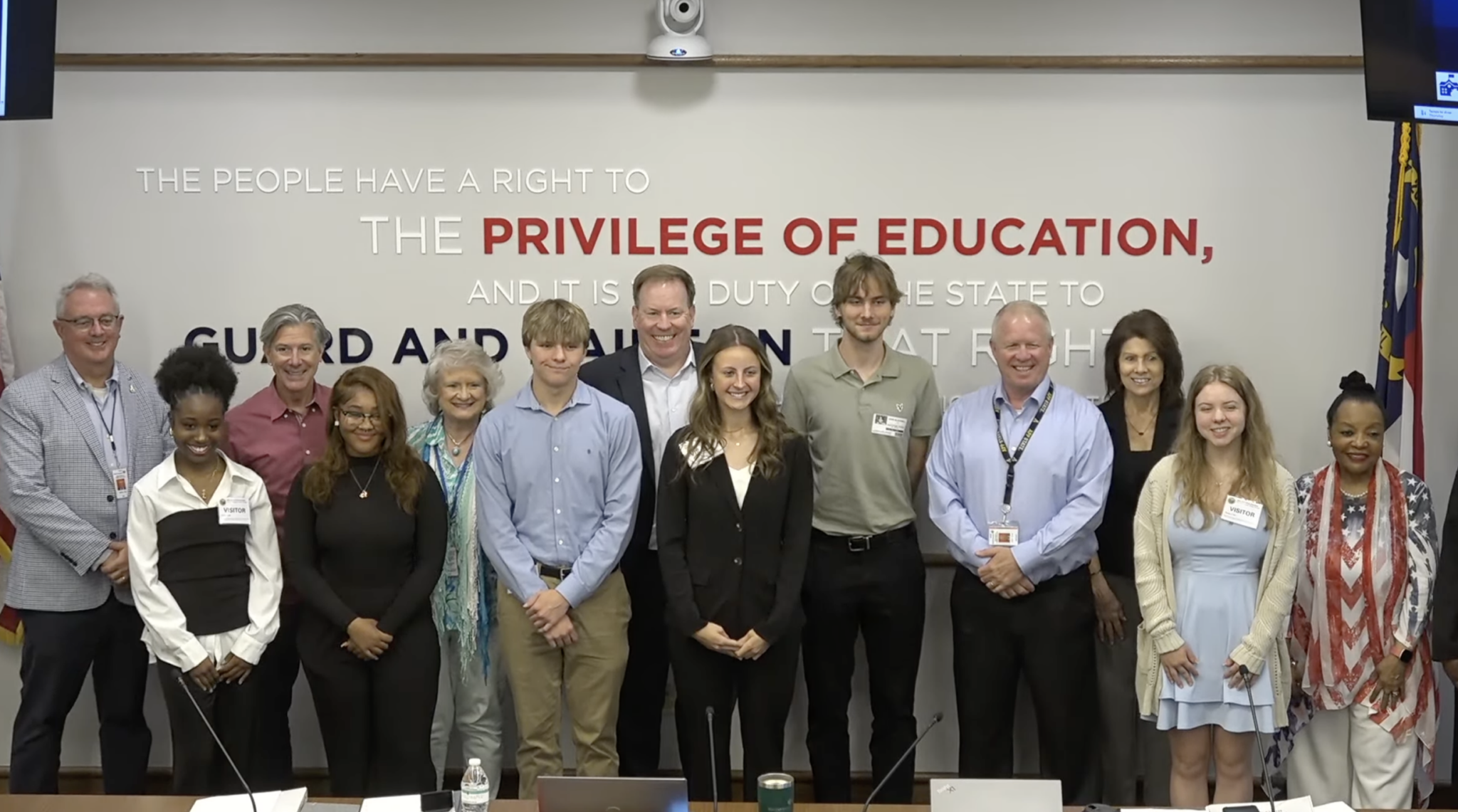
Norins also announced 10 charter students who earned a 2026 NC SECU (State Employees’ Credit Union) People Helping People Scholarship.
Seven of the students attended this month’s meeting, sharing their future college and career plans with the CSRB.
“This group of students has come from all over the state today to be present and to be acknowledged for their community service in and outside of their charter school,” Norins said during her presentation.
Charter scholarship recipients for 2026 are:
- Landon Oakley of Voyager Academy
- Kynzie Jordan of Chatham Charter School
- John Wallace Blackwell of The Hawbridge School
- Gabriel Young of Gray Stone Day School
- Zuri Agie of Rocky Mount Preparatory School
- Kyla-McKenzie Greene of Cornerstone Charter Academy
- Mia Chaney of Lincoln Charter School
- Kayla Lee of Longleaf School of the Arts
- Hayes Davis of Roxboro Community School
- Ethan Tomko of Community School of Davidson
Students will receive a $10,000 scholarship across their four years at a state university. Eligibility criteria encompass GPA requirements as well as “leadership, excellence of character, integrity, and community involvement.” Scholarship recipients must also be SECU members or the child of a SECU member.
“It’s quite apparent that the future of our university system is also quite strong when we have such outstanding students such as you attending,” Friend told the students.
The CSRB meets next on June 8.
Editor’s note: EdNC has retained Kristen Blair to cover the monthly meetings of the Charter Schools Review Board. Kristen currently serves as the communications director for the North Carolina Coalition for Charter Schools. She has written for EdNC since 2015, and EdNC retains editorial control of the content.
The list of SECU scholarship recipients was updated after publication, following a corrected list being sent out via email by the Office of Charter Schools.