
Leaders say childhood resilience is a ‘policy imperative’ at State of the Child Summit
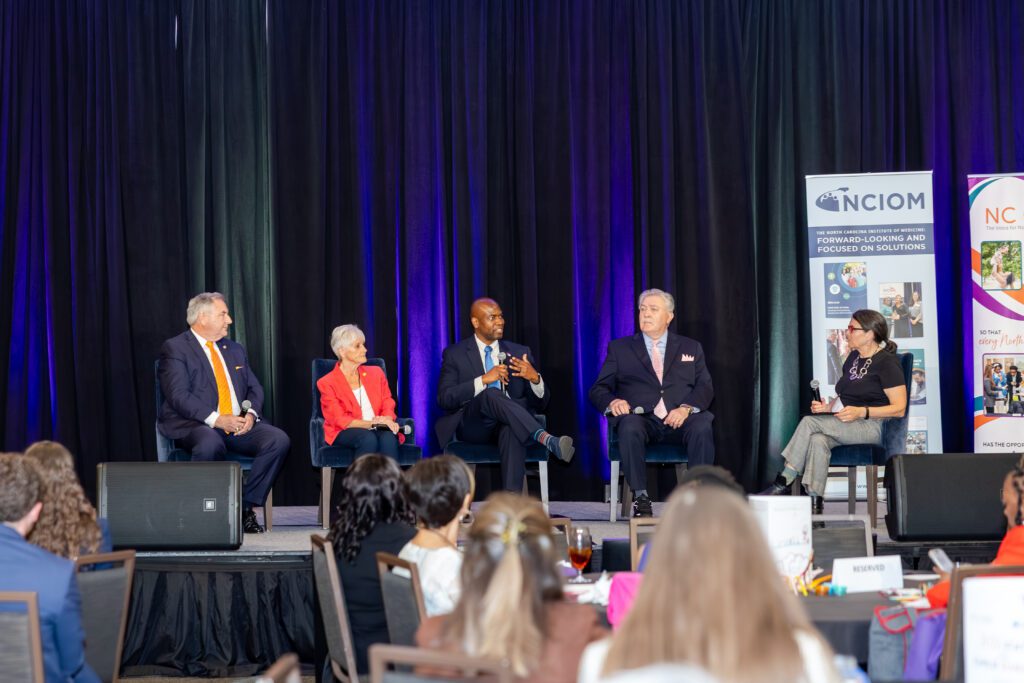
At this year’s State of the Child Summit, hosted by NC Child and the North Carolina Institute of Medicine, the focus was on supporting the health and well-being of children and families in every ZIP code — even when progress seems stalled.
The day-long summit took place in Raleigh last Thursday, with lawmakers, educators, health care providers, and other stakeholders in attendance. A recorded video from U.S. Sen. Thom Tillis, R-North Carolina, helped kick off the event. In it, Tillis said:
Every child in North Carolina deserves the opportunity to thrive regardless of their ZIP code. Whether we are discussing health outcomes, food insecurity, or educational success, our mission remains the same: putting our children first. We know that the last few years have been particularly tough in western North Carolina. Our families are still showing incredible resilience as they rebuild after the devastation of Helene. It reminds us that childhood resilience isn’t just a buzz word, it’s a policy imperative.
The case for incrementalism
Erica Palmer Smith, NC Child’s executive director, gave the third annual State of the Child address, emphasizing the importance of incremental progress.
“North Carolina is already first in flight and first in freedom, and we are on our way to being first in children,” Palmer said. “We have some big problems to address, and our children can’t wait.”
Palmer used the story of the Wright brothers to make the case for incrementalism:
The Wright Brothers imagined a future where powered flight was possible, and they did it — 12 seconds and 120 feet. But they didn’t stop there. That same day, they launched again and again and again. They went from 120 feet, to 175, to 200. They broke their own record every time they launched. At the end of the day was a flight that lasted 59 seconds and went 852 feet, and they only stopped there because the plane broke.
The story doesn’t end there, because this isn’t a story about the Wright brothers. It’s about us. Last week, the Orion spacecraft on the Artemis II mission traveled 252,756 miles from the earth. It is the farthest flight recorded in human history, and stowed away with the crew on this historic flight was a one inch section of the plane that made the first flight. When the Wright brothers were launching off the sand dunes at Kitty Hawk, space travel was not on their radar, but it happened because of them. It happened because of the other people who saw what was possible and had the courage to imagine a future that was even bolder and brighter. It happened because we had the courage to keep going, even when we didn’t get as far as we had hoped.
Palmer encouraged advocates to remain focused on the promise of progress, and to not be discouraged or distracted by problems along the way.
“Right now, there are too many children in North Carolina who face adversity that can seem insurmountable,” Palmer said. “But we know that there are actionable steps that we can take to get us closer to the big dreams that we have for them, and the ones they have for themselves.”
Youth insights
Following Palmer’s remarks, three members of NC Child’s Youth Advocacy Council (YAC) sat on a panel to discuss the status of youth mental health and their efforts to develop a policy proposal for a statewide peer support helpline.
Moderator Raymond Harrison, Jr., senior associate athletics director at North Carolina State University, asked the panelists what misconceptions adults have about the reality of the youth mental health crisis — and what they wanted everyone in the room to think about and act on moving forward.
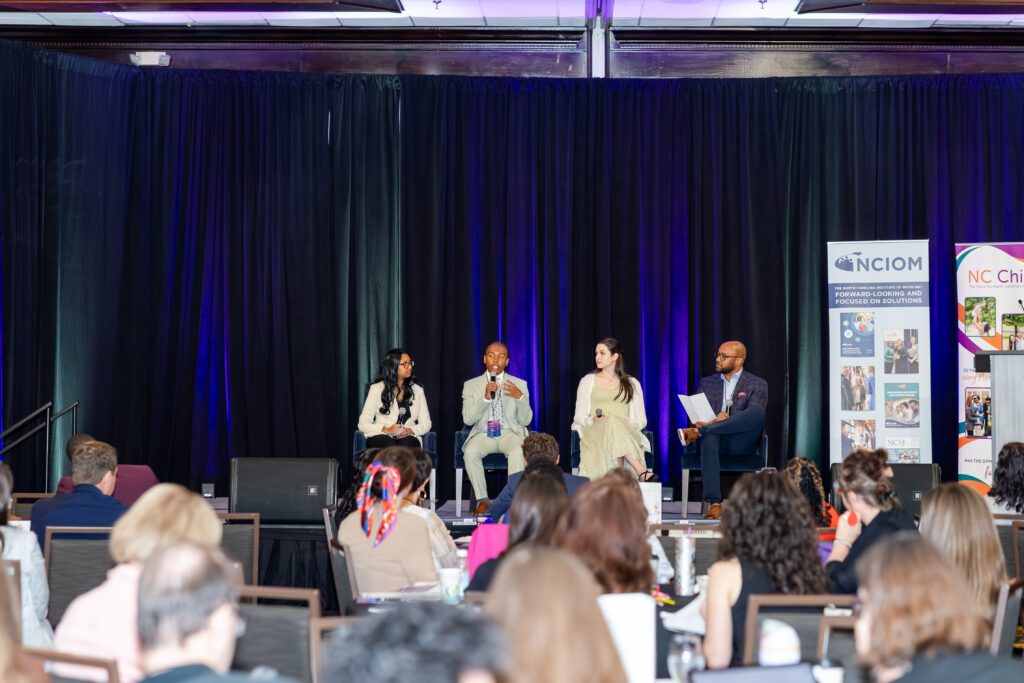
“One challenge that I see is a lot of times I feel as though adults forget what it was like to be a youth, what it was like to be a child,” said Carmello Gilliam, a high school junior from Bertie County.
Gilliam said one reason the YAC is proposing a peer support helpline is because youth often feel more comfortable talking to their peers than their families.
“But what I can say is that parents, if you raise your children well, then they have that mindset already to be there for one another, to hear one another, understand one another, and to try to share with one another,” Gilliam said.
Royce Allegretto, a high school senior from Alamance County, said: “I think a major misconception adults have is that youth mental health is just a phase, when in reality, conditions like depression, anxiety, stress can be more serious than that.”
Ananya Sampreeth, a high school sophomore from Iredell County, expanded on Allegretto’s response.
“What people don’t realize is that youth who have mental health problems grow up to be adults who have mental health problems,” Sampreeth said.
She added one piece of advice for the adults in the room who want to support the mental well-being of the youth in their lives: “We don’t want solutions, we want someone to talk to.”
 Sign up for the EdDaily to start each weekday with the top education news.
Expert insights
Following breakout sessions on topics including the risks of vaping and how to make the most of Medicaid, Gov. Josh Stein laid the groundwork for the second half of the day via a recorded video message.
In it, Stein spoke about the importance of early care and learning, free and healthy school meals, and Medicaid funding ahead of the release of his 2026-27 budget proposal.
Tassy Warren, co-executive director of Harvard’s Center on the Developing Child, gave a keynote presentation on why early care and learning is critically important to the health and well-being of children and their families.
“Being a caregiver and a parent is really hard, and there are so many ways in which the policies and the systems in this country make it even harder than it needs to be, and in very unequal ways,” Warren said. “And I want to change that, and I know that you all do too.”
Her presentation covered the science behind three key aspects of child development: brain architecture, serve-and-return, and toxic stress (all of which you can learn more about by reading the EdExplainer below.)
“The ZIP code where we live, learn, play and grow shapes our health in childhood and beyond, and there’s a well-established body of research that shows this,” Warren said, directing attendees to explore the Child Opportunity Index to learn more.
Warren’s keynote presentation was followed by an update on rural health from Colleen Briggs, president of the Blue Cross NC Foundation, who spoke about the role of philanthropy in rural health.
Briggs said that in her travels across the state, she’s seen what happens “when your ZIP code defines your health access and your health outcomes, when where you live determines if you have access to affordable and accessible care.”
She shared “some of the things we’re seeing work really well” when it comes to philanthropic support for rural health:
- Investing in local organizations who know their communities best.
- Solutions that meet communities where they are and are designed by the communities.
- Investing in comprehensive solutions, such as health, food, transportation, and housing.
Briggs also noted that organizations like hers are “going to have to be responsive to some of the big challenges that are facing rural communities,” such as increasing health care costs, workforce shortages, and changes to Medicaid and Supplemental Nutrition Assistance Program (SNAP).
She concluded on a message of hope:
The one thing that does really energize me, I’m seeing so much collaboration, a lot of new, creative thinking, everyone’s coming together with the same realization: the health care system is fundamentally broken, it’s not working for rural children and their families. But we’re seeing people come together and look at new paths forward, new ways that we can collaborate and create a future where we really could have affordable, accessible care for children and families.
Legislator insights
The final event of the day — following breakout sessions on topics such as oral health and child nutrition — was a panel discussion with state legislators, moderated by Rose Hoban, founder and editor of NC Health News.
The panelists were Sen. Gale Adcock, D-Wake; Sen. Jim Burgin, R-Harnett; Rep. Allen Buansi, D-Orange; and Rep. Donnie Loftis, R-Gaston.
During the panel, legislators shared their own concerns about access to health care, especially in rural areas.
Burgin shared and example from his own district. He said Harnett County has not had labor and delivery services for birthing parents in the last few years. Those parents have to go to a hospital in another county to give birth.
Legislators also discussed how changes in federal funding for programs such as SNAP and WIC are putting pressure on state and local resources to fill the gaps — all of which negatively affects the health and well-being of children and families.
“We should be thinking about how every policy we discuss is going to fall on families and children,” Adcock said. “They’re the future; it’s the obvious statement, but it’s also the truth, and if we don’t think in advance, then we have some really bad outcomes for kids that we didn’t even think about at the time.”
Editor’s note: The Blue Cross Blue Shield of North Carolina Foundation supports the work of EdNC.