
Research | A commitment to improving K-5 mathematics instruction in NC

Mathematics is foundational to long-term student success, and because math learning builds cumulatively, early mastery is critical. Yet across North Carolina, inconsistent curriculum quality, uneven instruction, and limited access to actionable data have weakened K-5 math outcomes, allowing gaps to compound over time and limit access to advanced coursework and career pathways.
A broad working group convened to align around a shared, student-centered vision for K-5 mathematics — calling for standards-aligned high quality instructional materials, curriculum-based professional learning, actionable assessments, and coordinated interventions. The resulting recommendations provide a coherent statewide framework aligning materials, training, assessment, staffing, funding, and policy to reduce variability and drive sustained improvement in math outcomes.
 Sign up for the EdDaily to start each weekday with the top education news.
North Carolina Counts on Math (NCCOM): Designing a Shared Vision for K-5 Math began with a statewide landscape analysis to establish an evidence-based understanding of current instruction. Through interviews with educators and state leaders, document reviews, and analysis of instructional practices, the project identified significant variation in curriculum quality, professional learning, assessment alignment, coaching, and data use — revealing both strong practices and systemic fragmentation.
Building on these findings, the working group convened over three months to align around a shared, student-centered vision for K-5 mathematics. The vision emphasizes well-supported teachers using standards-aligned, high-quality instructional materials; curriculum-based professional learning; aligned, actionable assessments; and coordinated interventions. The group developed a clear implementation framework outlining the roles of educators, school and district leaders, and policymakers to ensure statewide coherence.
The resulting recommendations align materials, training, assessment, staffing, funding, and policy into a cohesive strategy to reduce variability and drive sustained improvement in math outcomes statewide.
A shared, student-centered vision for K-5 mathematics
NCCOM convened educators, policymakers, researchers, and system leaders to examine K-5 math instruction across North Carolina. They found wide variation in students’ math experiences depending on where they attend school.
In response, the group aligned around a shared, student-centered vision to ensure every child consistently receives rigorous, coherent, and engaging math instruction that builds lasting understanding and skills.
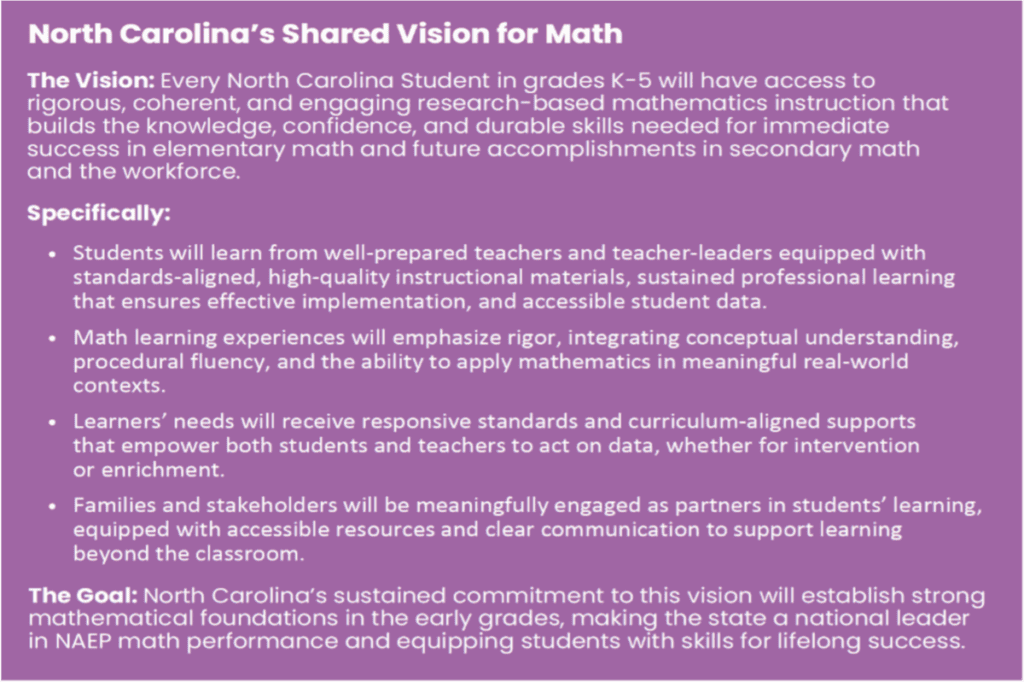
At the center of this vision is a commitment to ensuring that every student develops strong foundational knowledge in early mathematics, setting the stage for success in Math I, advanced coursework, and future career pathways. To achieve this, NCCOM identified four essential enabling conditions that must be aligned across classrooms, schools, districts, and state systems:
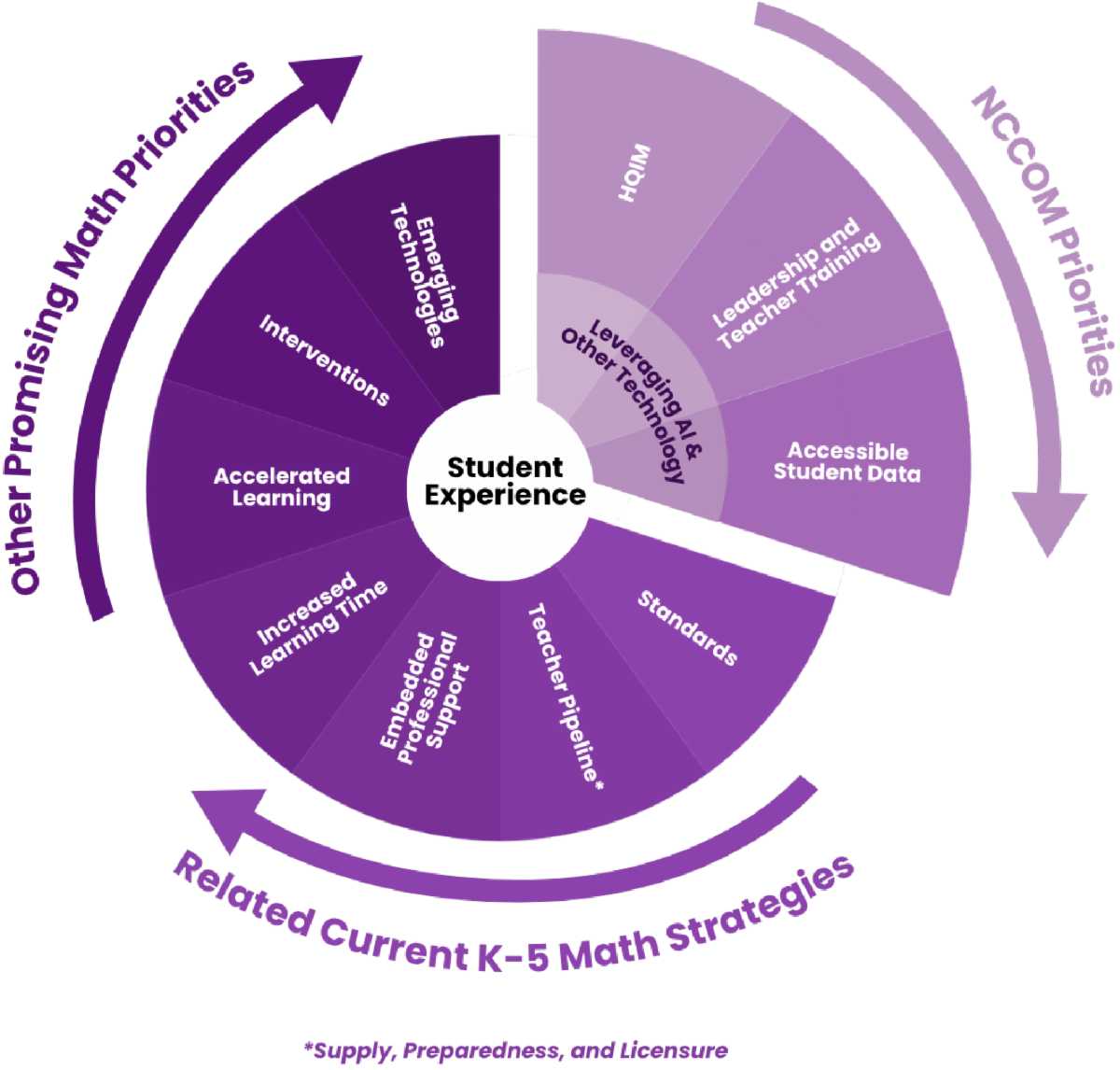
- High-Quality Instructional Materials (HQIM): Students must have access to standards-aligned, research-based instructional materials that provide coherent learning progressions, balanced rigor across conceptual understanding and procedural fluency, and meaningful opportunities for application.
- Educator training and support: Teachers and instructional leaders must be equipped with research-aligned instructional practices, sustained curriculum-based professional learning, and embedded coaching structures that enable strong implementation and continuous improvement.
- Accessible student data: Educators must have access to diagnostic and summative assessments that provide timely, actionable insight into student mastery of specific standards and prerequisite skills, enabling targeted instruction, intervention, and enrichment.
- AI and Emerging Technologies: Schools should leverage AI-powered data tools that synthesize student work, screeners, curriculum-embedded assessments, and classroom performance data to provide clear, actionable insight into student mastery — enabling teachers to target instruction, practice, and intervention with precision and timeliness.
Together, these conditions form the foundation of a coherent statewide strategy — ensuring that every North Carolina student, regardless of ZIP code, receives high-quality mathematics instruction grounded in research and aligned to a clear, shared vision of excellence.
Related reads



Myth busting: Providing clarity around HQIM authority
A legal analysis commissioned by BEST NC and conducted by McGuireWoods LLP affirms that North Carolina has a strong legal foundation to shape instructional quality statewide. Rooted in the state constitution, statutes, and case law, this framework clarifies how state leaders can require, recommend, and incentivize the use of high-quality instructional materials (HQIM).
Governance framework
The State Board of Education sets statewide curriculum and instructional expectations under constitutional authority, the Superintendent manages operations and funding, and the Department of Public Instruction (DPI) implements policy.
Authority over HQIM
When HQIM meet the broad legal definition of “textbooks” and are adopted through the state process, the State Board may require their use statewide.
Limits and legislative role
Supplementary materials cannot currently be mandated, but the General Assembly could expand authority through statutory updates.
Bottom line
North Carolina already has strong authority to require, recommend, and incentivize HQIM, with potential for broader mandates through legislative action.
Implementation recommendations
The NCCOM implementation recommendations provide a coherent, phased strategy for strengthening K-5 mathematics instruction statewide.
Rather than layering on additional initiatives, the recommendations align existing efforts around a shared, student-centered vision and focus on building the enabling conditions necessary for durable improvement. The plan emphasizes coordinated action across curriculum, professional learning, assessment, leadership structures, funding, and policy — ensuring that each lever reinforces classroom practice rather than operating in isolation.
At the core of the recommendations is the consistent use of standards-aligned HQIM, supported by curriculum-based professional learning and embedded coaching structures. Key instructional components include:
- Adoption and implementation of state-vetted HQIM aligned to the standard course of study.
- Curriculum-based professional learning (CBPL) tied directly to adopted materials.
- Expansion of Advanced Teaching Roles (ATR) to strengthen school-based coaching and collaborative planning.
- Protection of structured PLC time for lesson internalization and student work analysis.
- Strengthening assessment coherence and instructional decision-making through aligned data systems.
Assessment recommendations include:
- Implementation of a statewide K-5 numeracy screener aligned to grade-level standards.
- Alignment of screeners, curriculum-embedded assessments, and MTSS processes.
- Deployment of integrated data dashboards and AI-enabled tools to help teachers identify student mastery of specific standards and prerequisite skills.
- Clear statewide expectations for universal screening, progress monitoring, and intervention.
Finally, the implementation plan outlines policy and structural supports necessary to sustain this work at scale. These include aligning State Board guidance, funding streams, licensure expectations, and principal preparation standards to the shared vision; supporting district readiness through a phased cohort model; and strengthening DPI’s cross-divisional coordination capacity.
Together, these recommendations create a unified framework designed to reduce variability, increase instructional coherence, and ensure every North Carolina student builds a strong foundation in early mathematics.