
Closing the attainment gap: myFutureNC unveils new data and ‘Workforce Act’ to hit 2030 goal

In June 2019, North Carolina established an ambitious attainment goal: By 2030, 2 million residents between the ages of 25 and 44 will have completed a high-quality credential or postsecondary degree.
Now, state leaders are reflecting on progress made so far and what it will take to achieve it.
On Feb. 12, myFutureNC — the statewide nonprofit organization focused on educational attainment — convened education, government, business, and nonprofit leaders in eight virtual events to discuss North Carolina’s progress toward the statewide attainment goal and a proposed Workforce Act of 2026.
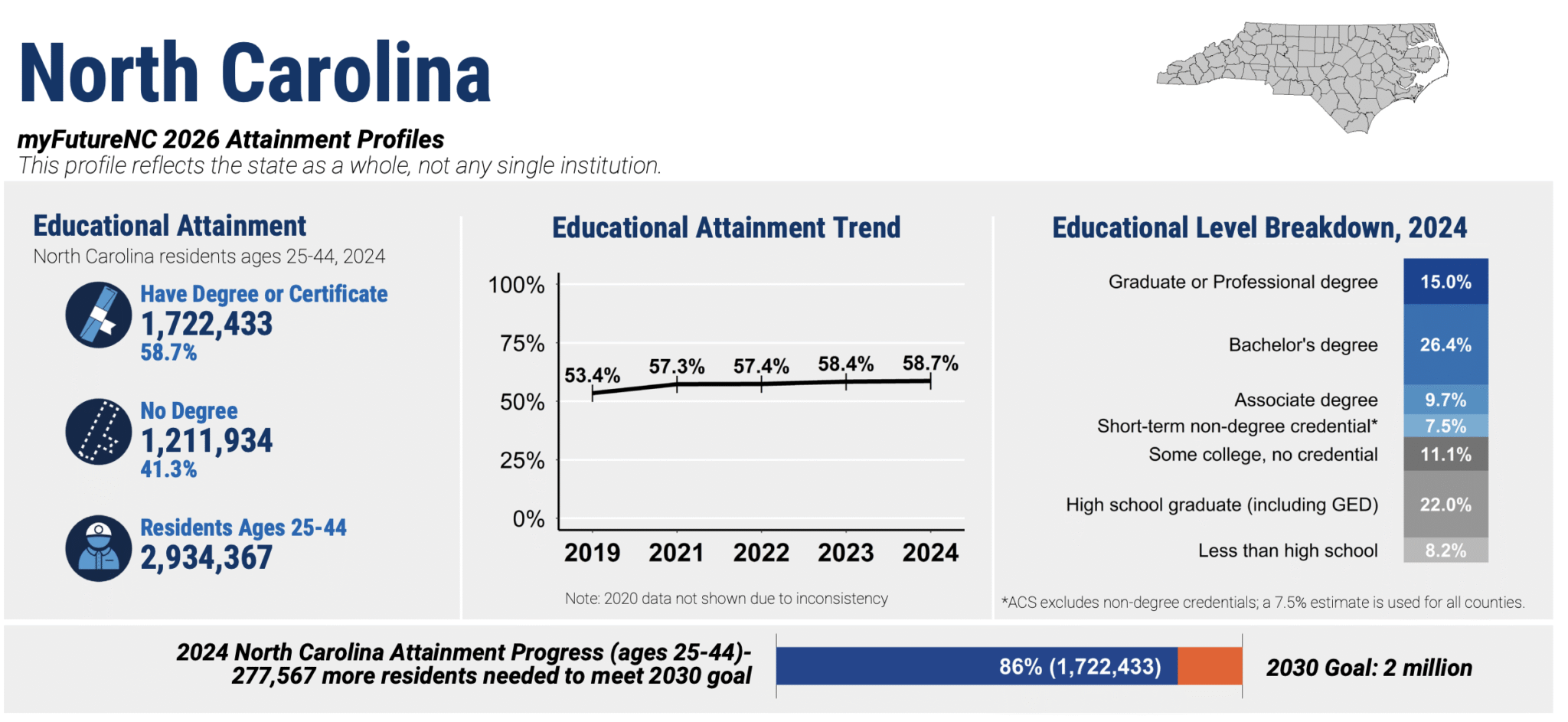
Since 2019, more than 272,000 North Carolinians ages 25-44 have earned a degree or industry-valued credential, including 57,000 who gained that degree or credential in the last year alone. That brings the state’s total to 1.72 million adults with a degree or credential in 2024 — roughly 280,000 short of the 2030 goal.
While this data represents progress, Cecilia Holden, president and CEO of myFutureNC, also called it a “warning light.”
“Nearly 40% of adults ages 25 to 44 in North Carolina — or about 1.2 million individuals — still do not have a degree or credential,” Holden said during the virtual event.
According to the statewide attainment profile, top opportunities for growing attainment include increasing the number of adults earning a family-sustaining wage, postsecondary completion, FAFSA (Free Application for Federal Student Aid) completion, and the number of 4 year olds enrolled in NC Pre-K.
Throughout the event, speakers emphasized that North Carolina’s progress in educational attainment relies on the coordinated efforts of many across the state — including educators, institutions, employers, policymakers, and philanthropists.
In prerecorded remarks, Gov. Josh Stein praised myFutureNC’s work and noted that the state ranked both No. 1 in business and No. 1 in workforce development in the last year.
“Neither of those accomplishments would be possible without the people of North Carolina,” Stein said. “To invest in our future, we have to invest in our people.”
In 2025, Stein created a Council on Workforce and Apprenticeships, which published a report in December with 30 recommended strategies for workforce development. Stein noted that those strategies include implementing new Workforce Pell Grants, creating more apprenticeships, engaging more employers in key sectors, launching a public awareness campaign about existing workforce development programs, and reaching the state’s 2030 attainment goal.
“Instead of reinventing the wheel, we want to build off what we’re already doing right here in North Carolina,” Stein said. “I’m committed to investing in our future, partnering with employers, strengthening community colleges, and creating pipelines from education to opportunity.”
Read more about the council’s work
North Carolina Speaker of the House Destin Hall, R-Caldwell, and Sen. Brad Overcash, R-Gaston, also praised the work of myFutureNC and others across the state who are advancing attainment efforts.
“A strong workforce doesn’t happen by accident — it requires coordination across education, industry, public leadership, and of course, our fine citizenry,” Overcash said. “We’re strengthening pathways from education to careers, improving alignment between credentials and those real workforce needs.”
Workforce Act of 2026
During the event, myFutureNC unveiled its proposed Workforce Act of 2026, which Holden said builds on strategies that are already working and scales them statewide.
“At its core, it invests in alignment — between education and employment, between what learners earn and what employers need, and between statewide goals and regional realities,” Holden said.
The act would focus on four policy priorities:
- Work-based learning: The act would expand paid, employer-led training tied to credentials by scaling ApprenticeshipNC, the state’s apprenticeship agency that helps businesses develop Registered Apprenticeship Programs to meet their workforce needs.
- Career exploration: The act would invest in NCCareers, the state’s online resource hub for students and working adults that helps them find a career that fits their skills and interests.
- Seamless education pathways: The act would support smoother transfer pathways across education systems through the adoption of technology to ensure students can move between institutions or return to education more easily.
- Employer-valued credentials: The act would support NC Workforce Credentials and short-term credential grants to expand access to credentials that employers value.
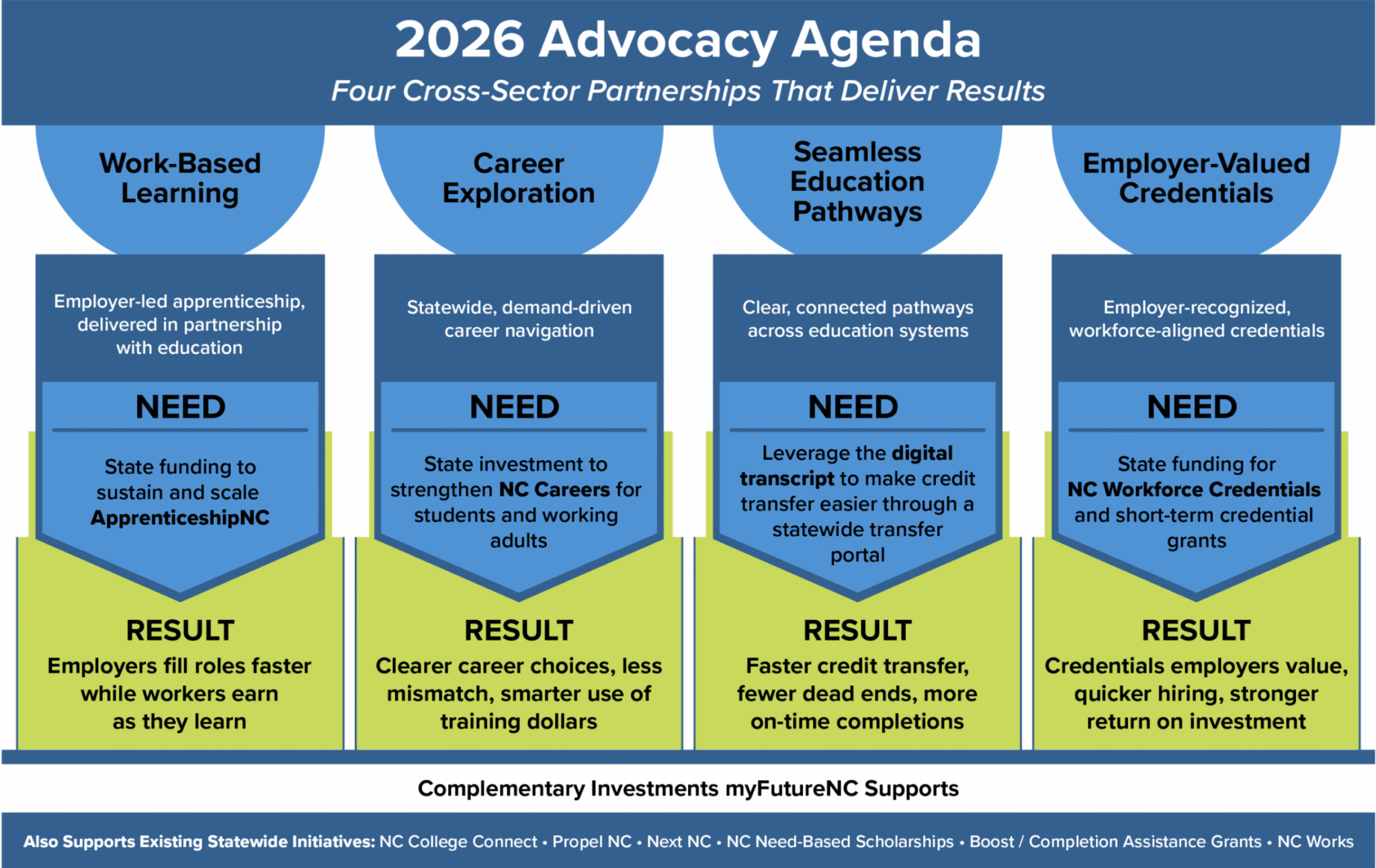
“Together, these strategies reduce friction across the education-to-employment system — making it easier for people to start a pathway, stay on track, and finish with a credential that leads to a good job,” Holden said.
Holden called on event attendees to support the development and passage of the Workforce Act of 2026, noting that reaching the state’s attainment goal will require both local and statewide action.
Attainment drivers and regional trends
Holden said progress toward the state’s attainment goal has been driven by two factors: an expansion in access to educational opportunity and increased alignment with employer needs.
“We’re seeing progress because pathways are opening earlier and staying open longer,” said Holden, noting that this year’s report shows more students earned credit before high school graduation, more adults returned to college, and more students stayed enrolled because of financial support.
Efforts to better align education with employer needs include expanding employer partnerships, scaling work-based learning, and increasing apprenticeships and pre-apprenticeships, which Holden said grew by 45% and 50%, respectively, in 2025.
“In North Carolina, employer leadership isn’t optional — it’s foundational,” Holden said.
The eight virtual events were divided by the state’s prosperity zones, allowing attendees to hear about regional attainment efforts. According to myFutureNC, 85 of North Carolina’s 100 counties have increased educational attainment since 2019.
Holden said some regions are accelerating attainment faster than the state average, while others still have a gap between employer demand and local talent pipelines.
“That’s why regional leadership matters — and why myFutureNC is focused on turning statewide goals into local results,” she said.
You can view attainment profiles by county, prosperity zone, workforce development board, and council of government on myFutureNC’s website. Each county attainment profile identifies unique opportunities for growth.
Holden encouraged attendees to review their local attainment profile and contact their myFutureNC Regional Impact Manager to discuss advancing local attainment efforts.