
Meet the program advancing teaching excellence for NC’s community colleges
North Carolina’s community colleges are economic drivers for the state, providing residents with credentials and supplying a robust pipeline for both college transfer and the workforce.
Nearly 18,000 faculty members lead this charge, serving as teachers, advisers, and mentors, and helping the state’s community college students meet their academic and career goals.
Despite their role in shaping the state’s economic future, these instructors often have few opportunities for advancement and recognition.
 Sign up for Awake58, our newsletter on all things community college.
Unlike universities, most of the state’s two-year colleges do not have academic ranks for their instructors, limiting salary growth as instructors cannot progress to more advanced titles.
Recognizing this, Dr. Lane Freeman, director of online learning programs and student services for the North Carolina Community College System (NCCCS), set out to create a program that would both serve as professional development for instructors and recognize teaching excellence across the state.
Freeman helped launch the North Carolina Community College Master Instructor (NC3MI) program in 2024 — a six-month professional learning experience for community college faculty modeled after the National Board Certification program for K-12 educators.
Before joining the system office, Freeman spent more than 11 years as a high school teacher, during which he earned National Board Certification from the National Board for Professional Teaching Standards (NBPTS). Considered the “gold standard” for K-12 educators, the program uses rigorous standards to evaluate teaching practice through performance-based assessment. It’s a standard Freeman wanted to bring to the community college system.
Unlike K-12 educators, college instructors are not required to complete pedagogical training, and certification processes are limited.
“Good pedagogy is good pedagogy,” Freeman explained, noting that NBPTS practices can be applied by any teacher, regardless of a students’ age or educational level.
Read more about community college faculty
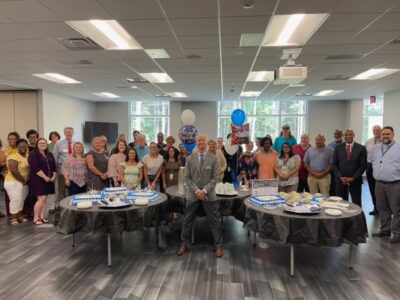
Through an application process, NC3MI selects faculty who exemplify high-quality, student-centered instruction. The program helps them develop and deepen research-based practices, which they can eventually model and spread across their campuses. Participants also earn a digital badge at the end of the program indicating they are a master instructor.
NC3MI requires participants to learn and apply research-informed strategies in courses they teach at their home college.
Throughout the program, participants implement strategies with their current students and then submit evidence of implementation, which may include documentation showing the strategy in action. Participants then reflect on the strategy’s impact, noting what worked, what didn’t, and what they would adjust next time, Freeman said.
Participants also engage collaboratively, sharing and discussing their strategies with cohort members and providing peer feedback through tools like discussion forums or VoiceThread.
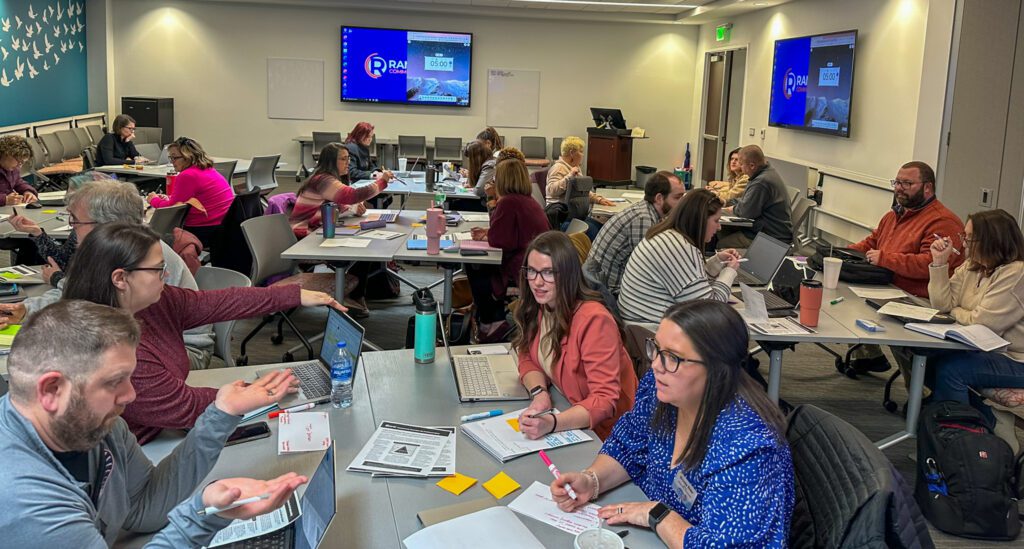
In his role, Freeman provides reflection prompts and guiding questions to structure the peer review conversations. While he monitors discussions to identify patterns or points of confusion, the reflection and revision process remains primarily peer-to-peer.
“This facilitative approach mirrors the spirit of the National Board for Professional Teaching Standards model,” Freeman said. “Participants aren’t being taught how to teach from scratch, they are demonstrating, reflecting on, and refining evidence of accomplished practice.”
Britt Honeycutt, an English instructor at Sampson Community College, and Jessica Brown, a biology instructor at Central Carolina Community College, recently completed NC3MI. Both faculty members said the experience not only helped them strengthen their whole-person approach to teaching but also served as a catalyst for their career growth.
Although Brown never received formal pedagogical training, she has always taught using a relational and holistic approach. Meeting student needs and adapting her teaching style along the way, much of which was intuitive, she said, has guided her through the years.
Even after teaching for 25 years, Brown said NC3MI was still beneficial, providing her with research-based practices, offering new perspectives from colleagues, and affirming that her own teaching habits were effective.
“Good teachers are always improving in the classroom,” Brown said.
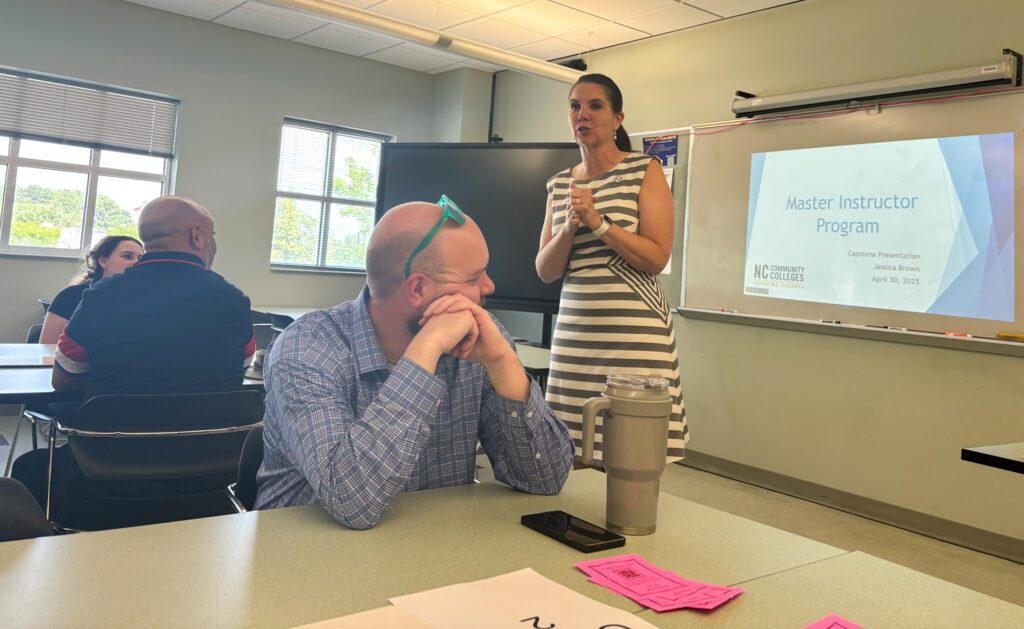
NC3MI includes 10 modules and a capstone project, during which participants must present their high-engagement practices to campus faculty and their supervisor or chief academic officer.
Brown described three main components of NC3MI, including how to teach most effectively, whether in person or online, how to connect course materials to industry standards, and how to better understand the students served by North Carolina’s community colleges.
During the 2024-25 academic year, the NCCCS enrolled more than 630,000 students across hundreds of programs. Adult learners, students ages 25 and older, make up over 50% of the system’s student population. These students enter college with complex needs and diverse backgrounds and goals. Many are parents, work full- or part-time jobs, and carry responsibilities that many younger students do not.
It’s crucial for instructors to understand who they are teaching in order to better serve their students, Brown said.
Read more about adult learners
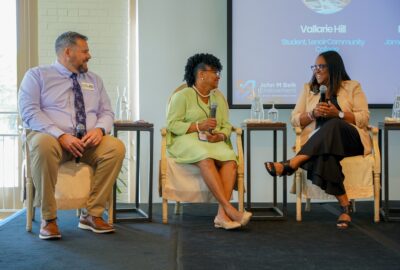
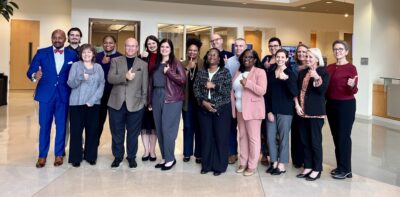
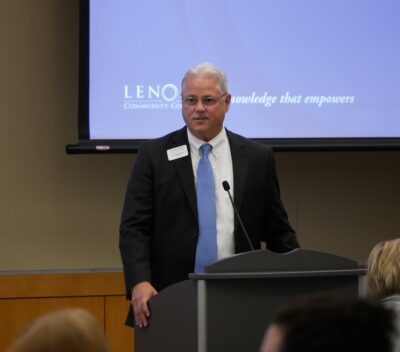
Honeycutt began her career in K-12 education and has been teaching at the community college for over 20 years.
For Honeycutt, NC3MI provided an opportunity to improve her teaching methods and apply new concepts from the program to her classroom almost immediately.
“The point of the program is to implement what you’re learning in real time and document how it is changing your students’ ability to understand your material and engage with your course,” Honeycutt said.
It also allowed her to collaborate with faculty members from across the state — an experience she described as unique and more beneficial compared to other professional development opportunities.
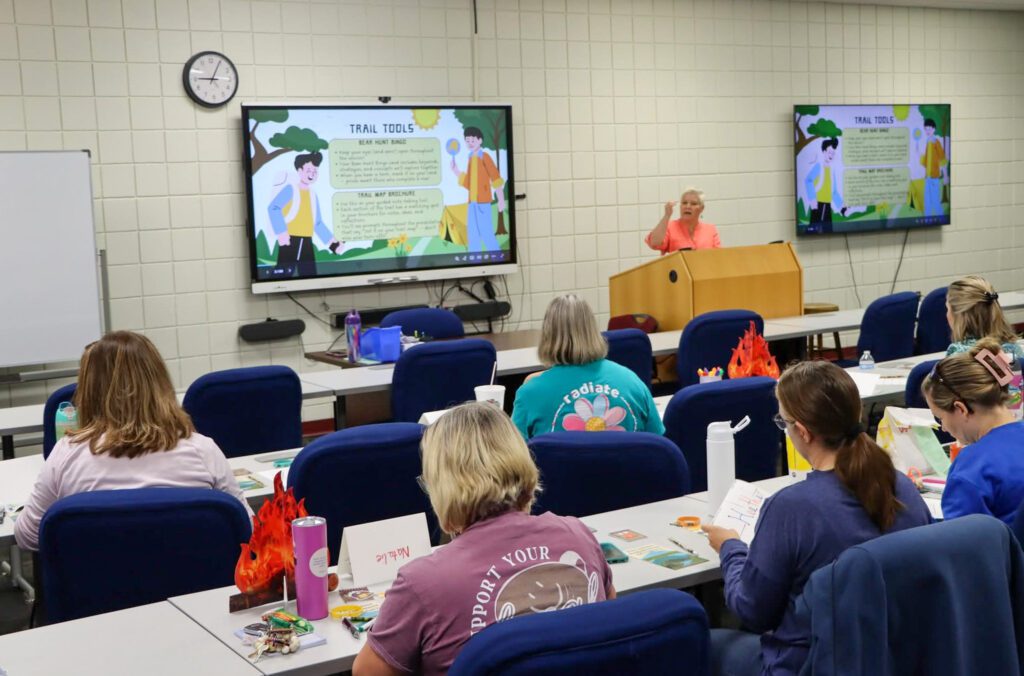
Honeycutt and Brown experienced another unique outcome after participating in NC3MI — new job responsibilities.
Brown is now the faculty professional development coordinator at Central Carolina Community College, and she leads new faculty orientation. Brown said she’s actively embedding practices that she learned in the program across her campus.
Honeycutt’s capstone focused on integrating artificial intelligence (AI) into the classroom and significantly impacted how the college invests in faculty training.
What was particularly powerful about her capstone wasn’t just the AI content itself, Freeman explained, it was how she taught it. Honeycutt modeled high-engagement instructional strategies, demonstrating practical ways faculty can use AI to design lessons, engage students, and create learning activities.
“In other words, AI was the topic and tool, but the key takeaway for observers was the master-level instruction behind it,” Freeman said.
As a result, Honeycutt now spends a large portion of her time organizing Sampson Community College’s professional development and facilitating the college’s faculty training course.
Both Honeycutt and Brown said they are excited for their new roles, but even more pleased to remain in the classroom.
Although completing NC3MI does not result in pay increases or stipends, Freeman said he hopes funding could become available in the future to provide some form of financial incentive for participants.
Since its launch, 42 of the state’s 58 colleges have faculty represented in the NC3MI program as graduates or current candidates.
Learn more about the North Carolina Community College Master Instructor Program
Who leads NC3MI: The program is led by the NCCCS and “developed by a cross-division task force grounded in the learning sciences and evidence-based teaching practice.”
The task force is primarily composed of system office staff, but the work of NC3MI has always been informed by perspectives from across the state, Freeman said, adding that he now leans heavily on feedback from past NC3MI graduates to improve the experience.
NC3MI Format: The program is primarily asynchronous, with live touchpoints throughout. Participants can expect to spend about 60 hours total across the full program, which, on average, is approximately four to six hours per module plus additional time for capstone planning and presentation. The time commitment can vary depending on an instructor’s teaching schedule and how quickly they can implement strategies in their classes.
Who is eligible for NC3MI: Full-time or part-time faculty members and college leadership who teach at least one course within the NCCCS can apply. Candidates must be nominated by college leadership at their home institutions.
Visit this website to find out more about the nomination process, program outcomes, and program contact information.