
New interest in an old problem: Faculty pay at North Carolina’s community colleges

This is the first article in a series on faculty pay at North Carolina’s community colleges. Click here to read the rest of the series.
“Adjunct Instructor, Advanced Manufacturing (Mechatronics),” began a recent classified advertisement in the pages of the Herald-Sun (Durham, NC).1 An applied technology field at the intersection of mechanical, electronic, control, and software engineering, mechatronics “are everywhere … from computer hard drives and robotic assembly systems to washing machines, coffee makers and medical devices.”2
Given the economic structure of Durham and the larger Triangle, such an ad from a local college or university would be unsurprising. What set this ad apart was the advertiser: Piedmont Community College (PCC), a public two-year institution serving Person and Caswell counties from two campuses located 40 to 50 miles away from Research Triangle Park.3
PCC’s Mechatronics Engineering Technology program requires full-time students to complete 68 credit hours over five semesters to earn an associate in applied science degree. The coursework is primarily technical in nature, involving such subjects as hydraulics, wiring, computer-assisted design, blueprint reading, automation, and physics.4 Graduates can enter such occupations as electro-mechanical technicians, robotics technicians, and automation technicians—all of which pay average annual wages in North Carolina of about $60,000.5
Attracting qualified instructors is not simply a challenge for rural colleges like PCC seeking to staff technical programs; rather, it is a perennial problem for all of the state’s two-year colleges. The mechatronics position for which PCC advertised was a part-time one, ideally for someone with a bachelor’s degree in engineering, paying between $18 and $24 per hour.6 Yet in North Carolina, such an experienced engineer earns, on average, $50 per hour.7 What might motivate someone, then, apart from a love of the subject, to pursue a contingent job that pays modestly, offers no benefits, and may require a lengthy commute and the associated out-of-pocket costs
North Carolina’s community colleges have a proud legacy of extending postsecondary education to all corners of the state and of training a skilled technical workforce. Those accomplishments, however, hinge on the work of dedicated faculty instructors—instructors who are paid much less than their national and regional peers.
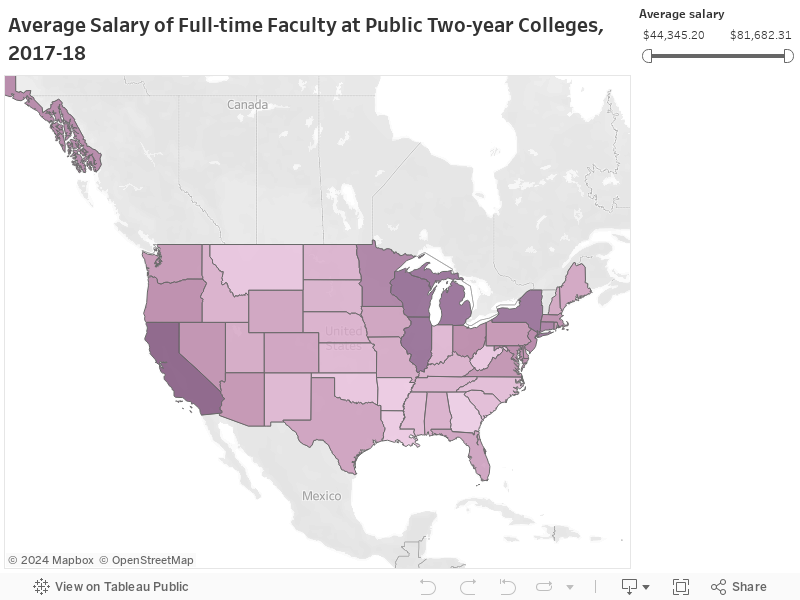
In 2017-18, the average full-time community college instructor in North Carolina earned $49,549, which was less than the corresponding salaries paid in all but seven states.8 At PCC, the average annual full-time faculty salary was $45,452, ranking the school 47th out of North Carolina’s 58 community colleges.9
Concern about faculty pay is not new, with public attention having waxed and waned since the 1980s. Over the past decade, North Carolina has allowed instructional salaries to stagnate, and all 58 colleges now are grappling with the resulting challenges. Rural colleges may struggle to attract instructors due to a mix of pay and location while urban colleges may struggle with salaries incommensurate with living costs. Some colleges may strain to find teachers for college transfer courses, others for applied technology courses. Schools have reacted by making difficult choices that may negatively affect the quality of classroom instruction.
In February 2020, the State Board of Community Colleges identified as its highest budget priority a salary increase of 5% for all faculty and staff employees—a proposal with an estimated annual cost of $62 million.10 While there is no guarantee the request will survive the budget process, the issue likely will attract attention in the upcoming legislative session.
This series frames the likely debate by describing who teaches in North Carolina’s two-year colleges, explaining how they are paid, discussing recent salary trends, exploring the institutional challenges stemming from low pay, and identifying elements of any long-term solution.