
A Transylvania County pilot is paying a group of grandparents, other at-home providers for ‘the invisible work’ of care

When Trudy McCall found out her son and daughter-in-law were pregnant, she immediately offered to help on the weekends.
At the time, McCall was living in Charlotte, and would drive two and a half hours each way to Transylvania County to help care for her grandchild. Eventually, McCall and her husband moved to Pisgah Forest in order to provide that care — every Saturday, Sunday, and part of Monday.
The care McCall provides — often called family, friend, and neighbor (FFN) care — is the most common form of childcare across North Carolina and the country. Advocates and families are calling for more support and investment for these caregivers, who often make large sacrifices to enable families to work and raise their children.
“People who provide care for friends and family are just as important as a child going to Head Start or something, because they’re still getting what they need … but they’re also getting extra because it’s more personal,” McCall said in an interview with EdNC.
 Sign up for Early Bird, our newsletter on all things early childhood.
About a quarter of North Carolina’s children from infancy to 4 years old were enrolled in licensed childcare in 2023, according to a 2024 report from Duke University’s Sanford Center for Child and Family Policy, while about 68% of young children had all parents in the workforce. That means families who aren’t using licensed care are using a combination of unlicensed, license-exempt, and informal care arrangements.
More and more early childhood advocates and funders are including FFN care in the larger push for childcare investment.
“We were missing this whole piece of childcare that really needed to be supported,” said Chelsea Stewart, community and family programs manager at Smart Start of Transylvania County, which hosts an FFN network of 73 providers, including McCall.
The network includes caregivers, most of whom are grandparents, who care for around 180 children younger than 5. Thirty of those providers are participating in the Thriving Providers Project (TPP), which is compensating providers for the care they provide for 18 months.
“The families that choose this care, it is a first choice,” Stewart said. “If they could have a family member who is trusted be there to provide that one-on-one care that is so pivotal, especially from birth to 3 years old … that is something definitely worth funding and making sure that’s well-resourced.”
The payments — $300 twice per month — are funded by the Bainum Family Foundation, a national philanthropic fund. TPP is giving direct cash payments to home-based providers in a handful of communities across the country to “to understand the degree to which stabilizing the economic well-being of providers improves the availability and quality of care for children and families,” according to a presentation on the project from Stewart. National nonprofit Home Grown is providing project management and evaluation support.
The results of the pilot will “inform a policy approach to shift how we fund childcare services to one that: values the contributions of home-based providers, adequately compensates their unique program model, and recognizes that children thrive when the adults who care for them do as well,” according to the presentation.
Stewart said Smart Start of Transylvania County started focusing on supporting FFN providers after previous efforts to expand licensed childcare were hitting roadblocks. The team was trying to help home-based providers become licensed family childcare homes. Yet licensure did not always make sense for those serving a very small number of children or for families who needed specific hours of care.
“There’s just elements to FFN care that weren’t being looked at or advocated for (through) the pathway of trying to just get people licensed,” Stewart said. “… They went from trying to get people licensed in a family childcare home to, ‘How can we look at the community more broadly and still provide support so that kids are more ready for kindergarten?'”
Related reads
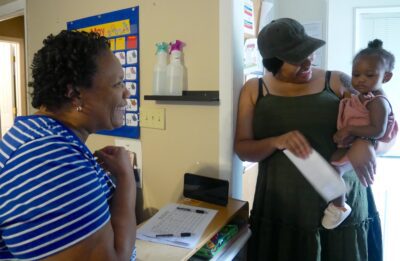
In the last three and a half years, Stewart has built connections with FFN providers “from the ground up.”
The network now provides monthly meetings, community resources, and “road maps” of engaging activities providers can check off. A recent road map encourages providers to complete activities in categories of educational development and/or field trips, intentional play, and self care, as well as providing reading logs and online learning tools.
“I’ve really tried to cultivate this tight-knit group of individuals and build a trust with them, and that’s been the biggest component,” Stewart said.
McCall, who worked as an educator in formal childcare settings before taking care of her grandchildren, said the community has been uplifting.
“It’s good to be able to hear the struggles other people are having and support each other,” she said.
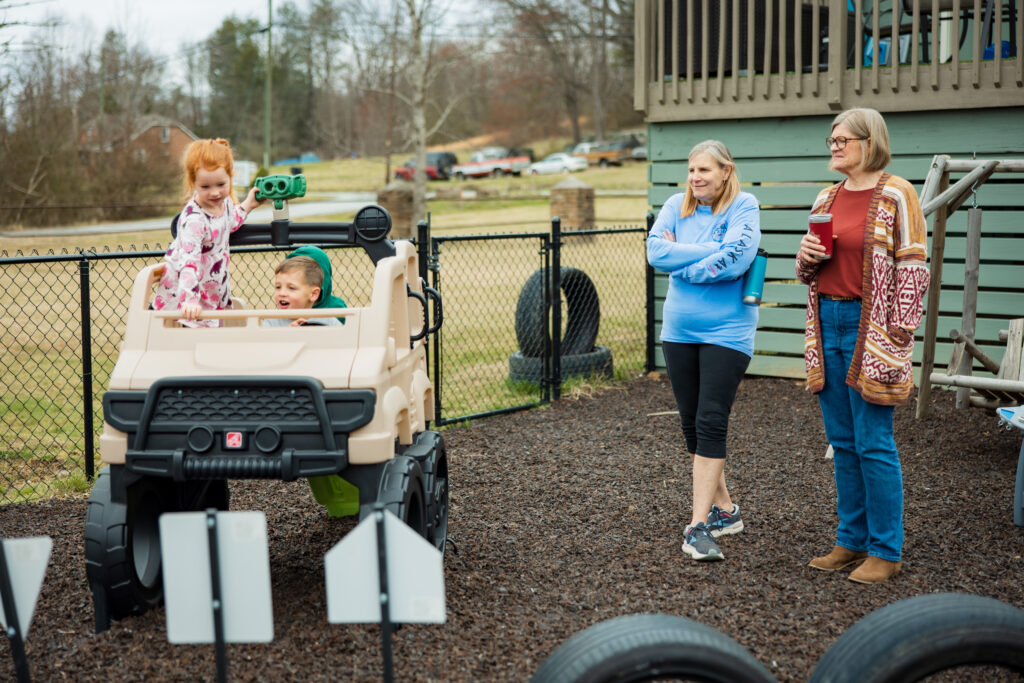
The resources have helped McCall plan intentional activities and follow her grandchildren’s interests rather than always directing their learning.
When she heard about the payments, McCall said she was surprised.
“It’s good to have that extra money to be able to get the tires on the vehicle, or buy that car seat, or the stroller or the wagon — these are all things that I’ve been able to get and not have to really save for, because I have that extra money,” she said.
Families are not asked for receipts or directed to use the funding in certain ways, Stewart said.
“Caring for kids, it’s the hardest job in the world, and it’s often the most underpaid,” Stewart said. “… It’s just really holding a spotlight to the invisible work that FFN providers provide, and the fact that they just need support, and that it should be given without a ton of strings.”