In a historic high, 54% of North Carolina’s high school graduates took and passed at least one college-level course before graduation in 2024-25, according to a report from the Department of Public Instruction (DPI). Those courses include Advanced Placement (AP), International Baccalaureate (IB), Cambridge International Education (CIE), and dual enrollment.
The number of high school graduates enrolled in dual enrollment courses specifically reached another record high at 38% — an increase of 2% compared with the previous year.
 Sign up for the EdDaily to start each weekday with the top education news.
In 2024-25, the state had 86,998 public high school students enrolled in at least one course in Career and College Promise (CCP), the state’s dual enrollment program, a 10% increase from the 2023-24 school year.
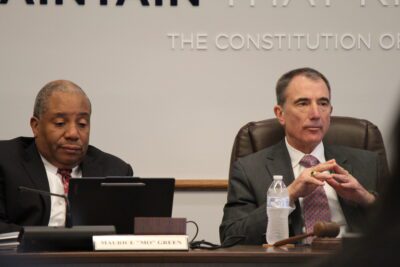
“These percentages and numbers matter because of what they represent,” said State Superintendent Maurice “Mo” Green during a Thursday press conference. “More students, including students who have never imagined themselves as college material, walking into a college classroom, earning college credit, and discovering they belong there.”
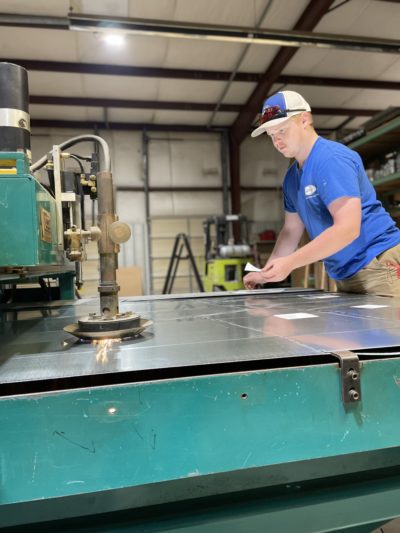
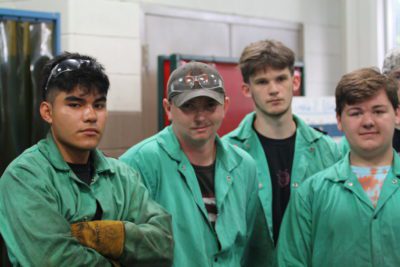
The CCP program allows students to choose from four pathways: the College Transfer pathway for students who plan to get an associate or bachelor’s degree; the Career and Technical Education (CTE) pathway for students to get industry-recognized credentials and certifications in a technical field; the College and Career Ready Pathway for students to receive work-based learning and career exploration opportunities; and Cooperative Innovative High School programs (CIHS) — known as early and middle colleges — for high school students to simultaneously work on an associate degree.
“Through high-quality instructional programming and close partnerships with institutions of higher education, Cooperative Innovative High Schools provide a unique opportunity for students to participate in college-level work while receiving robust support,” said Sneha Shah-Coltrane, senior director of advanced learning and gifted education at DPI, in a press release. “This program is especially powerful for first-generation college students and has the ability to drive economic mobility for families across our state.”
According to the North Carolina Community College System (NCCCS), participation in the CTE pathway grew 27% in 2024-25 and the College Transfer pathway grew 14%. Participation in a new CTE Workforce Continuing Education pathway also grew 68%, according to the report.
“With the support of the State Board, the work we are doing to expand CTE pathways will create more pre-apprenticeship opportunities and college prep coursework … with other community colleges,” said Aaron Mabe, state director of dual enrollment at NCCCS, in a press release. “It takes a village to make this work, but when school districts and colleges work collaboratively with industry partners, students … are granted opportunities to flourish.”
The report also examined employment and earnings data from 2019 to 2026, revealing that students in the College Transfer pathway were more likely to be employed and had 7% higher cumulative wages than their peers. CTE students were also more likely to be employed and had 14% higher cumulative wages, and CIHS students had cumulative higher earnings than their peers, DPI’s presentation said, “likely because they entered the workforce more quickly.”
Though enrollment in CIHS programs dropped by approximately 1,300 students in 2024-25, the number of graduating students, associate degrees, industry-recognized credentials, and diploma and certificate credentials all went up. Students in these programs had above-average high school retention and completion rates and better performance in community college courses than their counterparts, the report said.
After the report was presented, several students enrolled in CIHS and CCP programs shared their stories of the impact of dual enrollment during a press conference, which you can watch on DPI’s YouTube.
The Board also approved the applications of three CIHS programs last week:
- Durham Early College of Health Sciences, focused on nursing, allied health, surgical technology, and clinical research, applied to redesign its existing middle college model into an early college for grades 9-13.
- The creation of Hertford Early College at Chowan University, which would become the county’s second early college and focus on STEM pathways such as agribusiness, health care, advanced manufacturing, IT, and analytics.
- The School of Inquiry and Life Sciences, a long-standing early college, requested supplemental funding to expand programming, add another grade level, and hire a college liaison.
Final authorization and funding must be approved by the General Assembly.
Related reads

Remote academy applications
The Board received applications from four new remote academies seeking to open in the 2026-27 school year. The four academies are Brunswick Virtual Academy, a K-12 academy for 150 students; Northampton Virtual Academy for 25 students in grades 6-12; Wayne Middle High Academy, with an enrollment of 200 students in grades 6-12; and Blue Comet Global Academy, with 150 students enrolled in grades 6-12 in Asheboro City Schools.
Board Chair Eric Davis and Vice Chair Alan Duncan raised concerns about the effectiveness of fully virtual learning and the purpose of remote academies.
“We do have evidence that virtual instruction, if used very carefully within a very constructive strategy as a complement to traditional education, is a good option for students. I think the data also supports that when it’s all virtual instruction, our students don’t get the education that we need to deliver,” Davis said. “Our job is to make sure that the program we’re offering will deliver. And I’m just not convinced that it will.”
The Board chose to remove the item from the voting agenda, and the applications will return to a future Board agenda, according to Rupen Fofaria, director of Board operations and policy.
Needs-Based Public School Capital Fund
Nathan Maune, director of DPI’s Office of School Facilities, presented a report on the ongoing gap between school construction needs and available funding.
According to the report, over the past nine school years, districts have requested $11.9 billion in funding from the Needs-Based Public School Capital Fund — less than the $13 billion in needs identified in a 2020-21 statewide facilities survey. But the fund has only been able to award $2.4 billion in response.
“In many of these projects that are ongoing or have been awarded over the last two or three years, they are leaving things out because the money does not match up to what all the needs would be for a fully modern classroom experience,” Duncan said.
In this year’s grant cycle, districts submitted $1.99 billion in grant requests and $392 million were awarded across ten districts, as originally announced in December. Some funds will be used to replace or renovate buildings dating back to the 1940s and 1950s, the report shows.
Math standards, Indian education report, and more
Math standards
Dr. Charles Aiken, DPI’s section chief for math, science, and STEM, presented an update on the second draft of the state’s new K-12 standards for math. Aiken said that after receiving feedback on the first draft, the priority of his office’s writing teams has been clarity and concision, while ensuring the standards provide conceptual understanding, procedural fluency, and real-world applications for math, according to his presentation.
DPI aims to release the second draft on April 15, followed by a 30-day window for feedback. Aiken’s team aims to present a third draft to the Board at its August meeting. The tentative timeline would allow DPI to spend the next two years on resource development and professional learning, followed by formal implementation in the 2028-29 school year.
Related reads
State Council on Indian Education annual report
The Board heard a report from the State Advisory Council on Indian Education, which found the state has 14,769 American Indian/Alaskan Native students representing 41 Tribal Nations and 16,174 students receiving support through programs funded by the Title VI Indian Education Act (IEA) of 1972.
According to the report, American Indian students outpaced the nation’s participation and scores in AP exams during the 2024-25 school year. In North Carolina, American Indian students’ participation grew 15.8%, while nationally that number dropped by 8% compared to the previous school year. Likewise, the number of qualifying scores rose by nearly 50%, far exceeding the national rate of 4.5%.
Still, the report also revealed significant gaps in end-of-grade (EOG) and end-of-course (EOC) exam results at or above grade level between American Indian students and white students. For example, on the Reading EOG, 64.8% of white students performed at or above grade level, compared to 39.1% of American Indian students — a difference of 25.7 percentage points. The four-year cohort graduation rate for American Indian students was also 6.4 percentage points lower than white students, at 84.6%.
But those numbers are improvements compared to previous years. Grade-level proficiency on these students’ EOGs and EOCs has grown since 2022-23, including a 5 percentage-point jump in Math EOGs in 2024-25 compared to 2022-23. Their graduation rate has also jumped 4.3 percentage points since 2022-23, when the rate was 80.3%.
The report called for the creation of a formal tribal consultation protocol to integrate tribal input and student data into educational decision-making. It also recommended enhancements to statewide “data system fields and validation checks for American Indian students and students enrolled in the Title VI Indian Education program.”
Related reads



Rules for reform model
The Board approved rules to clarify how the state implements school reform models for low-performing schools. The new rules require districts to submit applications and school improvement plans outlining goals for student achievement, growth, budgets, and timelines across three models — school transformation, turnaround, and restart.
The updated rules also require annual reporting on student outcomes and establishing long-term benchmarks. The State Board would have the authority to revoke or deny continued authorization if schools fail to improve, while districts could close schools if reform efforts prove ineffective.
Michael Taranto, a Reform Model lead at DPI, presented the status of 42 schools across 10 districts participating in the Restart program, which gives low-performing schools more flexibility in how they operate in exchange for improving student outcomes. The relaxed rules allow schools to lengthen the school day, spend funding more flexibly, and assign teachers to roles outside their usual licensure, among other changes.
According to Taranto’s presentation, 23 schools are recommended to continue under the Restart model after meeting or exceeding expectations for academic gain, while four schools must reapply after failing to demonstrate sufficient progress. Guilford County requested to exit the model for all of its schools after determining that the program was no longer necessary to maintain or exceed their growth.
Requests for Proposals
DPI announced a new Request for Proposals (RFP) for the Instructional Innovation Grant open to all districts. The program is built around “two pathways designed to strengthen digital teaching and learning,” focusing on professional learning and the integration of innovative technologies, according to a presentation. Districts can apply for awards of up to $50,000 for traditional districts and up to $20,000 amounts for charter and regional schools. Submissions will be due June 18, and selections will be announced in August.
The Board also voted to approve the May 11 launch of an RFP for districts to join the Advanced Teaching Roles program, which enables highly effective teachers to earn additional pay for taking on more students or mentoring their peers. Districts must submit their applications by Aug. 14, and the Board will select participants on Oct. 15.
The full Board meets next May 5-7.

Recommended reading