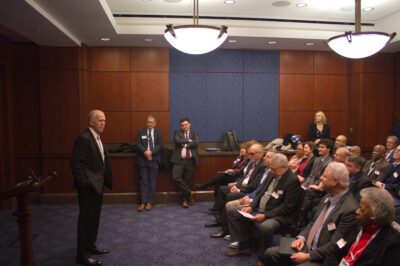
The U.S. House Appropriations Committee met on Wednesday, March 4, to hear from community college leaders across the country on how the federal government can best support these institutions. The committee raised questions about the current needs of community colleges, the value of college education, and the student-to-workforce pipeline.
Four community college leaders and advocates appeared as witnesses, including Dr. Patricia Sims, president of Drake State Community & Technical College in Alabama; Dr. Brad Hall, president of Blackfeet Community College in Montana; Shawn Morgan, vice president of workforce and strategic initiatives at Bevill State Community College in Alabama; and Shalin Jyotishi, founder and managing director of the Future of Work and Innovation Economy Initiative at New America.
The economics of education
The chair of the committee, Rep. Robert Aderholt, R-Alabama, opened the hearing by outlining his belief in the importance of community colleges to students and their communities. He praised the present leaders for providing students with an education “aligned with workforce needs” that is also “cost-effective.”
“The secret is clearly out, and that’s the value that community colleges clearly deliver to students and the local economy,” Aderholt said.
Many committee members and witnesses discussed the financial strain of a traditional four-year degree on students, characterizing community college programs as a less burdensome alternative.
In her opening remarks, ranking member Rep. Rosa DeLauro, D-Connecticut, noted the rising cost of living: “Just about everything in this country is more expensive,” she said. “And the cost of education is by no means an exception to this trend.”
 Sign up for Awake58, our newsletter on all things community college.
Later in the hearing, Rep. Mark Pocan, D-Wisconsin, brought up the projected shortfall for the Pell Grant program as an upcoming issue.
“Given the increase Pell uptake due to the FAFSA completion, there’s projected to be a Pell shortfall,” he said.
In light of current economic realities, the community college leaders urged the committee to continue funding for and expand federalized support of Pell.
“The Pell Grant Program is foundational,” said Hall, president of Blackfeet Community College. “We are grateful that Congress acted to prevent near term shortfalls and maintain maximum award for fiscal year (2026). We respectfully ask that we continue the Pell Grant Program and avoid eligibility challenges that would restrict access.”
Several members of the committee indicated their support for the Pell Grant Program and expanding financial support for community colleges.
The witnesses also expressed enthusiasm for Workforce Pell Grants, which are set to go into effect on July 1, 2026. This new program will expand traditional Pell Grant eligibility, funding eligible short-term workforce training programs for the first time.
However, DeLauro raised concerns about the potential downside to Workforce Pell Grants. “It could lead to the proliferation of low-quality programs, specifically those that are, I’ll just be frank, by predatory, online for-profit companies,” she said.
Related reads

Community colleges filling gaps in the workforce
The committee also highlighted the strong connections to local industry that many community colleges have fostered. Several of the witnesses described programs their schools offer that connect students to employers, giving them real-world experience and valuable credentials along with their degree.
“Students can enter quickly, earn wages quickly, and stack credentials overtime that can lead to higher degrees,” said Morgan, regarding programming at Bevill State Community College.
Shortages in the workforce were also a large concern raised by the committee.
“We’ve done a lot of hard work identifying the workforce shortages, designing programs that work, but we still see only pockets of success and not the sustained effort that I think is necessary,” said Rep. Josh Harder, D-California.
The witnesses said that attempting to base programs off of specific industry needs has proven to have tremendous success in filling those gaps. Flexibility in entering as a part-time student also allows students to continue working while they earn their degree, witnesses said, allowing students to upskill as they go.
Rep. Mike Simpson, R-Idaho, said Native American reservations in particular have a large need to recruit skilled workers like nurses and dentists. He asked Hall — president of Blackfeet Community College, a public tribal college — how he thought the issue should be approached.
In response, Hall described the college’s principle of “growing their own,” emphasizing that investing in students who want to stay in their community is actually an investment in the community itself.
Aderholt concluded the meeting by telling the community college leaders they have “a lot of friends here in Washington and Congress for community and technical colleges.”
At the same time the appropriations committee met, Wake Technical Community College President Dr. Scott Ralls testified before the U.S. House Committee on Education and Workforce. He discussed how schools should handle preparing their students for the influence artificial intelligence (AI) will have on the workplace.
Ralls said Wake Tech is seeing a renewed interest in technical education and skilled-trade programs.
“For years, we had what I sometimes refer to as an interest gap. We had the employment, we had the programs, too often we didn’t have enough students,” he said. “Now, we’re seeing waiting lists that we’ve never seen before, so I think students are seeing opportunity there and part of that opportunity is driven by AI.”
You can watch the full meeting below, or read more about Ralls’ testimony in a press release from Wake Tech.

Recommended reading