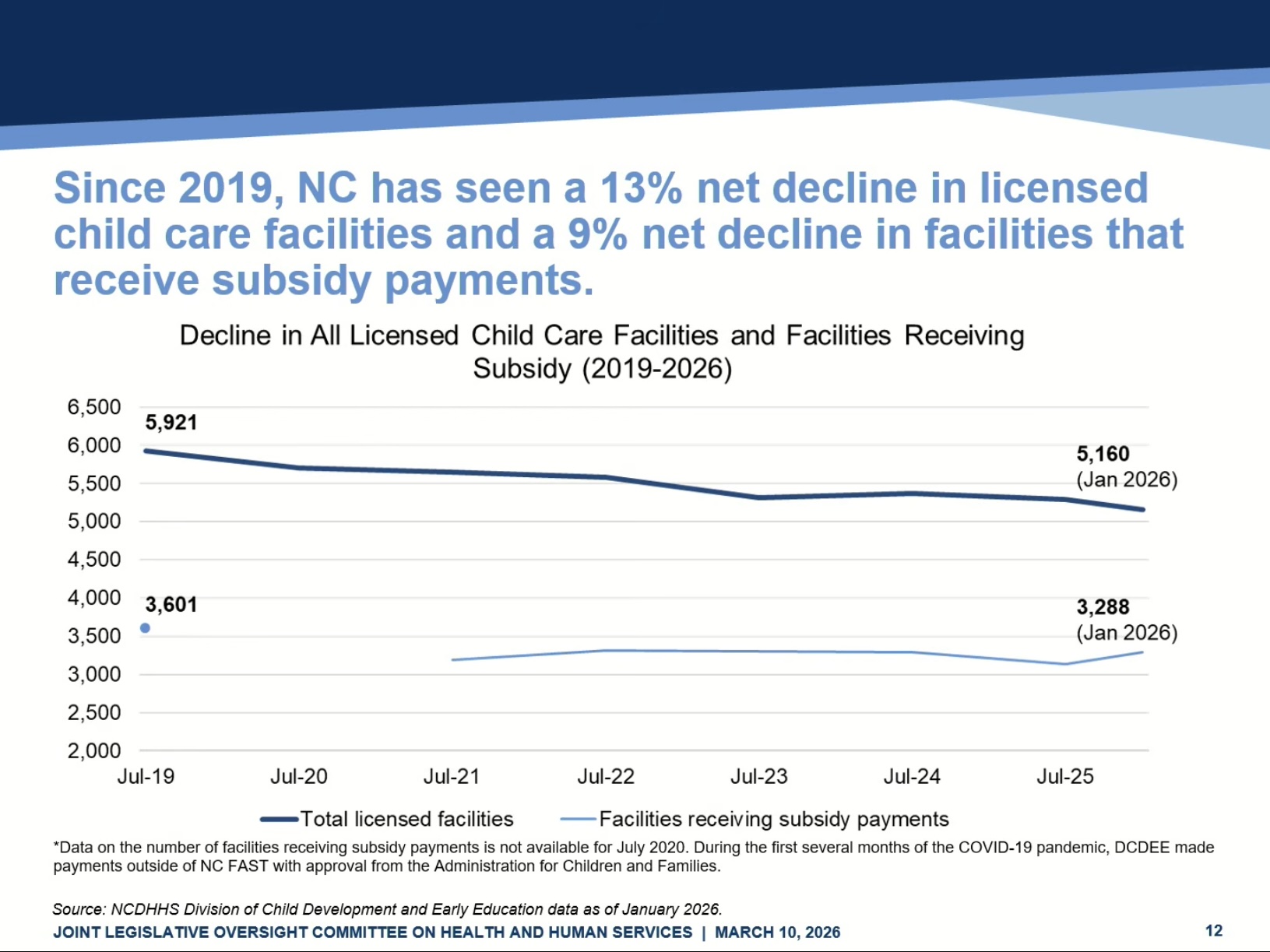
North Carolina has experienced a 13% net loss of child care programs since 2019, with record lows of licensed care expected in the next year, said Candace Witherspoon, director of the Division of Child Development and Early Education (DCDEE) to legislators Tuesday.
Families are struggling to afford care and programs are struggling to recruit and retain staff, Witherspoon told members of the Joint Legislative Oversight Committee on Health and Human Services.
“When we look at access and affordability, our current funding model wrongly assumes that parents can pay what it costs to provide quality early education to our youngest citizens,” Witherspoon said.
 Sign up for Early Bird, our newsletter on all things early childhood.
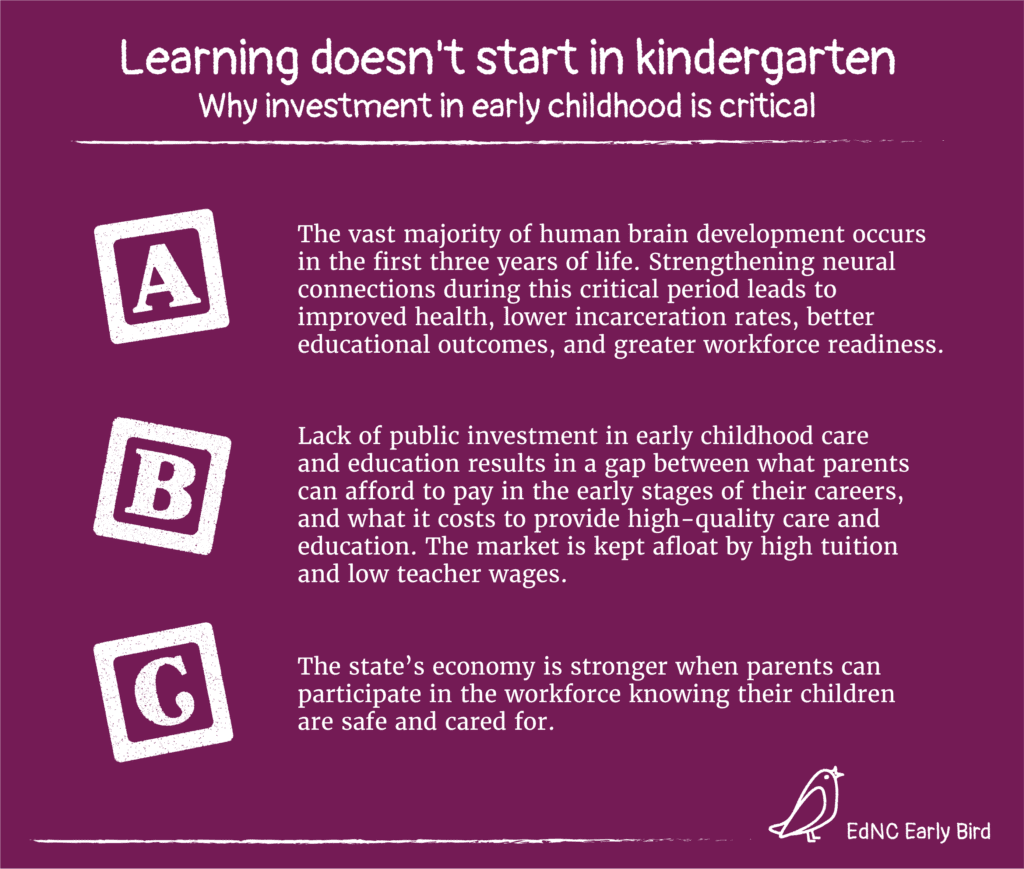
The majority of child care funding comes from private parent tuition. Yet with rising operating costs since the pandemic, child care programs are struggling to keep tuition low enough for parents to afford and bring in enough revenue to make ends meet. Programs’ highest cost is labor, and most are unable to pay teachers living wages.
The average wage for child care teachers in the state was $14.20 in 2024, according to the Bureau of Labor Statistics.
“While we understand the foundational impact of early education to the state’s well-being, the early education industry is built on an unsustainable business model, which result(s) in an education crisis that hurts each of us,” she said.
Related reads

Witherspoon outlined the social, academic, and economic benefits of high-quality early care and education for children and families. She pointed to an estimated $5.65 billion in annual economic loss for the state due to lack of child care access, from a 2024 report from the U.S. Chamber of Commerce Foundation, the N.C. Chamber Foundation, and NC Child.
“There’s probably over half the people in this room who wouldn’t be here today if it wasn’t for someone who had child care at home that you could leave your children with,” said Rep. Larry Potts, R-Davidson, a co-chair of the committee. “When less and less people show up to work because there’s less and less slots available, I’m sure it’ll start becoming more important then.”
Large subsidy waitlists, serving fewer children
One way the state could help increase stability and affordability is investing more funding into the child care subsidy program, which helps low-income working families afford care, Witherspoon said.
Though the number of licensed programs has decreased, the share that participate in the subsidy program has remained fairly steady at about 60%, she said.
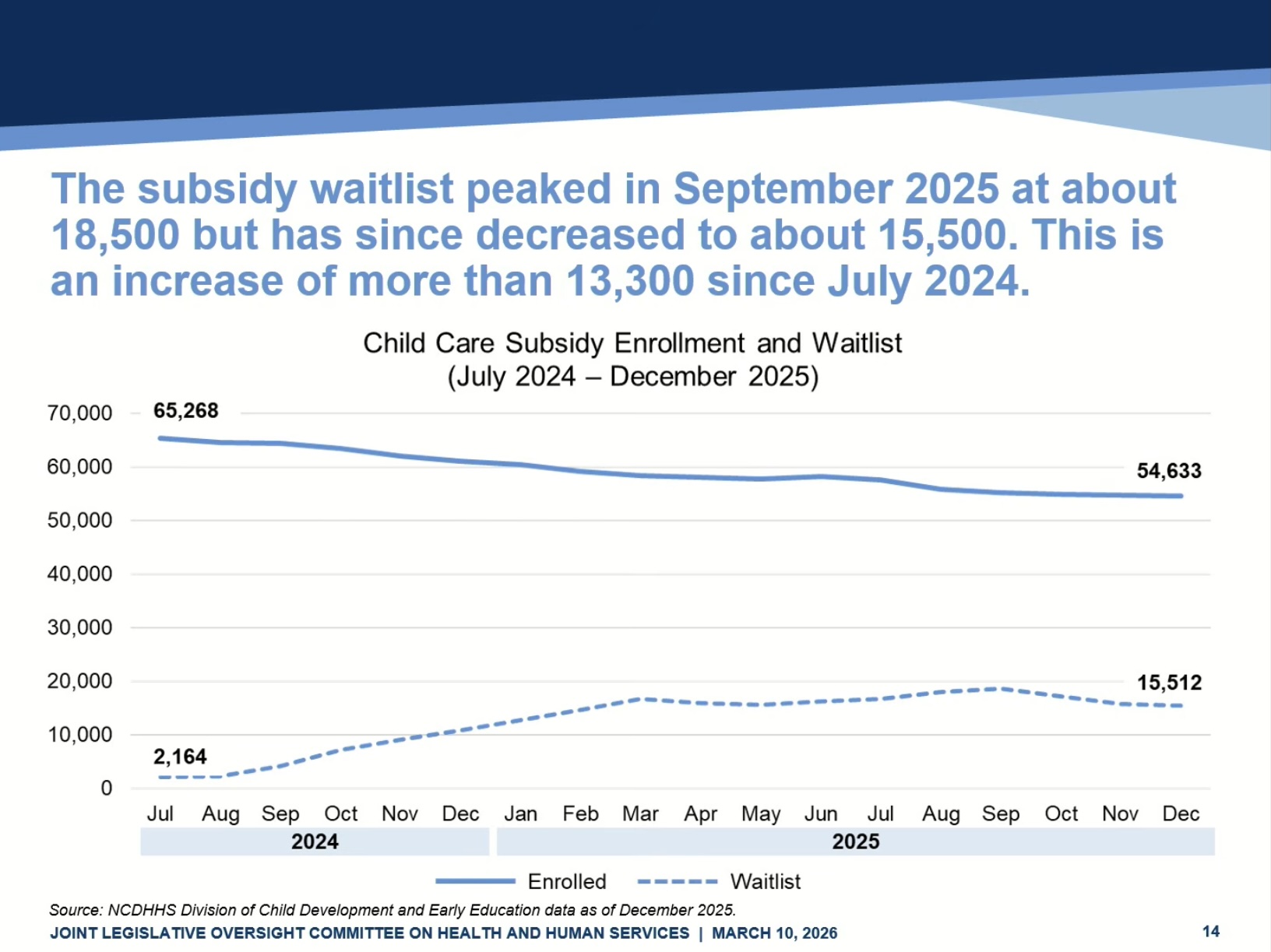
However, the number of children served through the program has declined by about 15% since 2019, Witherspoon said. And the waitlist for subsidized care is seven times bigger than in mid-2024, increasing from 2,164 children in July 2024 to 15,512 in December 2025.
“As we await state funding for child care subsidies, we ended 2025 serving fewer children and seeing more children on our waitlist, waiting for an opportunity to participate in one of North Carolina’s quality early education programs,” Witherspoon said.
For years, early childhood advocates have asked for funding for a statewide subsidy floor, which is the leading recommendation from Gov. Josh Stein’s bipartisan Task Force on Child Care and Early Education.
A floor would increase the per-child amount many programs receive to serve low-income children. It would provide the statewide average rate at minimum, with programs already receiving more than average held harmless. The amount programs receive varies more widely based on location than place-based cost differences account for.
Related reads
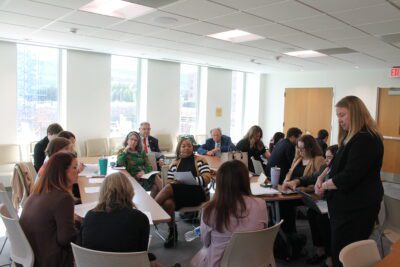


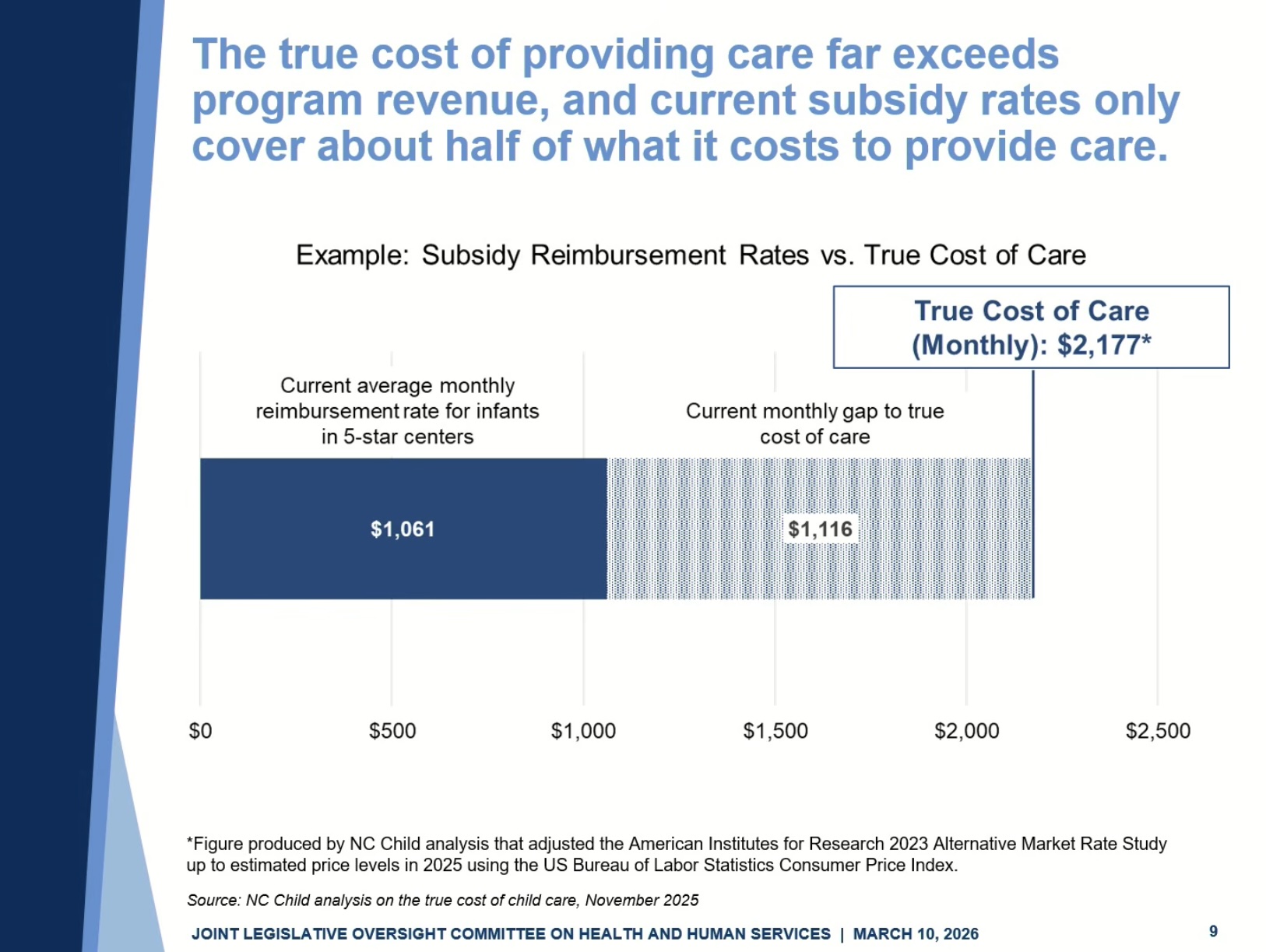
Witherspoon said the subsidy reimbursement rates providers receive cover less than half of the true cost of care.
“Our parents can’t afford to make up the difference,” she said.
Stein’s budget proposal, released Monday, includes $20 million in recurring subsidy funding for the last quarter of fiscal year 2025-26. This would raise the rates providers receive to the most recent results of a mandated market rate study. Advocates last year were asking for $145 million each year to establish a floor.
‘A historic low’
Witherspoon reported 5,160 licensed programs in January 2026, compared to 5,921 programs in July 2019. She said the division projects that overall number to fall below 5,000 in 2027, “which would be a historic low for North Carolina and put significant operational and financial strain on businesses, reduce tax revenue and negatively impact the state’s overall economy.”
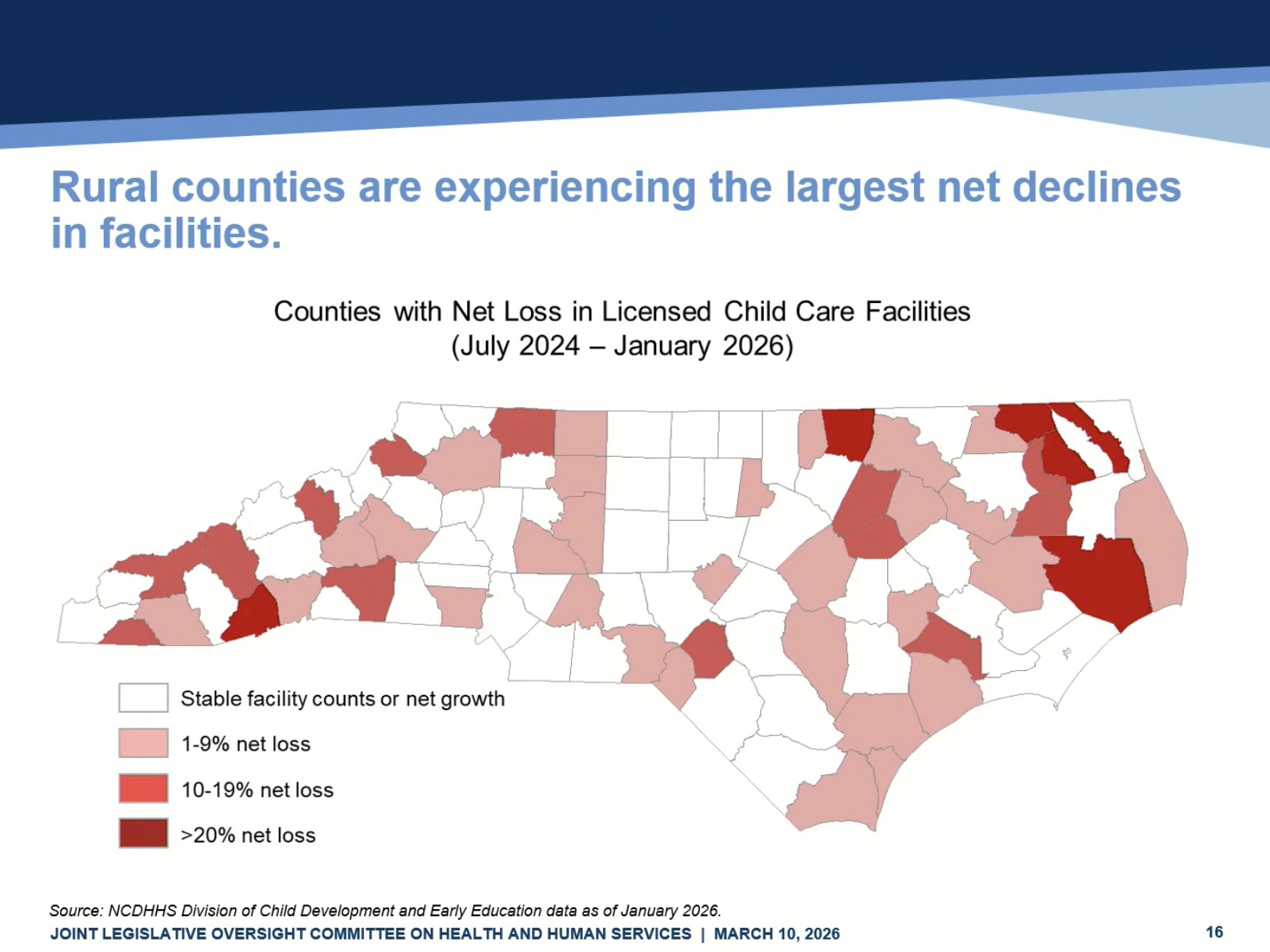
Though every county has a lack of affordable, quality care, Witherspoon said rural communities have experienced the largest net declines in facilities since July 2024.
Last year, North Carolina passed legislation to loosen regulatory requirements with an aim to increase access to care.
The legislature raised the maximum size of groups of children in a classroom, while maintaining the same teacher-child ratios. And they said one lead teacher could care for two groups of children rather than one. They also made five years or more of teaching experience equivalent to the state’s Early Childhood Credential.
DCDEE conducted an anonymous survey, Witherspoon said, to see how providers were utilizing the flexibilities. Out of more than 1,000 respondents, the survey found 21% of programs were using the lead teacher flexibilities and increased group sizes, and 66% reported employing lead teachers with five years or more of experience.
Witherspoon uplifted recommendations from the year-end report of Stein’s task force. On top of establishing a statewide subsidy floor, the group recommends legislators:
- Explore the creation of a child care endowment to fund child care needs.
- Develop approaches to offer non-salary benefits to child care professionals.
- Explore subsidized or free child care for child care teachers.
- Link existing workforce and compensation support programs for early childhood professionals into a cohesive set of supports.
- Explore partnerships with the University of North Carolina System, North Carolina Community College System, and K-12 public school systems to increase access to child care for public employees and students.
Community colleges offer on-campus child care, struggle with cost
Davidson-Davie Community College President Jenny Varner also presented on the benefits and struggles that come with operating an on-campus licensed child care center.
“For all of these many decades that we’ve been in operation, back to our first days, we have certainly been focused on education and the workforce, no doubt, but equally significant has been understanding and serving the needs of our communities, and child care is right there up at the top of that list,” Varner said.
The college is one of 13 out of 58 colleges that host on-campus, five-star licensed child care programs. More would, Varner said, yet the tight financial model of child care presents campus-based programs with many of the same challenges as community-based programs.
Related reads


Varner said providing benefits to child care employees is a financial strain on the college and, even with those benefits, centers are unable to pay their teachers enough to stop turnover. Varner said her fellow presidents on campuses with centers face the same challenges.
“All of us say about the same thing: We are extremely committed to this service that we offer our communities, and we recognize how important our centers are to our communities, but I’ll be perfectly honest, we all have some concern about the future viability of our centers,” she said.
Varner said consistent funding from the state would make a big difference in offsetting operational costs. She recommended colleges be able to use existing state funding for child care operations and that the state consider per-child subsidies to help colleges offer care.
She also said state funds are needed for construction or expansion of facilities, curriculum and materials, operating child care academies, and providing incentives for child care teachers to further their education.
Related reads


Varner said the college has 100 students enrolled in its early childhood education program, which provides degrees and certificates in the field. The on-campus child care center provides hands-on training to these prospective teachers.
Sen. Ralph Hise, R-Watauga, asked Varner how she justifies operating the early childhood program when graduates are entering into a field with such low wages.
Varner said the college does not have a perfect answer, but tries to present early childhood students with pathways to career progression. Even if a teacher starts out in child care, she said, they might have better career prospects elsewhere in education.
“You’ve hit on our big dilemma,” Varner said. “We have one of our most important areas out there — taking care of children and having them ready for school, for the rest of their lives — and we’re paying low wages in these jobs.”

Recommended reading