
College students believe in the value of their degree, 2026 Lumina-Gallup research shows


Gallup and the Lumina Foundation recently released new research — the 2026 State of Higher Education Study — finding that most students who are actively enrolled in college believe they will benefit from their degree in the future.
The study surveyed nearly 4,000 associate and bachelor’s degree students ages 18-59 between Oct. 2 and Oct. 31, and nearly 6,000 college graduates between Nov. 10 and Dec. 1.
“Roughly nine in 10 associate and bachelor’s degree students say they are confident or very confident that their education will both equip them with the skills needed for the job they want and help them secure employment after graduation, with about four in 10 in each group reporting they are ‘very confident’ in these outcomes,” a Gallup press release said.
 Sign up for Awake58, our newsletter on all things community college.
Gallup has recently reported that public trust in higher education has slowly been on the rise, coming back from a recent low in 2023. Increased confidence in higher education since 2023 and 2024 was seen among most societal subgroups, Gallup said, including college graduates (up six percentage points to 48%) and those without a four-year college degree (up seven points to 40%).
“Students’ confidence in the quality of their program’s curriculum translates into an even stronger belief that the degree they are pursuing is adequately preparing them for their postgraduate careers,” the new Lumina Foundation-Gallup study says.
However, a few Americans still have concerns.
Twenty-three percent of Americans express little or no confidence in higher education, the report found, and there are three main explanations as to why: the perceived politicization of campuses; the idea that the education does not focus on the right things, like job-relevant skills; and that the cost and expenses — including high tuition prices and loan burdens — are too high.
Most of these worries, however, were not reflected in the results of Gallup’s study of current students.
Across political parties, college students feel comfortable expressing themselves on campus, the report found, with 71% of all students reporting that all or most of their professors create a classroom environment that supports open dialogue. Beyond the classroom, the study found that only “3% of all Republican students say they feel like they don’t belong on campus because of their political views, compared to 1% of Democrats and 2% of independents.”
“Although significant partisan gaps in confidence persist among adults, such differences are not observed among students themselves,” Gallup’s landing page for the report says.
In terms of job-preparedness, students also reported high feelings of confidence. For example, as seen in the chart below, 75% of all college graduates said their degree was either “critical” or “important” to reaching their career goals. Among associate degree graduates, that number was 56%.
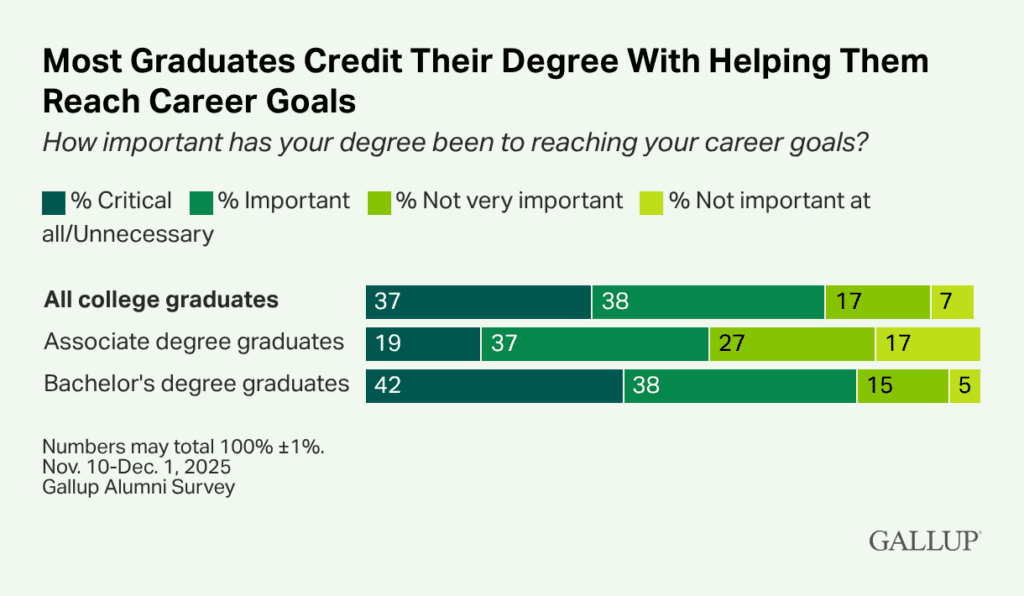
The majority of “recent graduates say they secured quality jobs relatively quickly upon graduation,” the Gallup press release says. However, Gallup said “recent associate degree graduates are somewhat less likely to say they quickly found a good job upon graduation.”
Nationally, college graduates are consistently found to have lower unemployment rates and higher earnings across their lifetime than high school graduates who do not attend college.
These benefits come at a real cost, though. The Education Data Initiative has found that the cost of college has increased 41.7% faster than the cost of inflation during the 21st century.
“Just over half of college students (57%) say four-year universities do not charge fair prices, while 25% say the same of two-year colleges,” the Lumina-Gallup study says.
Still, 93% of bachelor’s and 89% of associate degree students believe that the overall investment they are making in college is worth it, and “about three-quarters of students and college graduates agree that their degree is or has been worth the cost.”
“Colleges and universities can strengthen public confidence by clearly communicating graduates’ success stories while continuing to address student concerns about free expression, belonging and the value of their educational investment,” says the study.