
Leandro judge says he will not tell legislature how much money to spend, urges ‘cooperative effort’

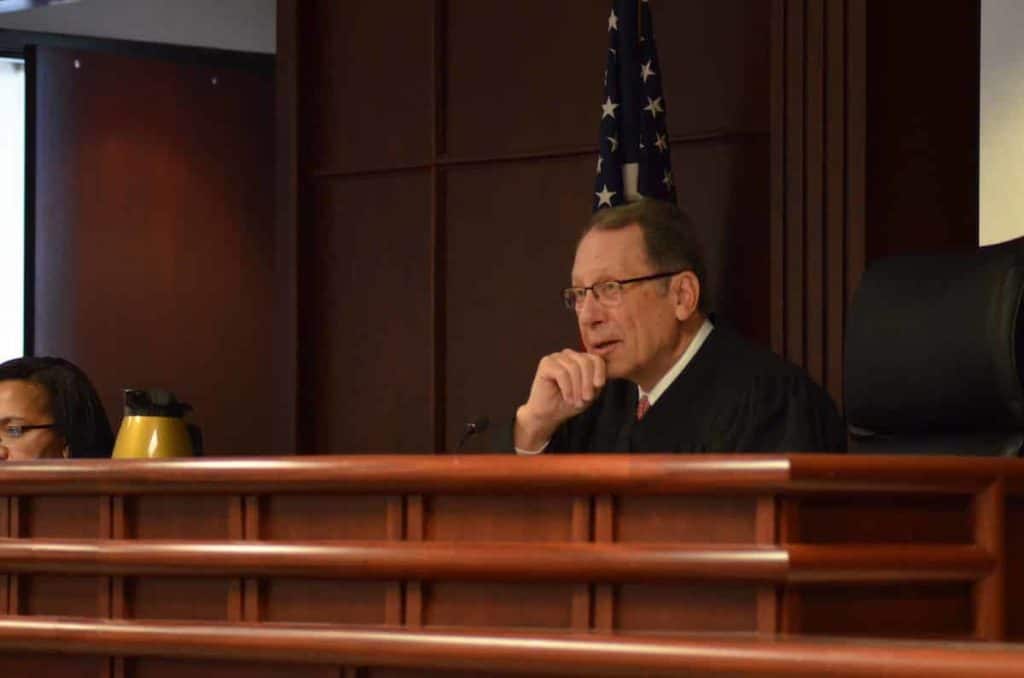
Judge David Lee said in a hearing on the long-running Leandro court case on Tuesday that he has no intention of telling lawmakers how much money they need to spend. He said, rather, that he wants buy-in from them to address the needs laid out in a comprehensive plan sent to the court by all parties in the case last month.
“I want this to be a cooperative effort with everyone having the same goal in mind,” he said. “I don’t know why you would not have that goal in mind, which is to educate these children and give them a sound, basic education so that everyone will have a better tomorrow.”
Lee called the hearing today to discuss the comprehensive plan, which looks at what the state should do in education over the next eight years and includes details on how much funding should be spent in various areas, like teacher recruitment and preparation, equity, teacher and principal pay, and more. Though, in the case of some of the salary requirements, the amount of funding needed is still to be determined.
Right now, the comprehensive plan is a general outline of how the state will move forward in meeting its obligations to provide the opportunity of a sound, basic education to all the state’s students. A motion from the court, however, is needed to turn that plan into a legal requirement by the state. The purpose of the hearing today was to discuss what such a motion would look like.
You can read the comprehensive plan below or by clicking here. Also below is the appendix to the report with a detailed look at funding and timeline for implementation. You can also see that here.
During the hearing, Lee asked about the various rounds of federal funds coming to the state’s public schools to address the impact of COVID-19. He wondered if these funds could be used at all to help address some of the tenets of the comprehensive plan.
In discussion with the various attorneys and other parties to the case representing both the plaintiffs and the defendants, Lee heard that the federal funds are non-recurring and could be used for some one-time expenses — such as broadband. But Mark Dorosin, a managing attorney at the Lawyers’ Committee for Civil Rights Under Law representing the Charlotte-Mecklenburg branch of the NAACP, said that to really address the needs of the state’s public school students, recurring funds will be necessary.
 Sign up for the EdDaily to start each weekday with the top education news.
That led Lee to wonder out loud how the parties in the case can get lawmakers to address some of those recurring needs.
“Is there something that can be done to better liaison with or educate the General Assembly?” he asked.
Dorosin said it’s critical that the court enter an order or a set of directions that would “facilitate [the comprehensive plan’s] implementation.” He said there was a plan last year that was supposed to go into effect for 2021 at a cost of $426 million but it wasn’t funded because lawmakers didn’t appropriate the money for it.
“We are back where we were a year ago,” Dorosin said, adding later: “We’re concerned that we can’t just hope that the General Assembly takes this action.”
Parker Poe Attorney Melanie Dubis, a lawyer for the plaintiffs in the case, said there is an opportunity right now to take action on Leandro for a variety of reasons, including the federal COVID-19 funding, the current budget surplus, and the fact that the legislature is in its long session where the biennium budget is formed.
Dubis said the governor’s proposed budget for the next two years would accomplish the first couple of years of the comprehensive Leandro plan. She said that the court has the chance to say that it thinks the steps laid out in the comprehensive plan are the steps that need to be taken and that the various parties in the case could get together and propose a plan for communicating with lawmakers.
The judge ultimately asked the parties to take a shot at drafting an order that would address next steps, including how to communicate or work with the General Assembly.
Thomas Ziko, an attorney for the State Board of Education, said that the attempts to come up with a cost for addressing the needs laid out in the comprehensive plan were detailed but that he didn’t want everyone to get too bogged down in the numbers. He said there are a lot of estimates involved, and that planning financially for eight years out isn’t an exact process. He said he hopes whatever order is adopted will focus more on programs and what strategies need to be adopted rather than hitting any particular financial target.
Judge Lee said he expects to see a draft of that order toward the end of the month, though he won’t sign any order until after the State Board of Education can meet and lend their input. The State Board doesn’t meet again until the second week of May.