
How legislative tactics almost shut down an early college high school

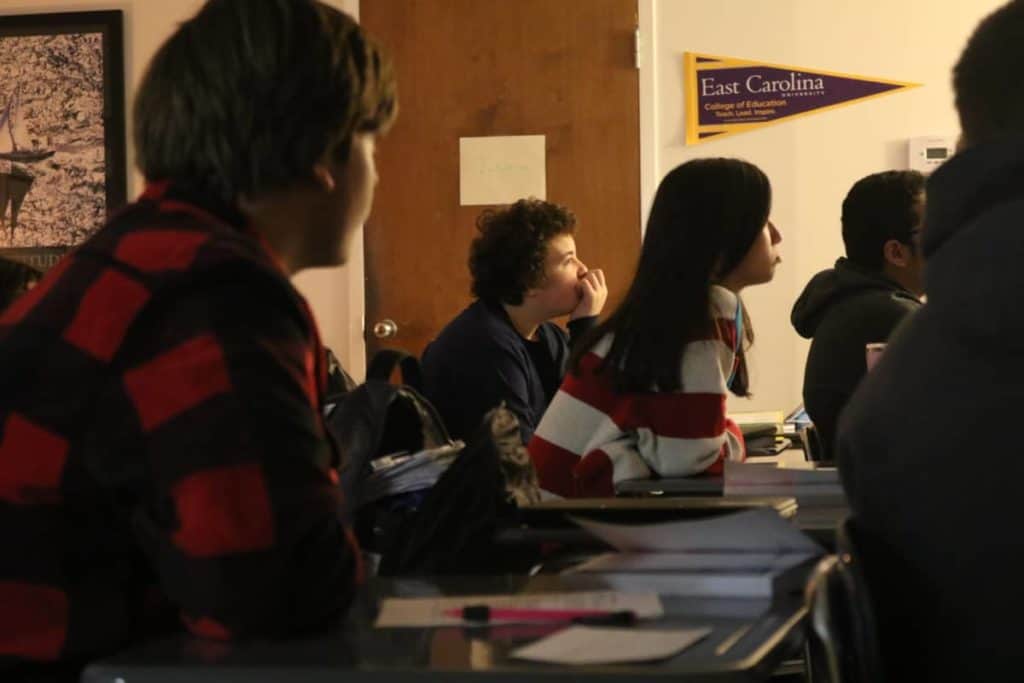
One early college high school in North Carolina was almost shuttered thanks to a negotiating gambit by Senate Republicans. But, nearly at the last minute, a local school board vote has restored the school.
A provision in the Senate budget would have phased out supplemental funding for so-called Cooperative Innovative High Schools, which allow students to earn college credits while working toward graduation. These schools often pair with institutions of higher education in the area, usually community colleges.
The supplemental funds received by Cooperative Innovative High Schools are above and beyond the traditional funding that schools in North Carolina receive, and these mostly-small schools rely on that money to survive.
When the Senate budget passed, one local school board panicked. The Carteret County Board of Education voted to close the Marine Science and Technology Early College High School (MaST) in part because the supplemental funding might go away.
The compromise budget that eventually passed the General Assembly did not include that provision. But the Carteret school board chair had already said the board was unlikely to change its mind, even if the money was restored.
But, this week, that same school board voted to keep the school open after all. Classes start August 7.
This whole incident highlights the danger not just of what legislators do, but also of what they threaten to do.
Rep. Craig Horn, R-Union, said at the time that the early college supplemental funding cut was likely just a negotiating tactic on the part of the Senate. But it ended up being one with real consequences. Outside observers can’t necessarily distinguish real policy intention from legislative maneuvering, and local school officials have to make decisions based on incomplete information so they can get their district ready for school — which usually starts only a few months from the time that lawmakers are debating the budget.
Senate lawmakers may have introduced the early college provision with absolutely no intention of going through with it. But, in the absence of mind-reading technology, that hidden reality is known only to them. And what people can’t know definitely can hurt them.
Could layoffs at virtual public school mess up your student’s fall semester?
News broke this week that the North Carolina Virtual Public School is temporarily laying off 220 of its teachers because of a state law regarding temporary employees, possibly affecting 150 classes and 7,300 students. Fortunately, legislators and education officials are already working on a solution.
For years the school’s teachers have been hired as temporary workers. But temporary workers are supposed to work for no longer than 12 consecutive months without a break in service. DPI recently found out that the law applied to the virtual public school’s teachers, necessitating the temporary layoffs.
Last week, DPI and the State Board of Education sent an email to General Assembly education chairs asking them to intervene. Officials are hoping that the problem could be solved in the short term if virtual public school teachers could get an exemption from the legal requirement to take a break in service.
Eric Davis, chair of the State Board of Education, sent the following update to virtual public school educators last week, as well.
According to Cecilia Holden, director of legislative and community affairs for the State Board of Education, Rep. Craig Horn, R-Union, a chair of both the education and education appropriations committee, is hard at work on the issue.