
An open letter to my son, Miles: Safe space

Dear Miles,
Every day, I watch you investigate the nuances of your environment, already identifying questions and finding answers for yourself. Your observations of your environment are shaping your worldview. Your exploration of the physical world is the early evidence of your self-directed learning experience.
As part of your self-discovery, you will be socialized, resulting in the internalization of societal values, attitudes, knowledge, biases, and stereotypes. This happens primarily in school, through mass media, and from our social groups. Social groups include family, friends, and religion. Let’s talk about school.
I want your socialization to be a positive part of your life journey. But in my experience, many Black students are unable to find a safe space in our schools and this has negative consequences.
Schooling
In America and in North Carolina, the educational system has been dominated by the attitudes, values, and beliefs of the majority. No matter the subject area, the European, middle-class American worldview is the basic foundation from which the subject content is taught.
Our social struggles make it difficult for many of us to meet the European, middle-class expectations.
Traditionally, schools have failed to create an understanding of the positive significance of various ethnic groups in America. The stereotypes and prejudices embedded in our school system negatively impact Black students. Our social struggles make it difficult for many of us to meet the European, middle-class expectations.
Students of color feel left out and respond to the pressures of schooling by defining their space without including any educational goals. Because Black males, in particular, struggle to relate to the mainstream attitudes, values, and beliefs at school, they pursue alternatives, turning to sports, crime, and gangs, or they give up hope, often dropping out.
Education becomes a non-reality, a part of their life that is hard to relate to and therefore schooling becomes irrelevant.
The deficit model
The hardest part of my job is to receive a suspended young student, normally a Black male, and to have them speak of themselves with very little hope. Even at the ages of 14 and 15, they have conceded to the deficit model.
This negative image of the Black student is internalized and passed down by social groups: peers, parents, relatives, anyone, every one.
The deficit model historically was used to explain “the inferior intelligence, perceptual skills, cognitive styles, family structure, and other negative factors associated with African-Americans.”1
Behaviors, values, and lifestyles that differ from white, middle-class norms are not valued.
All we hear about is Black students who dropout and fail rather than the ones who succeed.
This negative image of the Black student is internalized and passed down by social groups: peers, parents, relatives, anyone, everyone.
The 14-15 year old consumes this message of defeat, deficit, and failure, and it becomes the definition of who they are.
Safe space
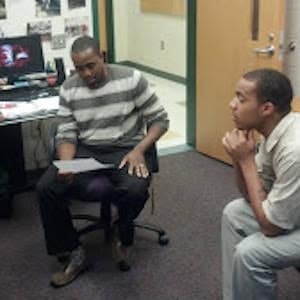 I created a safe space at my school. The safe space allows for raw conversations, quality time, and a caring heart where an adult is able to speak against that negative self-image of struggling students. The safe space allows an educator to see beyond the tattoos, attitudes, high absence rate, and low-performing attributes. It redirects the focus to the opportunities that lay hidden in the future life plan of the student.
I have seen some of the most guarded students who belong to gangs appreciate the safe space. These gang members willingly let down their guards to be a child again, to be a student again. In this safe space, these same students speak about the emotional hurt of not knowing their fathers and the burden of being afraid of not meeting the expectations of their mothers.
Mentors
Studies show that students regardless of race perform better when coached by someone who cares about their progress. Many students are in need of caring adults who can show them the path from a school experience defined by failure to a school experience full of hope. How can teachers help struggling students develop a more positive self-image? How can safe spaces start turning up in our schools and communities?
Miles, my hope is that the deficit model will not be part of your schooling experience and that your schools are a safe space for you to grow and learn from the very beginning. I think digital learning is an important part of this shift.
Digital learning
The act of learning is personal. I see this in all that you do now as you explore your physical space. Each person’s mind maps out ideas and concepts differently.
Each person’s mind maps out ideas and concepts differently.
I believe digital learning is the game changer when it comes to how Black students experience school. I hope that the tools of schooling keep pace with our global age. When students are able to control their electronic space, then each child’s self-discovery will reflect the individuality of that student. I’m excited about an international project that seeks to provide every child in the world with a tablet. Students will be able to arrange, like, dislike, customize, explore, or adopt any available information to create their own space, their safe space.
Each child’s self-directed learning experience in school through digital learning will be viewed by the world as their progress, their purpose, their success.
Your Dad
Previous letters: