Editor’s note: EdNC’s Alli Lindenberg Semon contributed reporting to this article.
The child care center at Davidson-Davie Community College (Davidson-Davie) helps student parents stay in school, attracts faculty to the college, and provides hands-on learning to prospective teachers, college administrators told members of the North Carolina Task Force on Child Care and Early Education last Wednesday.
The college is one of about 15 of the state’s 58 community colleges that provide on-campus child care, said Sen. Jim Burgin, R-Harnett, co-chair of task force, during a visit to the campus.
“We need to duplicate that on every campus,” Burgin said after task force members toured the Child Development Center and heard from college leaders about its benefits and challenges.
More on community colleges and child care


The task force was established by Gov. Josh Stein in March 2025 to identify solutions to the state’s child care challenges.
“The matter is not getting better,” Burgin said at Wednesday’s meeting.
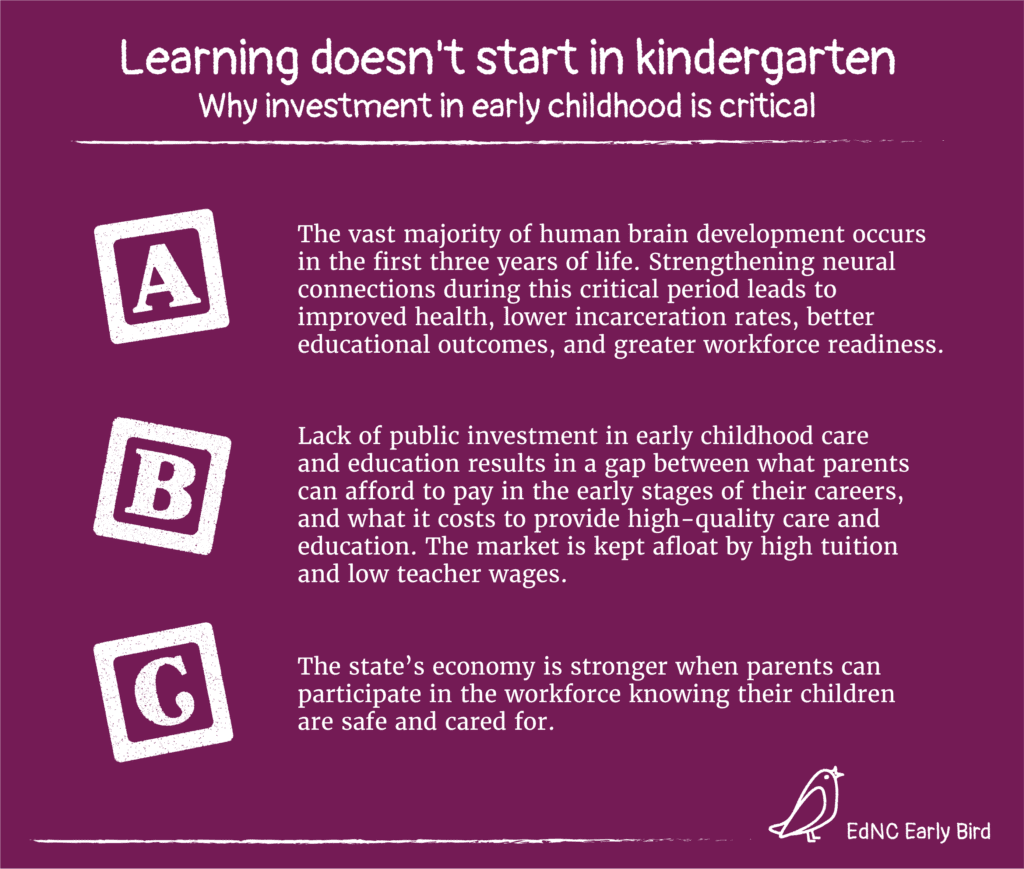
Child care is unaffordable for many North Carolinians, and difficult to find. The state has lost 7% of licensed child care programs since the start of the pandemic, with those losses accelerating last fall.
Even with high tuition rates, child care businesses are often unable to pay teachers living wages because of the labor-intensive nature of the industry. Child care teachers were making an average of $14.20 an hour in 2024, according to the Bureau of Labor Statistics.
Advocates say public investment is needed to expand high-quality, affordable access. The governor’s task force is forming its recommendations for the legislative short session. Consulting firm Afton Partners is creating a report, to be released in April, to inform those recommendations, according to a presentation given on Wednesday.
Davidson and Davie counties are not immune to these challenges, said Davidson-Davie President Jenny Varner. She said the on-campus center is central to the college’s mission as a community institution.
“One of the great things about community colleges is that it’s not just purely about education,” Varner said. “It’s about education, but also how it connects to every facet of the communities we serve.”
Partnering with public education institutions like the N.C. Community College System is one of the state early childhood task force’s strategies to increase access to high-quality, affordable care, released in its 2025 end-of-year report.
Davidson-Davie prioritizes the center because of its benefits to the campus and the community, Varner said, though it takes “a very large financial commitment to a center, up-front and ongoing.”
“I wish all our sister colleges had centers too, except I know why most of them don’t, and that is (that) they are expensive to maintain at a high-quality level, and you know, we struggle all the time,” she said.
Students and faculty are able to study and work while knowing that their children are safe and learning, leaders said. The same is true of other working parents in the county. The center also welcomes newcomers to the campus, and leaders said they see it as a form of outreach.
“It helps remove barriers,” said Allison Carr, dean of arts, sciences, business and technology at the college. “… It just adds to that culture that we like to have here at the college — that community feeling.”
 Sign up for Early Bird, our newsletter on all things early childhood.
The college currently enrolls around 100 early childhood students working toward early childhood credentials and degrees, leaders said. Those students are able to observe high-quality instruction at the center and gain real-world experience.
The college also operates a child care academy, a fast-track option to prepare individuals who are new to the field with the basic training and knowledge necessary to work in a child care setting. It is one of 16 recipients of grant funding from the state Division of Child Development and Early Education, under the Department of Health and Human Services, to launch child care academies through the federal Preschool Development Grant. Academy participants at Davidson-Davie are also able to observe best practices in action in the child care center.
“We’re at the intersection of maintaining a high-quality child care workforce, and tutoring and monitoring and educating the next generation of professionals,” said Sonja Eley-Ghee, director of the center.
The child care center’s teachers are able to access benefits as state employees of the community college system. This is unique in the early childhood field. In 2023, 17% of early childhood settings in North Carolina were providing health insurance coverage, according to an early childhood workforce study by nonprofit Early Years.
The college’s benefits are both a reason for teachers to stay and a challenge for the college to sustain, leaders said.
“It’s just part of that ongoing dilemma of how to compensate well but also have enough funding to continue to run a center,” Varner said.
According to EdNC’s analysis of federal data, 29 community colleges in North Carolina offered dependent care on campus in 2004.
In May 2025, there were 17 colleges offering on-campus child care in some form, including drop-in care, according to EdNC’s analysis. Twenty-one colleges had closed on-campus child care, and 20 had never operated on-campus child care.
Sharon Carter, Davidson-Davie faculty member and program chair of early childhood, said she has been in the field long enough to see many of those on-campus sites shutter.
“It was primarily because of the financial commitment, because child care centers don’t run on their own,” Carter said. “If you want high quality, there has to be subsidy somewhere.”
Other community colleges interested in operating centers should come visit the program, she said, and should secure support on multiple levels.
“You’ve got to have your administrative support, your trustee support, you’ve got to have that financial support to figure out how you can best accomplish those higher levels (of quality),” she said. “Because if it’s in a community college, you want it to be at the highest level and the highest quality — and then plan from there.”

Recommended reading