A new report from The Hunt Institute found bipartisan consensus on Americans’ core educational priorities and values nationwide.
The Across the Aisle 2026 Nationwide Education Survey — produced in partnership with Burson Insights, Data & Intelligence — compiled survey data from 1,100 national likely voters and reflections captured in ethnographic journals from 15 likely voters and 10 public school educators.
 Sign up for the EdDaily to start each weekday with the top education news.
The survey found that likely voters are aligned in their primary educational priorities, with nine-in-ten agreeing on the importance of three key issues: hiring quality teachers, teaching real-world skills for the future workforce, and addressing students not reading at grade level.
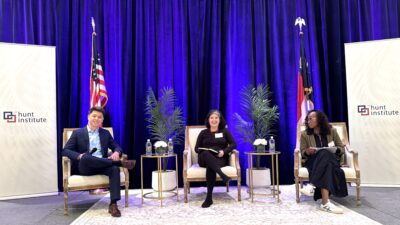
“It was unexpected to me just how much agreement there was among voters,” said Jacqueline Scott-Douglas, vice president of Burson Insights, during a Jan. 23 webinar. “We live in a moment where there’s a lot of disagreement — I see this every day as a pollster, especially on key policy issues — however, we just didn’t see that same degree of division or disagreement.”
Going into the 2026 midterm elections, likely voters’ top education policy priorities have to do with teaching students skills such as communication, decision-making, financial literacy, or personal responsibility, as well as workforce skills and providing training opportunities in high school, the report says. Another popular policy proposal among the report’s likely voters was ensuring that teachers are equipped with the training, resources, and support needed to succeed.
“It’s all future-forward looking. I think what this does is underscore a pragmatic approach that voters are looking for to prepare students for adult life, for economic participation,” Scott-Douglas said.
Related reads


Underneath voters’ policy preferences, though, were a set of agreed-upon values and beliefs about education, the report said. Equity, hard work, and freedom were the most common educational values likely voters brought up. Respondents also agreed that education should prepare students for the job market, and they viewed education as a “moral imperative” that demands strong support for public schools.
Applied learning through apprenticeships, technical certifications, or on-the-job training, is especially popular among voters, the report said, who see these as clearer pathways to career advancement. That said, 80% of respondents still believe a bachelor’s degree is valuable, and 78% believe an associate is valuable.
But likely voters also agreed that public schools are struggling.
Roughly 18% of respondents said public schools nationwide are doing a “poor” job preparing students for the future — though only 13% of respondents agreed when it comes to schools in their community. Overall, likely voters largely believe public school funding is getting worse nationwide (63%), as is student mental health (63%), students’ preparation to be good citizens and workers (57%), students’ academic preparation (57%), or their ability to engage with diverse viewpoints (50%), among other concerns.
Voters also seem to hold schools responsible for more than academics, with nearly 90% calling for better mental health services in schools, as well as resources and direct support services for students struggling with poverty, homelessness, food insecurity, learning difficulties, and health care access.
“Families are asking our schools to help prepare their students not just academically but also for the real world, to connect the learning from the classroom to the skills that they’ll need in the workplace,” Missy Testerman, the 2024 National Teacher of the Year, said on the webinar.
Students’ future success also requires career counseling and job training opportunities, support navigating college admissions, and after-school or summer learning, according to more than three-fifths of voters.
“Together, these views reflect a broad expectation that the public education system should provide a continuum of supports that prepare students not only for academic success, but for long-term economic and social mobility,” the report says.
Teachers are the most trusted figures in education, above parents and policy experts, the report found. Additionally, local elected leaders and state legislators registered some of the lowest levels of trust among voters.
“This survey shows what I’ve found practically in 40 years of campaigning in some form, which is the teacher is the most important voice when it comes to both policy and implementation,” said former West Virginia Gov. Bob Wise.
Still, voters recognized that teachers also need more support — or at least more money.
Roughly three-in-five likely voters said salaries are too low to attract or retain teachers in their communities, or at least too low relative to the cost of living. But respondents said the work itself is an issue, too, with more than half of likely voters identifying teachers’ workload, large class sizes, and poor treatment as factors affecting their ability to keep working in local schools.
In line with these calls for more support, two-thirds of likely voters believe elected officials talk too little about education, the report found.
“It’s clear there is an appetite, frankly, if not an expectation, among voters that elected officials need to elevate education within the national conversation,” said Scott-Douglas.
Read the full report here. Watch a recording of the full webinar here.

Recommended reading